

Somatostatin Neurons Reveal Epilepsy’s Hidden Cascade
Research By: Steve Danzer, PhD
Post Date: October 20, 2024 | Publish Date: Oct. 20, 2024

Anesthesiology | Top Scientific Achievement

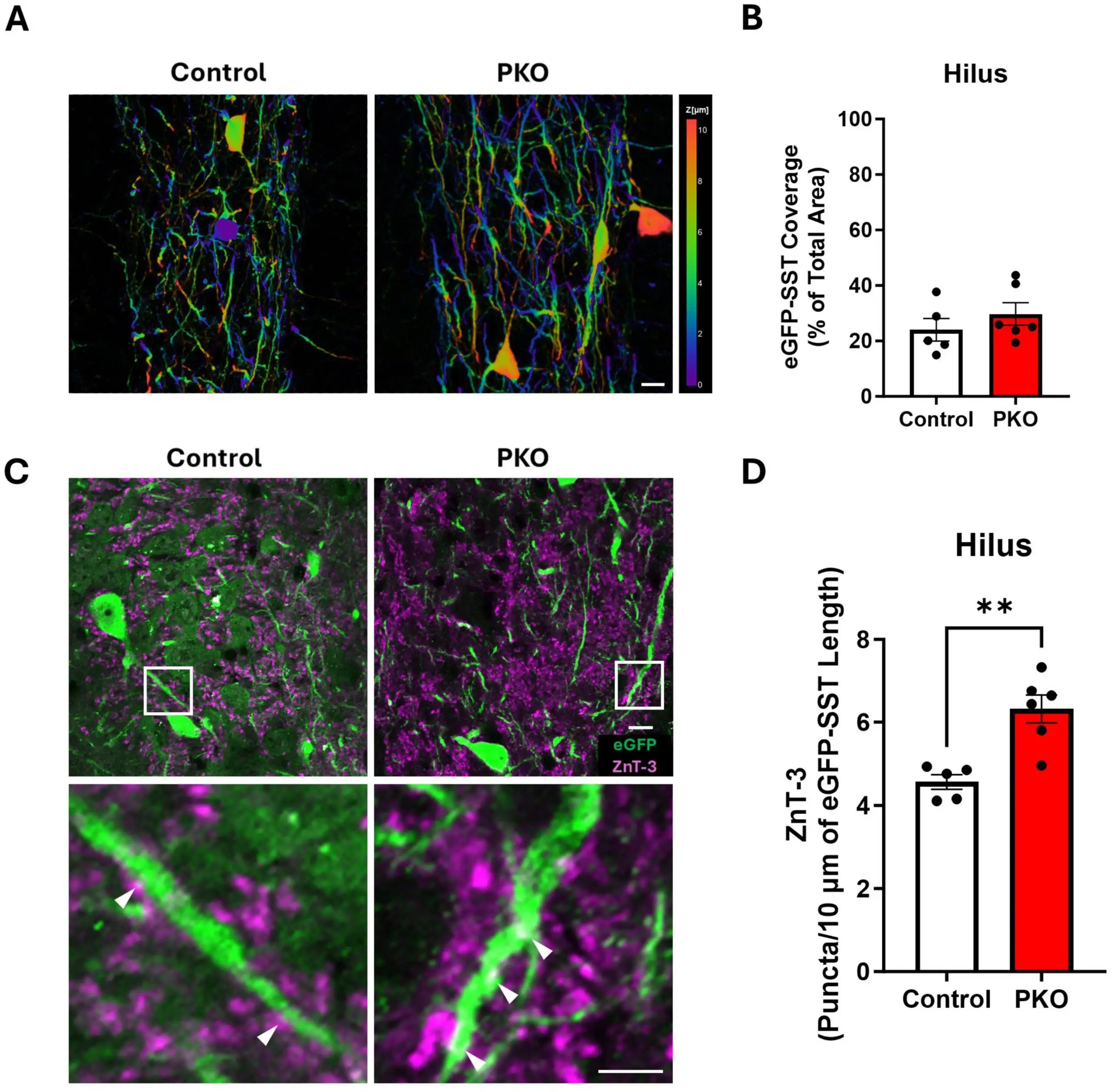
A team led by Steve Danzer, PhD, in the Department of Anesthesia at Cincinnati Children’s, has uncovered how specific inhibitory neurons—somatostatin (SST) interneurons—respond to epileptic activity, revealing a complex mix of loss and adaptation that could reshape how we understand and treat epilepsy.
Using an advanced genetic “fate-mapping” system in a preclinical model, the researchers traced SST interneurons after deleting Pten, a key regulator of the mTOR pathway, from excitatory granule cells in the hippocampus. This approach mirrors mTORopathies—genetic epilepsies in which mutations can be limited to excitatory neurons. Although SST neurons themselves weren’t genetically altered, they displayed both degeneration and compensatory growth in response to seizures.
Details were published in October 2024 in Frontiers in Cellular Neuroscience.
The team found that SST neuron density dropped across several hippocampal regions. Surviving cells showed enlarged structures and heightened activity, with evidence of increased input from hyperactive excitatory neurons. Despite cell loss, inhibitory fibers remained dense, suggesting that surviving neurons sprout new connections to maintain balance.
“These findings show that even neurons not directly affected by a mutation can be caught up in—and attempt to counteract—the network instability that drives seizures,” Danzer says. “Understanding these adaptive and pathological responses could help us design therapies that stabilize the system before it spirals into epilepsy.”
The work provides critical insight into how inhibitory networks degrade over time in genetic forms of epilepsy without acute brain injury. Next, Danzer’s team plans to explore molecular pathways that govern interneuron survival and regeneration—work that could lead to neuron-protective treatments.
About the study
Cincinnati Children’s co-authors also included Austin Drake, PhD student; Lilian Jerow; Justin Ruksenas; and Carlie McCoy.
Funding sources included the National Institute of Neurological Disorders and Stroke (R01 NS065020, R01 NS121042, F31NS136029).
Explore the 2025 Research Annual Report
Don’t Miss a Post:
- Subscribe to the Research Horizons Newsletter
- Follow Cincinnati Children’s Research Foundation on Bluesky, X and LinkedIn
| Original title: | Somatostatin interneuron fate-mapping and structure in a Pten knockout model of epilepsy |
| Published in: | Frontiers in Cellular Neuroscience |
| Publish date: | Oct. 20, 2024 |
Research By

The primary goal of our research program is to understand how the normal brain becomes epileptic.
Latest Posts

About this blog
The Research Horizons blog features news and insights about the latest discoveries and innovations developed by the scientists of Cincinnati Children's. This blog does not provide medical advice, diagnosis, or treatment. Email researchnews@cchmc.org with questions or ideas.
Subscribe to Our Newsletter