

Childhood Wheeze Patterns Linked to Distinct Asthma Subtypes Later in Life
Research By: Kieran Phelan, MSTP student | Gurjit Khurana Hershey, MD, PhD
Post Date: July 9, 2025 | Publish Date: April 4, 2025

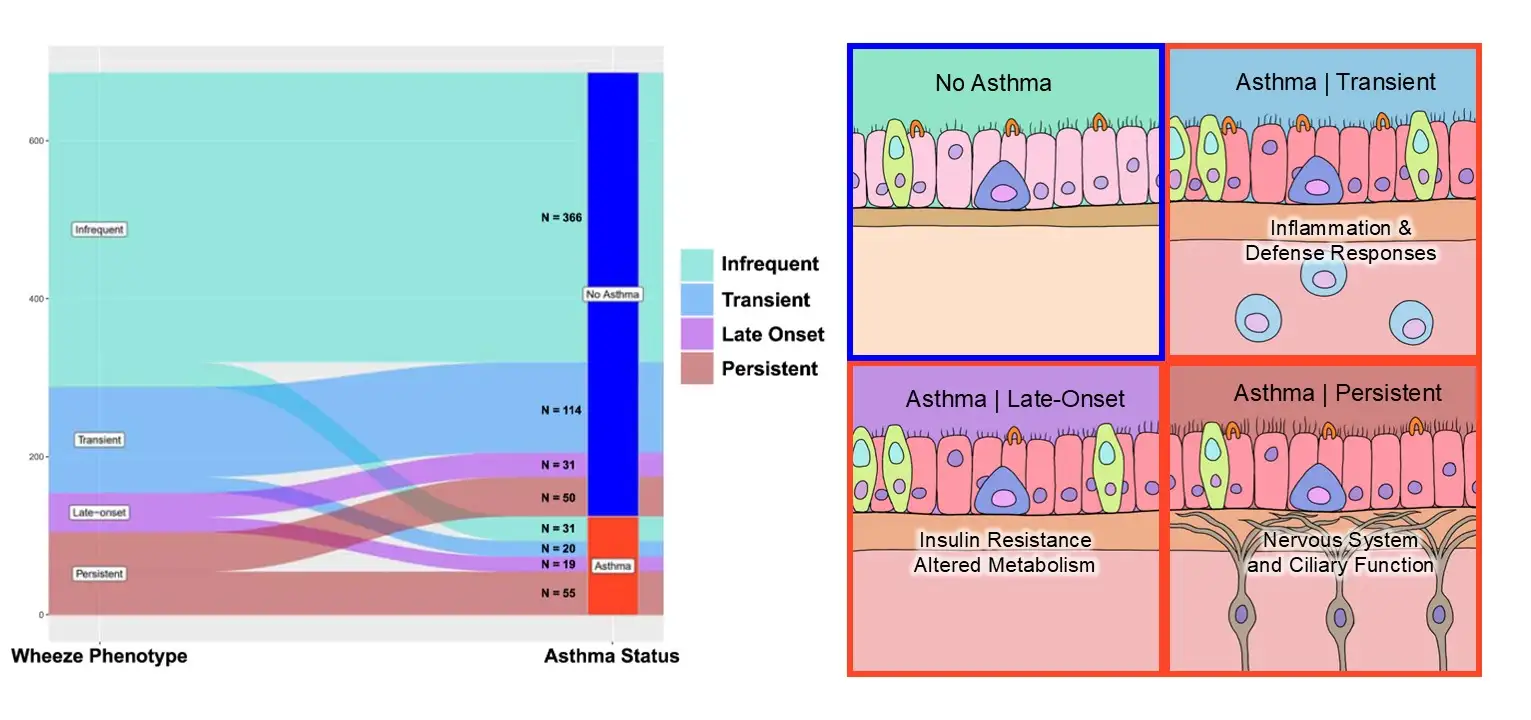
The frequency and duration of wheeze episodes in early childhood may help clinicians identify the type of asthma they develop later in life—potentially allowing for earlier adjustments in treatment and prevention strategies, according to experts at Cincinnati Children’s.
Asthma development and clinical presentation can vary widely from one individual to another. Similarly, wheezing patterns can differ from one child to another, which can complicate diagnosis and treatment. A study led by Kieran Phelan, PhD—published online April 4, 2025, in the Journal of Clinical Allergy and Immunology—reveals that early-life wheeze patterns are linked to distinct asthma subtypes.
“These findings are important because they indicate that the child’s early-life wheeze phenotype helps to inform the type of asthma that ultimately develops. As such, it highlights that new prevention and treatment strategies should consider a patient’s specific wheeze history,” says Gurjit Khurana Hershey, MD, PhD, corresponding/senior author of the study.
Early-Life Wheeze Patterns and Asthma Development
There are four patterns of childhood wheeze episodes. Some children experience infrequent wheezing, while others have persistent wheeze episodes that continue over time. In some cases, children have frequent wheezing that decreases as they grow older – this is termed transient wheeze. Others develop more frequent wheezing later in childhood, known as late-onset wheeze. This study provides new insights into biological pathways that link these wheeze patterns and the development of asthma.
Researchers collected nasal swabs from participants aged 11 to 32. Participants were grouped based on their early-life wheeze history and asthma diagnosis. Over half of those with early-life persistent wheeze and nearly 40% of those with late-onset wheeze developed asthma. In contrast, less than 8% with infrequent wheeze and 15% with transient early-life wheeze went on to develop asthma. Notably, while asthma developed in all groups, the type of asthma varied depending on wheeze pattern.
Upper Airway Gene Expression Patterns Contribute to Asthma Subtypes
Examination of gene expression in the upper airways revealed that different wheeze patterns were associated with distinct biological processes that influence the kind of asthma that children may develop.
For example, those experiencing transient wheeze had increased expression of genes related to inflammation and defense responses. This suggests that they may have a more effective response to respiratory infections, an ability that is reduced in children with a history of late-onset or persistent wheeze.
Another known biological pathway that can lead to asthma is weight-independent insulin resistance. This study identified that children with late-onset wheeze developed asthma that was linked to insulin resistance.
Finally, children who developed asthma and had a history of persistent wheeze did not have a significant increase in allergic inflammation compared to children with the same history but who did not develop asthma. Instead, these participants exhibited increased gene expression in pathways related to nervous system function and ciliated epithelial cells, such as those that line the respiratory tract.
Next Steps
The study’s authors suggest that treatment strategies could be more effective if tailored based on a patient’s wheeze history. They also emphasize that asthma pathology may extend beyond the classic Th2-inflammatory model, highlighting the need for further investigation of these alternative biological processes.
About the study
Kieran Phelan, MSTP Student, Division of Asthma Research, was the first author of the study. Co-authors included experts from the divisions of Biomedical Informatics and Biostatistics and Epidemiology. Research was supported by the CREW Consortium under award number UH3 OD023282. Funding sources also included multiple grants from the National Institutes of Health (NIH U24AI179612, K08 HL153955, and NIH U19 AI162310, T32 GM149200-01, T32 5T32HL007752-29, 1F30HL172613-01A1, NO1-AI-25496, NO1-AI-25482, HHSN272200900052C, HHSN272201000052I, 5UM1AI114271, UM2AI117870, and 5U19AI070235).
Don’t Miss a Post:
- Subscribe to the Research Horizons Newsletter
- Follow Cincinnati Children’s Research Foundation on Bluesky, X and LinkedIn
| Original title: | Early-life wheeze trajectories are associated with distinct asthma transcriptomes later in life |
| Published in: | Journal of Clinical Allergy and Immunology |
| Publish date: | April 4, 2025 |
Research By


My lab combines epidemiologic, basic, translational and clinical research approaches to answer fundamental questions related to childhood asthma, atopic dermatitis, food allergy and allergic rhinitis.

Latest Posts


About this blog
The Research Horizons blog features news and insights about the latest discoveries and innovations developed by the scientists of Cincinnati Children's. This blog does not provide medical advice, diagnosis, or treatment. Email researchnews@cchmc.org with questions or ideas.
Subscribe to Our Newsletter