

Trailblazing for Pediatric Penicillin Allergy Delabeling
Research By: Andrew Winslow, MD | Kimberly A. Risma, MD, PhD
Post Date: April 27, 2026 | Publish Date: Dec. 22, 2025

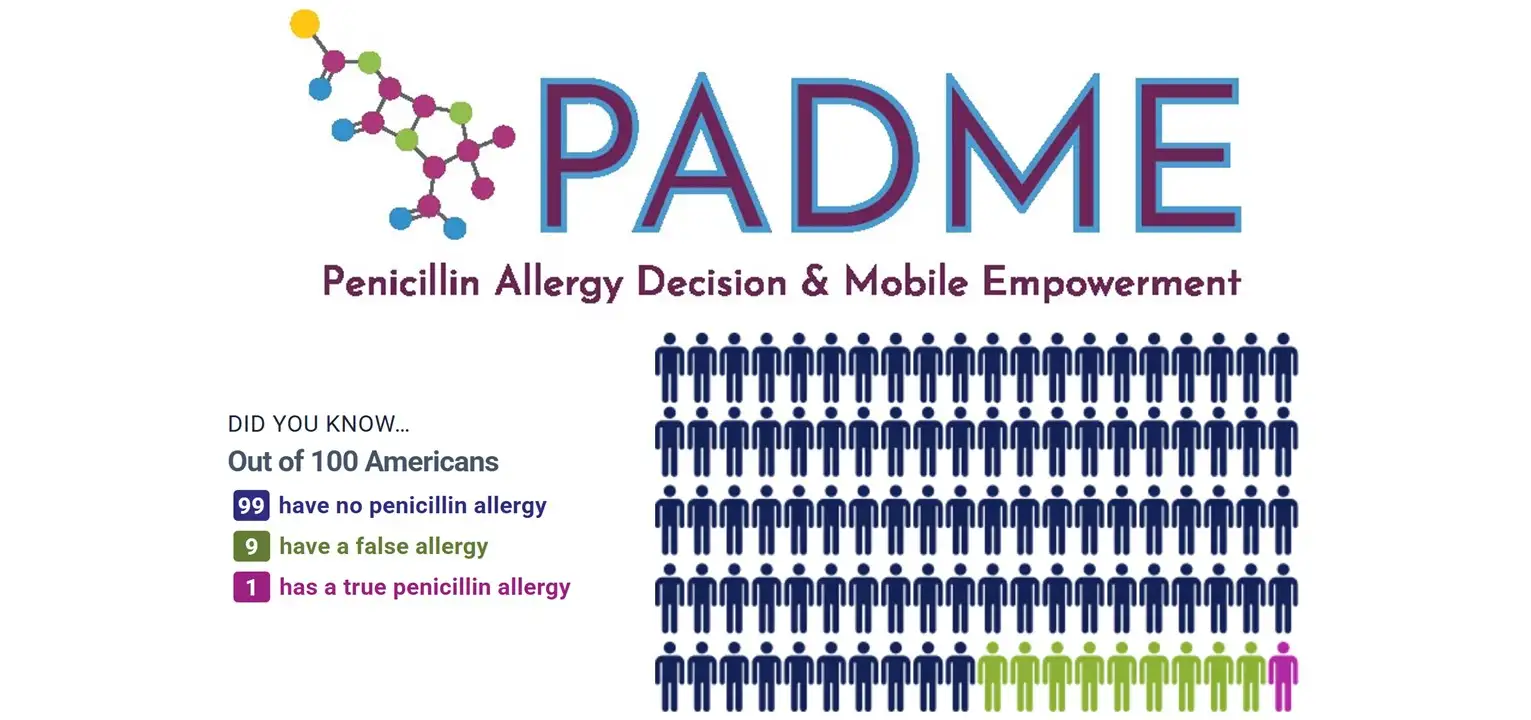
Researchers at Cincinnati Children’s helped develop a mobile-enabled tool responding to the widespread use of inaccurate penicillin allergy labels in children
Penicillin allergy labels are common in childhood—but most are not needed. Research shows that about 96% of people labeled as allergic to penicillin are not truly allergic. Yet when these labels remain in a child’s medical record, they can limit treatment options and lead to the use of broader antibiotics that may have higher costs and cause more side effects.
Removing inaccurate penicillin allergy labels can improve care. It can reduce healthcare costs, decrease reliance on second-line antibiotics and lower rates of antimicrobial resistance. Yet many children never receive an evaluation.
In a manuscript published in The Journal of Allergy and Clinical Immunology: In Practice in December 2025, researchers at Cincinnati Children’s describe how they developed the Penicillin Allergy Decision and Mobile Empowerment (PADME) tool. PADME is a free mobile-enabled tool designed to help parents and caregivers navigate expanding options for penicillin allergy delabeling. It supports action outside of specialty care, making delabeling more feasible for more families.
“This tool is important because many children carry a penicillin allergy label for years without ever being evaluated,” says senior author Andrew Winslow, MD, pediatric allergist in the Division of Allergy and Immunology. “That label can limit treatment options and lead to the use of alternative antibiotics that may not be necessary.”
How PADME Initiates Change for Children and Antibiotic Use Practices
Most penicillin allergy decision support tools were developed for adults and for use by clinicians. While effective in adult care, these tools do not translate as well to pediatrics. Caregivers often report children’s penicillin allergy histories, sometimes based on family history alone rather than a documented reaction. Over time, these labels can persist without reassessment, especially when access to allergy specialists is limited.
PADME was designed to address these challenges by giving clear information and guidance to begin the delabeling process. It is a bilingual, patient-facing tool for children ages 0–17 that guides caregivers through a structured assessment using clear, health-literate language. PADME is designed to support collaboration between patients and their healthcare providers, who will review the results together and decide on risk-specific next steps.
By supporting risk-based pathways, PADME allows some children to be delabeled by non-allergist providers, when appropriate. This approach can reduce the need for specialty referrals and may help remove inaccurate penicillin allergy labels among children with limited access to allergy care.
The Power of PADME
Based on a child’s reported history, PADME assigns one of four risk categories:
- Delabeled: History suggests no true allergy, such as recent tolerance of penicillin.
- Minimal risk: A non-severe rash that occurred more than six months ago.
- Low risk: Histories such as swelling of the lips, face, or tongue, joint pain, concern for anaphylaxis, or a rash within 6-12 months.
- High risk: Histories suggestive of severe allergic reactions.
Each category includes guidance to help families and providers decide what to do next, whether that is confirming history, seeking specialist evaluation, or considering repeat use of penicillin when appropriate.
“One distinguishing feature of PADME is its ‘minimal risk’ category, which is not included in most existing algorithms,” says Winslow. “For some children, repeat use of penicillin without allergy testing may be appropriate when families and providers are comfortable, particularly when access to specialty care is limited.”
Looking Ahead
This initial work focused on designing and implementing the PADME platform. Next steps include clinical validation, evaluation of patient outcomes, and increasing awareness and use of the tool. Researchers will also examine how factors such as the time since a child’s original reaction affect risk classification.
Beyond obstructing routine management of common childhood illnesses, inaccurate penicillin allergy labels can have long-term effects on care and antibiotic use over a person’s lifetime. By helping families and providers take practical steps toward reassessment, PADME may help reduce this burden over time.
“These labels often persist into adulthood and affect not only individual patient care, but also clinical practices regarding antibiotic use,” says Winslow. “Eliminating the excess labels that are not true allergies would be transformative for public health and antibiotic stewardship.”
About the Study
Kimberly Risma, MD, PhD, Division of Allergy and Immunology at Cincinnati Children’s was a co-author. Other co-authors include two experts from the University of North Carolina School of Medicine.
Funding sources included grants from Pfizer Global Medicine Grants (Pfizer Quality Improvement Grant: Building Capacity to Address Health Disparities in the United States through Antimicrobial Stewardship Telehealth & Telemonitoring); the American Academy of Allergy, Asthma & Immunology (Drug Hypersensitivity Research Grant); Connected Health Applications & Interventions Core (CHAI Core); National Institutes of Health grants (DK056350, P30-CA016086, U19 AI70235 and R01 ES011170).
Learn More
Don’t Miss a Post:
- Subscribe to the Research Horizons Newsletter
- Follow Cincinnati Children’s Research Foundation on Bluesky, X and LinkedIn
| Original title: | Penicillin Allergy Decision & Mobile Empowerment (PADME)—Ideation and design of a novel delabeling program for children |
| Published in: | The Journal of Allergy and Clinical Immunology: In Practice |
| Publish date: | Dec. 22, 2025 |
Research By

Latest Posts
About this blog
The Research Horizons blog features news and insights about the latest discoveries and innovations developed by the scientists of Cincinnati Children's. This blog does not provide medical advice, diagnosis, or treatment. Email researchnews@cchmc.org with questions or ideas.
Subscribe to Our Newsletter