

Laser Therapy Shows Promise for Children With Hard-to-Treat Epilepsy
Research By: Francesco Mangano, DO, FACS, FAAP, FACOS
Post Date: June 12, 2026 | Publish Date: June 12, 2026

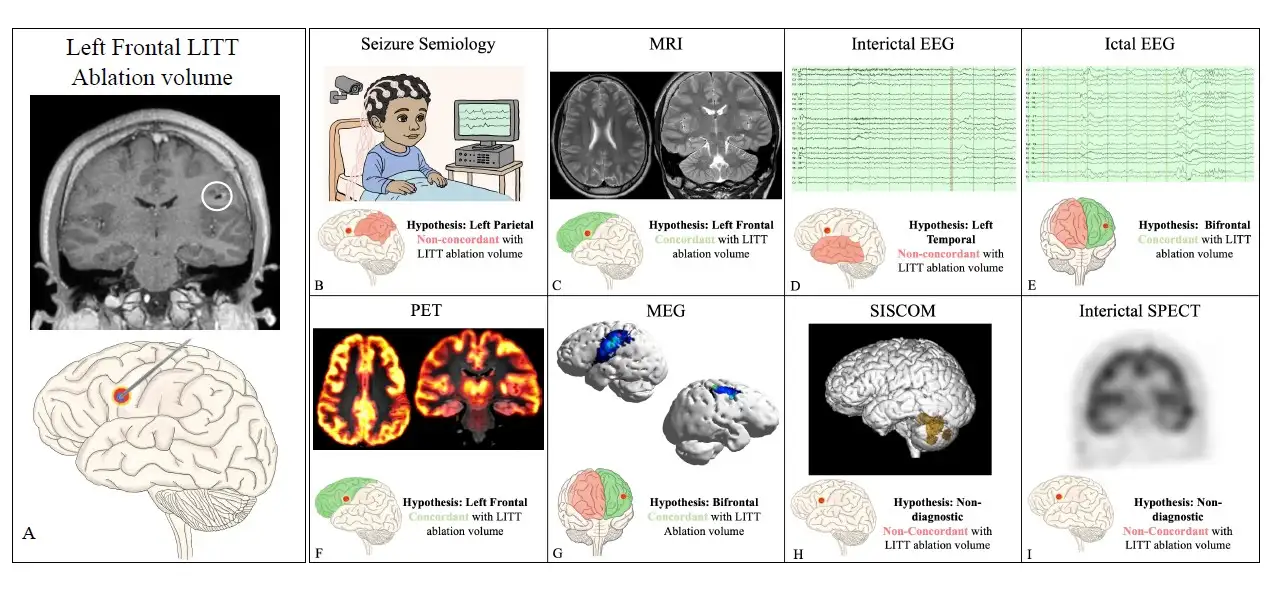
Study finds minimally invasive treatment can control seizures in carefully selected children with extratemporal lobe epilepsy
Children with drug-resistant epilepsy may continue to have seizures even after trying multiple medications. For those whose seizures begin outside the temporal lobe, surgery can be especially challenging because the abnormal activity may involve complex, widely connected brain networks.
The study—led by neurosurgery experts at Cincinnati Children’s— was published online in June 2026 and selected to be featured on the September cover of the Journal of Neurosurgery: Pediatrics. It reports that laser interstitial thermal therapy (LITT) can offer a safe, minimally invasive option for some patients with extratemporal lobe epilepsy (ETLE). At 12 months, nearly half of the patients had a favorable seizure outcome, while 41.4% were seizure-free.
“This study demonstrated that LITT can be a safe, minimally invasive option for ETLE within the pediatric population and can achieve good rates of seizure freedom,” says the study’s first author Bryce Owen, MD, a neurosurgery resident at the University of CIncinnati.
Targeting Seizures with Heat
LITT uses a thin laser probe placed through a small opening in the skull. Guided by MRI, the probe heats and destroys targeted tissue believed to be driving seizures. Compared with open surgery, the approach can reduce postoperative pain, shorten hospitalization and speed recovery. It also may help specialists more effectively reach seizure-generating areas near critical brain regions or along difficult surgical pathways.
The study recaps outcomes for 29 children and adolescents treated from 2015 through 2023 at Cincinnati Children’s, a Level 4 epilepsy center. Before treatment, most underwent extensive testing—including video EEG, MRI, PET and MEG—and 26 underwent stereo-EEG monitoring. The team assessed seizure outcomes and several other factors at 12 months post-procedure.
PET Alignment Emerges as a Key Signal
Fourteen patients (48.3%) achieved a favorable outcome, defined as International League Against Epilepsy classes 1–3. Twelve patients (41.4%) were seizure-free. Six patients needed another operation within the first year.
PET scans provided the clearest predictive signal. When PET findings matched the area ultimately treated with LITT, patients had 8.8 times greater odds of a favorable outcome. MEG findings aligned with the treatment target in all 13 patients with favorable outcomes, although this association did not reach statistical significance.
Minimally Invasive, But Not a One-Size-Fits-All Solution
The procedure showed a favorable safety profile. However, longer-term follow-up highlights the complexity of ETLE. By an average follow-up of 43 months, 13 patients had undergone another epilepsy procedure. Seven of those 13 achieved a favorable result.
These findings suggest that LITT can be meaningful for carefully selected children with ETLE.
“Avoiding more invasive operations such as craniotomies is a meaningful outcome to more than 40% of our patients,” says senior author Francesco Mangano, DO, Associate Surgeon-in-Chief and Director of Pediatric Neurosurgery at Cincinnati Children’s. “The results reinforce the importance of combining multiple imaging and electrophysiological studies before surgery, especially in looking for agreement between PET findings and the planned ablation target.”
About the Study
Cincinnati Children’s co-authors on this study also included Amber Gaulden, MD, Torin Karsonovich, DO, (now with Christus Children’s Pediatric Neurosurgery, San Antonio, TX), Hansel Greiner, MD, Ravindra Arya, MD, James Leach, MD, Paul Horn, PhD, and Jesse Skoch, MD.
Don’t Miss a Post
- Subscribe to the Research Horizons Newsletter
- Follow Cincinnati Children’s Research Foundation on Bluesky, X and LinkedIn
| Original title: | Seizure outcomes after laser interstitial thermal therapy for pediatric extratemporal lobe epilepsy |
| Published in: | Journal of Neurosurgery: Pediatrics |
| Publish date: | June 12, 2026 |
Research By


Latest Posts


About this blog
The Research Horizons blog features news and insights about the latest discoveries and innovations developed by the scientists of Cincinnati Children's. This blog does not provide medical advice, diagnosis, or treatment. Email researchnews@cchmc.org with questions or ideas.
Subscribe to Our Newsletter