

Beyond Individual Expertise: How Shared Awareness Strengthens Patient Safety
Research By: Maya Dewan, MD, MPH | Eric Williams, MD, MS, MMM
Post Date: November 18, 2026 | Publish Date: Spring 2026

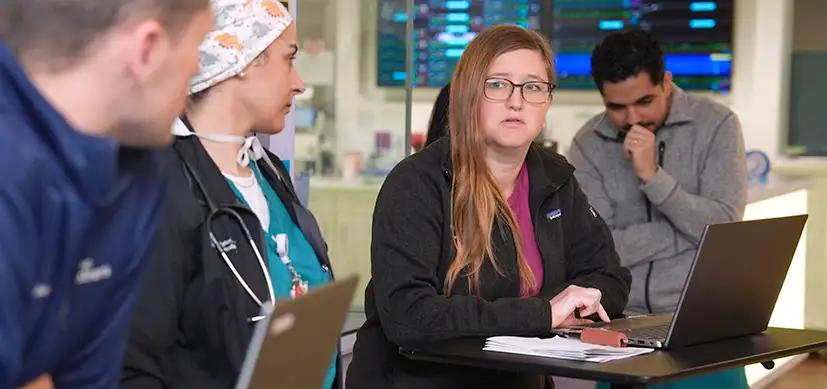
Experts from Cincinnati Children’s and collaborating organizations explore how shared situational awareness, stronger team structures and proactive safety approaches can help critical care teams anticipate risks and deliver safer care.
Key Takeaways
- In critical care, patient safety depends not only on individual clinical expertise but also on a team’s ability to develop a shared understanding of changing conditions and recognize emerging risks early.
- Experts from Cincinnati Children’s and collaborating organizations describe four complementary approaches to strengthening situational awareness, coordinated decision-making and clinical readiness.
- Proactive safety emphasizes anticipating risks, adapting early and preventing harm rather than relying solely on responding to challenges after they arise.
- Moving beyond traditional hierarchies toward more connected, empowered teams can help healthcare organizations build systems that continuously learn and adapt to evolving patient needs.
In critical care, patient conditions can change rapidly, requiring healthcare professionals from multiple disciplines to make complex decisions and coordinate care in real time.
While individual clinical expertise is essential, no single healthcare professional has a complete picture of every factor influencing a patient’s care. Delivering safe, high-quality care also depends on how effectively teams bring their knowledge together to recognize emerging risks and act before conditions deteriorate.
This concept is central to proactive safety, an approach that emphasizes anticipating risks, adapting to changing circumstances and strengthening systems to prevent harm before it occurs.
A recent article published in Critical Connections explores how healthcare organizations can advance proactive safety by building shared situational awareness, strengthening connections across disciplines and designing systems that support continuous learning and adaptation.
Co-authored by experts from Cincinnati Children’s, the University of Cincinnati College of Medicine and the McChrystal Group, the article calls for a shift from relying primarily on individual expertise and traditional hierarchies toward systems that enable teams to collectively recognize, understand and respond to evolving risks.
Four Approaches to Building Proactive Safety Systems
Traditional healthcare structures often organize expertise and decision-making within individual disciplines and established hierarchies. While these structures provide important clinical oversight, the authors suggest that increasingly complex care environments require a more integrated approach.
Rather than simply improving communication within existing structures, healthcare organizations must intentionally design systems that connect teams, support shared decision-making and empower clinicians to act on emerging information.
The authors highlight four complementary approaches:
- Team-of-Teams: Moving beyond rigid organizational hierarchies by creating stronger connections across disciplines, building shared awareness and empowering teams to make coordinated decisions. This approach distributes responsibility for safety across interconnected teams working toward common goals.
- Shared Situational Awareness: Developing a common understanding of patient conditions, operational challenges and emerging risks through multidisciplinary rounds, structured handoffs, visual management tools and real-time information sharing. This collective awareness helps teams recognize subtle changes earlier and coordinate timely responses.
- Resilience Engineering: Strengthening an organization’s ability to anticipate, monitor, respond to and learn from changing conditions. Rather than focusing exclusively on understanding problems after they occur, this approach examines how teams successfully adapt to complexity and how those capabilities can be built into everyday operations.
- Just-in-Time Training: Reinforcing critical skills through targeted refresher sessions, simulations and microdrills. By integrating timely learning into clinical workflows, teams can maintain readiness and respond effectively to evolving situations.
Together, these approaches create a foundation for healthcare systems that do more than respond effectively when challenges arise. They help teams recognize emerging risks, adapt earlier and take coordinated action to support safer patient care.
Advancing From Reactive to Proactive Safety
The authors emphasize that improving patient safety requires a shift in how healthcare organizations are designed to operate.
Traditional safety efforts often focus on understanding what happened after an unexpected event. Proactive safety builds on these efforts by strengthening the ability to recognize changing conditions, anticipate potential challenges and respond before they escalate.
At Cincinnati Children’s, established approaches to shared situational awareness and just-in-time simulation provide examples of capabilities that can support this broader vision.
“Cincinnati Children’s has been a leader in building systems that create shared situational awareness and in using just-in-time simulation to help teams prepare for risk before it becomes harm,” says Maya Dewan, MD, MPH, director of the Critical Care Medicine division at Cincinnati Children’s.
Dewan and her fellow authors emphasize that these capabilities are a foundation for continued progress, not the endpoint.
They advocate for further investment in team-of-teams structures and resilience engineering to help healthcare organizations move toward systems designed to anticipate risks, adapt early and prevent harm.
Achieving this vision will require more than adopting new technologies or introducing additional protocols. It will involve intentionally redesigning how teams connect, share information and make decisions, while fostering a culture that embraces innovation, continuous learning and new ways of working.
Implications Beyond Critical Care
Although the article focuses on critical care, the principles of proactive safety have broader implications across healthcare systems.
Healthcare organizationsmust find ways to connect specialized expertise across disciplines while ensuring teams have the shared information and decision-making authority needed to respond to changing conditions. For the authors, the next frontier in patient safety is not simply helping individual clinicians or teams respond more effectively. It is creating healthcare systems in which shared awareness, coordinated action and proactive safety are intentionally designed in the system.
Learn More About Quality and Safety at Cincinnati Children’s
For more insights into healthcare quality, safety and improvement:
- Subscribe to Improvement Insider, a quarterly digest from the James M. Anderson Center for Health Systems Excellence at Cincinnati Children’s featuring research, expert perspectives and opportunities to learn and collaborate.
- Browse our latest “Quality & Safety” articles
Don’t Miss a Post
- Subscribe to the Research Horizons Newsletter
- Follow Cincinnati Children’s Research Foundation on Bluesky, X and LinkedIn
| Original title: | Seeing the Same Truth at the Same Time: Building a Culture of Safety in Critical Care |
| Published in: | Critical Connections |
| Publish date: | Spring 2026 |
Research By

My research focuses on using the electronic health record to increase situation awareness to aid in the prediction and prevention of deterioration in PICU patients.

Latest Posts
About this blog
The Research Horizons blog features news and insights about the latest discoveries and innovations developed by the scientists of Cincinnati Children's. This blog does not provide medical advice, diagnosis, or treatment. Email researchnews@cchmc.org with questions or ideas.
Subscribe to Our Newsletter