

Weight Stigma Fuels Anorexia Struggles for Youth in Larger Bodies
Research By: Jessica Lin, MD | Michelle Recto, MD
Post Date: December 2, 2024 | Publish Date: December 2024

Adolescent and Young Adult Medicine | Top Scientific Achievement

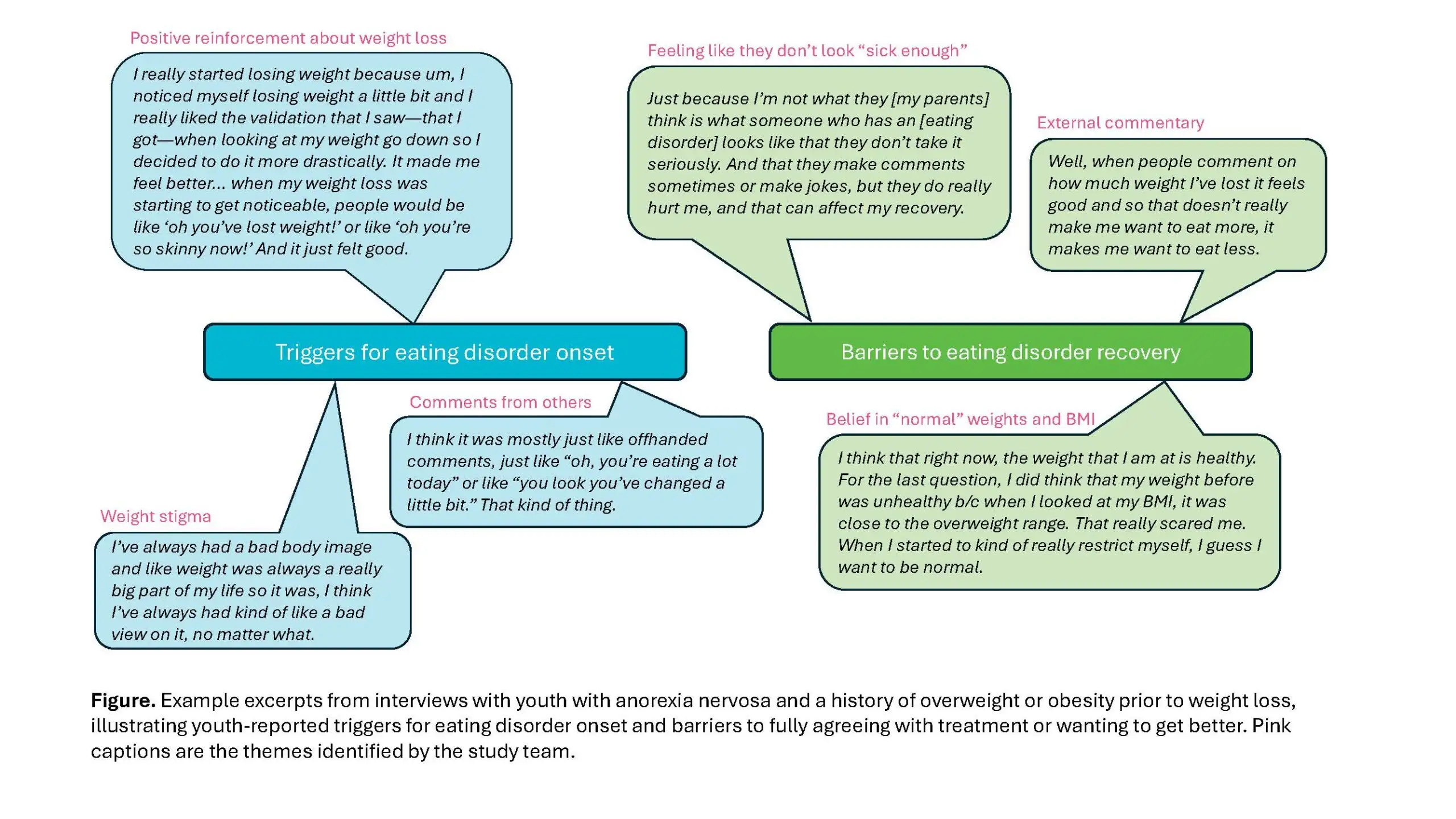
A qualitative study co-led by Jessica Lin, MD, and Michelle Recto, MD, of Cincinnati Children’s, reveals how weight stigma may contribute both to the onset and persistence of anorexia nervosa (AN) and atypical anorexia nervosa (AAN) among adolescents who previously lived in larger bodies.
Through semi-structured interviews with 11 youth–parent pairs, the research uncovered how societal and familial attitudes toward weight deeply shaped unhealthy attempts to lose weight and prevented the willingness to get better, even after developing anorexia. Findings were published in December 2024 in the Journal of Eating Disorders.
Both youth and parents cited weight stigma—from peers, family members, healthcare providers, and social media—as the most common trigger for disordered eating. Many described internalizing harmful body ideals, leading to restrictive behaviors, and receiving praise for weight loss, which reinforced their behaviors. At the start of treatment, these young patients reported uncertainty about treatment weight goals and often felt “not sick enough,” while parents expressed confusion about appropriate weight restoration targets, sometimes influenced by their own internalized stigma.
“People aren’t always aware that adolescents who grew up in larger bodies can develop anorexia nervosa. But unfortunately, despite now needing life-saving treatment for the weight loss, they continue to face long-standing pressure to look, eat, or move a certain way.” Lin says. “Recognizing how weight stigma operates within families and clinical care is essential to improving eating disorder treatment and prevention.”
The study underscores the need for more inclusive, evidence-based guidelines addressing weight restoration for patients with anorexia nervosa who were overweight or obese prior to weight loss. Clinicians are encouraged to examine biases that may lead to underdiagnosis or incomplete recovery targets for youth who do not present as underweight.
Future work will focus on reducing weight stigma within multidisciplinary treatment environments and developing clearer standards for defining recovery in this underrepresented population.
About the study
Other collaborators were from Boston Children’s Hospital, Harvard Medical School, and the University of Vermont.
Funding was provided by the Boston Children’s Hospital House Staff Development Award and the Health Resources and Services Administration of the U.S. Department of Health and Human Services (HRSA; MCHBT71MC00009 LEAH training grant).
Explore the 2025 Research Annual Report
Don’t Miss a Post:
- Subscribe to the Research Horizons Newsletter
- Follow Cincinnati Children’s Research Foundation on Bluesky, X and LinkedIn
| Original title: | Growing up in a larger body: youth- and parent-reported triggers for illness and barriers to recovery from anorexia nervosa |
| Published in: | Journal of Eating Disorders |
| Publish date: | December 2024 |
Research By



Latest Posts

About this blog
The Research Horizons blog features news and insights about the latest discoveries and innovations developed by the scientists of Cincinnati Children's. This blog does not provide medical advice, diagnosis, or treatment. Email researchnews@cchmc.org with questions or ideas.
Subscribe to Our Newsletter