

Unexpected Discovery Points to New Possibilities for Lung Repair
Research By: Hyunwook Lee, MD/PhD student | William Zacharias, MD, PhD
Post Date: April 21, 2026 | Publish Date: April 21, 2026

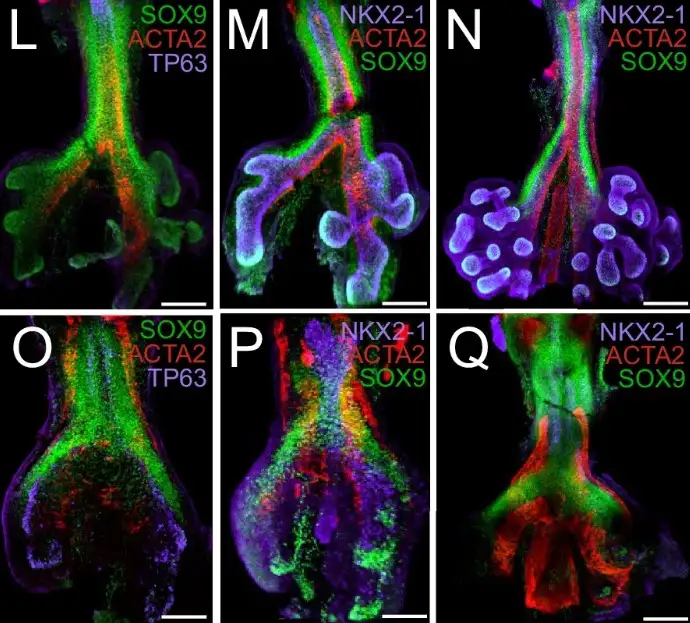
A surprising finding shows that the developmental signal BMP4 can bypass a key defect in lung cell generation
When lungs do not develop normally or fail to repair themselves after serious injury, physicians have no treatment to improve the underlying developmental or regenerative process. William Zacharias, MD, PhD, wants to change that.
Zacharias is a developmental biologist at Cincinnati Children’s and an adult pulmonary and critical care physician at the University of Cincinnati. His research focuses on how lung cells make decisions during development and repair throughout life.
“We’re trying to build a wiring diagram of the signals that guide those decisions,” says Zacharias. “The ultimate goal is to identify biological ‘levers’ that someday could be used to help lungs recover.”
A study published April 21, 2026, in Nature Communications provides an important piece of that diagram. Zacharias was senior author of the five-year study, led by first author Hyunwook Lee, an MD/PhD student in the Medical Scientist Training Program at the University of Cincinnati College of Medicine.
Opening the Right Genetic Instructions
The study focused on the BAF complex, a group of proteins that helps control chromatin, the material that packages DNA inside cells. By opening or closing chromatin, BAF helps determine which genes a cell can access and use.
Previous work in Zacharias’s lab identified ARID1A, a component of the BAF complex, as a leading potential regulator of developing lung progenitor cells.
Eliminating both ARID1A and the related ARID1B in preclinical models prevented lungs from forming. Removing them individually revealed a specific role for ARID1A. Models lacking ARID1A developed lungs through gestation but died at birth from respiratory failure.
The critical defect involved the alveoli, the tiny air sacs where gas exchange occurs. Without ARID1A, some cells that should have become alveolar cells became airway cells instead, while others remained immature. Most notably, the lungs essentially failed to produce alveolar type 1, or AT1, cells. These thin cells form the surface across which oxygen enters the blood and carbon dioxide leaves it.
The molecular signals needed to make AT1 cells were present. But without ARID1A, the cells could not open the necessary regions of chromatin and complete the process.
A Shocking Result
Because the preclinical models died at birth, the researchers grew lung organoids from genetically altered lung cells. That allowed them to test whether different signaling pathways could overcome the defect.
They tried multiple pathways known to be involved in forming the alveoli. Most did not fix the problem. Then researchers added the developmental signal BMP4 to the medium in which the lung organoids were growing. The cells began differentiating into both major alveolar cell types despite the absence of ARID1A.
“BMP4 completely rescued the differentiation process,” Zacharias says. “That was a shock.”
The result was so unexpected that Zacharias and Lee repeated the experiment multiple times and reconfirmed that ARID1A was absent. Additional experiments requested during peer review supported the finding that the rescue effect was specific to BMP among the pathways tested.
Zacharias suspects BMP4 may recruit another chromatin regulator to do ARID1A’s job, a mechanism the lab is now investigating.
From Development to Regeneration
The researchers are now testing whether the same biology also operates during lung repair later in life. Early findings in adult preclinical injury models suggest ARID1A may be required to produce AT1 cells during regeneration and that BMP4 signaling may again be able to bypass the problem.
That raises long-range clinical possibilities for children and adults. Zacharias points to bronchopulmonary dysplasia as one potential pediatric example. Premature infants with BPD can sustain lung injury and develop inadequate gas-exchange capacity. Someday, researchers might be able to activate BMP signaling in the right lung cells using a targeted drug, nanoparticle or gene therapy to improve recovery.
Toward a Deeper Understanding
Major hurdles remain. BMP signaling is important throughout the body, so any future therapy would need to reach the right lung cells at the right time without affecting other organs.
But the discovery gives researchers a new lever to investigate—one they were not looking for when the project began.
For Zacharias, the motivation to keep pursuing answers comes from his work as a physician. “There’s nothing more frustrating than a patient asking you what they need to do to get better and you not having a good answer,” he explains. “The most exciting discoveries are the ones you know are true but don’t yet understand. They give you a chance to build a better model of how the lung works. From better models come better treatments.”
ABOUT THE STUDY
In addition to Zacharias and Lee, co-authors included Abigail Jaquish; Sharlene Fernandes, MS; Barbara Zhao; Amber Elitz; Kathleen Cook; Sarah Trovillion; Natalia Bottasso-Arias, PhD; Simon J. Y. Han, PhD; Samantha Goodwin; Nicholas Russell; Gerald Saunders; Amanda Zacharias; Samantha Brugmann, PhD; Jeffrey Whitsett, MD; Debora Sinner, PhD; Xin Sun, PhD; and Daniel Swarr, MD.
Don’t Miss a Post:
- Subscribe to the Research Horizons Newsletter
- Follow Cincinnati Children’s Research Foundation on Bluesky, X and LinkedIn
| Original title: | Cell fate specification during respiratory development requires ARID1A-containing canonical BAF complex activity |
| Published in: | Nature Communications |
| Publish date: | April 21, 2026 |


Latest Posts

About this blog
The Research Horizons blog features news and insights about the latest discoveries and innovations developed by the scientists of Cincinnati Children's. This blog does not provide medical advice, diagnosis, or treatment. Email researchnews@cchmc.org with questions or ideas.
Subscribe to Our Newsletter