

How Newborns’ First Microbes Help Build Protection Against Infection
Research By: Theresa Alenghat, VMD, PhD
Post Date: October 7, 2026 | Publish Date: October 7, 2026

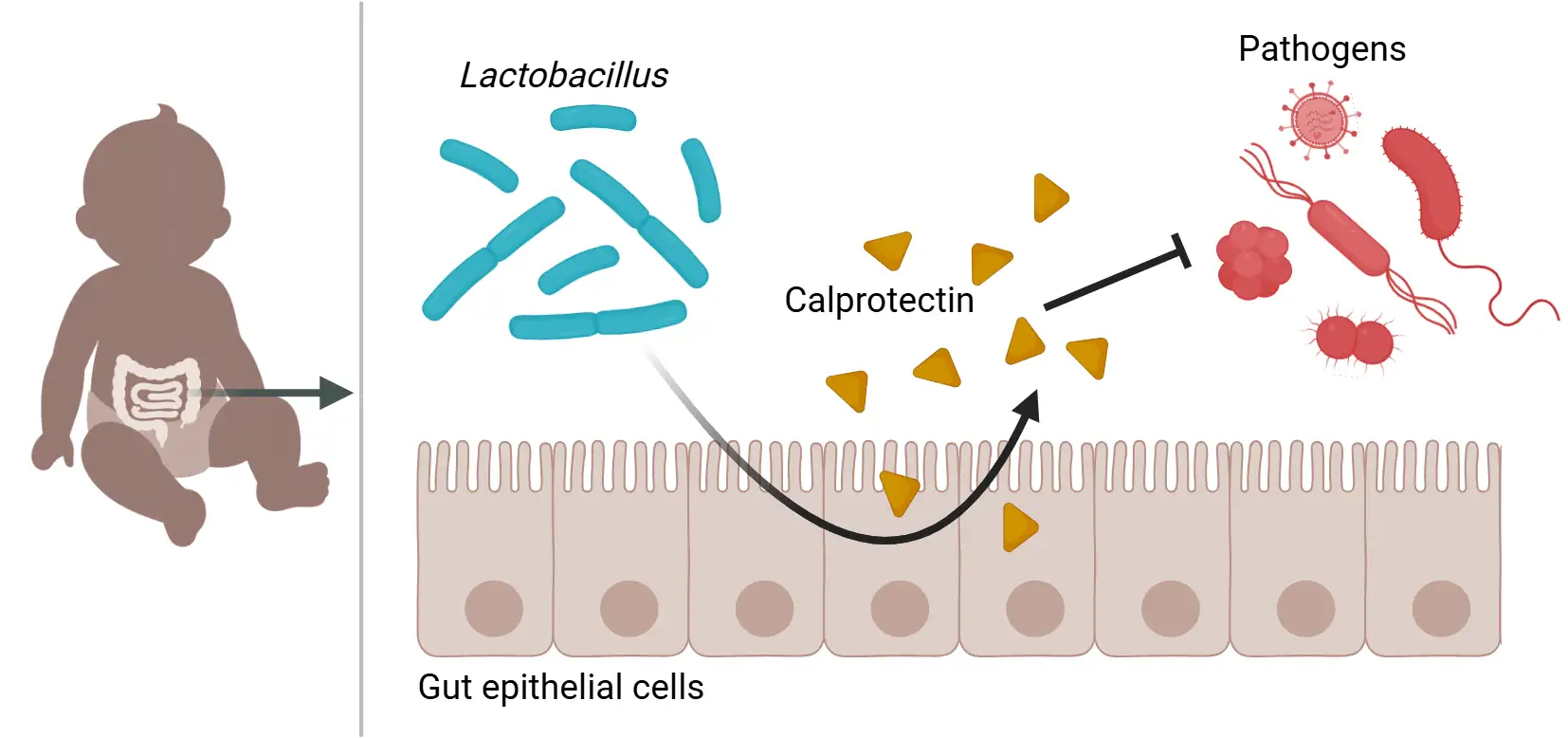
Researchers at Cincinnati Children’s discovered that beneficial gut bacteria trigger production of calprotectin, an antimicrobial protein that helps defend newborns during early life
Key Takeaways
- In a study published in Science Translational Medicine, researchers found that beneficial Lactobacillus bacteria stimulate cells lining the newborn intestine to produce calprotectin, a protein with antimicrobial activity.
- The findings reveal an unexpected protective role for calprotectin in newborns and highlight the importance of early microbial colonization during immune development.
- Human organoid studies suggest the newly identified pathway may also operate in people, opening new avenues for future research.
Newborns enter the world at a time when many parts of their immune system are still developing. Therefore, they are particularly vulnerable to serious outcomes from infection. Within days of birth, the infant gut also becomes home to millions of beneficial microbes, raising an important question: How do these initial colonizers in the newborn influence potential threats?
A new study, published on October 7, 2026 in Science Translational Medicine, identified a previously unknown pathway that helps answer that question. Researchers found that beneficial Lactobacillus bacteria stimulate intestinal epithelial cells to produce calprotectin, an antimicrobial protein that helps defend newborns against infection during a critical window after birth.
“We’ve begun to appreciate that early microbial colonization is important for infant health, but the mechanisms behind those benefits have been difficult to define,” says Theresa Alenghat, Division of Immunobiology. “This study identifies a specific pathway through which beneficial microbes help protect newborns.”
Scientists have recognized that the newborn microbiome plays an important role in immune development and protection against infection. They have also observed that healthy newborns naturally have high levels of calprotectin in their intestine.
Whether these two phenomena were connected remained unclear. Researchers did not know what drives calprotectin production in newborns or whether it plays a unique role during early life.
Connecting Microbes to Immunity
The study uncovered a chain of events that helps explain how beneficial microbes protect newborns:
- Cells lining the newborn intestine are an important source of calprotectin. Researchers have traditionally associated the antimicrobial protein with immune cells and inflammation.
- Early microbial colonization helps drive that response. When researchers disrupted microbial colonization in neonatal mice, calprotectin levels fell and susceptibility to infection increased.
- Lactobacillus emerged as a key player. These bacteria were particularly effective at stimulating epithelial cells to produce calprotectin.
- The signal comes from a bacterial metabolite. Researchers identified indole-3-lactic acid (ILA), produced by Lactobacillus and other resident bacteria, as an important trigger of the pathway.
- Researchers observed similar responses in human intestinal organoids. The findings suggest the newly identified pathway may extend beyond mouse models and warrant further study.
Together, the findings revealed a direct line of communication between beneficial microbes and intestinal epithelial cells during a narrow developmental window after birth.
“Our study identifies a functionally critical relationship in which a baby’s first microbial colonizers induce cells lining the gut to express antimicrobial peptides that protect the newborn,” says Alenghat.
The findings help explain how beneficial microbes communicate with the developing intestine during a narrow window after birth.
The results also offer a new perspective on calprotectin itself. Although the protein is widely used as a marker of inflammation, the study suggests it plays an important protective role during early life. That role may have been overlooked because most previous research focused on mature immune systems rather than newborns.
Looking Ahead
The findings may be of particular interest to clinicians because early microbial colonization can be altered by factors such as antibiotic exposure during pregnancy and infancy. The study suggests those microbial communities do more than populate the gut. They may help activate protective immune pathways during a critical period of development.
“These findings highlight how important early microbial colonization may be for newborn health,” says Alenghat. “They also raise important questions about how disruptions to those microbial communities might influence natural protective pathways in infants.”
The authors caution that additional research is needed before the findings can inform care decisions. However, the study identifies potential avenues for future investigation, including whether specific beneficial microbes or their metabolites could someday help support vulnerable newborns.
About the Study
Shikha Negi, PhD, a Research Associate in the Division of Immunobiology, was the first author of the study. Additional Cincinnati Children’s co-authors included members of the divisions of Immunobiology, Gastroenterology, Hepatology and Nutrition, Allergy and Immunology, and Neonatology, as well as the Center for Inflammation and Tolerance.
External collaborators included experts from the University of British Columbia, CHU de Québec-Université Laval Research Center and Cedars-Sinai Medical Center.
Funding for the study was supported by the National Institutes of Health, Crohn’s and Colitis Foundation and Burroughs Wellcome Fund.
Don’t Miss a Post:
- Subscribe to the Research Horizons Newsletter
- Follow Cincinnati Children’s Research Foundation on Bluesky, X and LinkedIn
| Original title: | Early-life microbiota direct an epithelial S100 program required for neonatal immunity |
| Published in: | Science Translational Medicine |
| Publish date: | October 7, 2026 |
Research By

The Alenghat Lab investigates epithelial and immune cell homeostasis in the context of intestinal health and disease.

Latest Posts

About this blog
The Research Horizons blog features news and insights about the latest discoveries and innovations developed by the scientists of Cincinnati Children's. This blog does not provide medical advice, diagnosis, or treatment. Email researchnews@cchmc.org with questions or ideas.
Subscribe to Our Newsletter