

Study Reveals Novel Method to Spur Lung Blood Vessel Growth to Treat BPD
Research By: Minzhe Guo, PhD | Mingxia Gu, MD, PhD |
Post Date: December 24, 2025 | Publish Date: Dec. 24, 2025

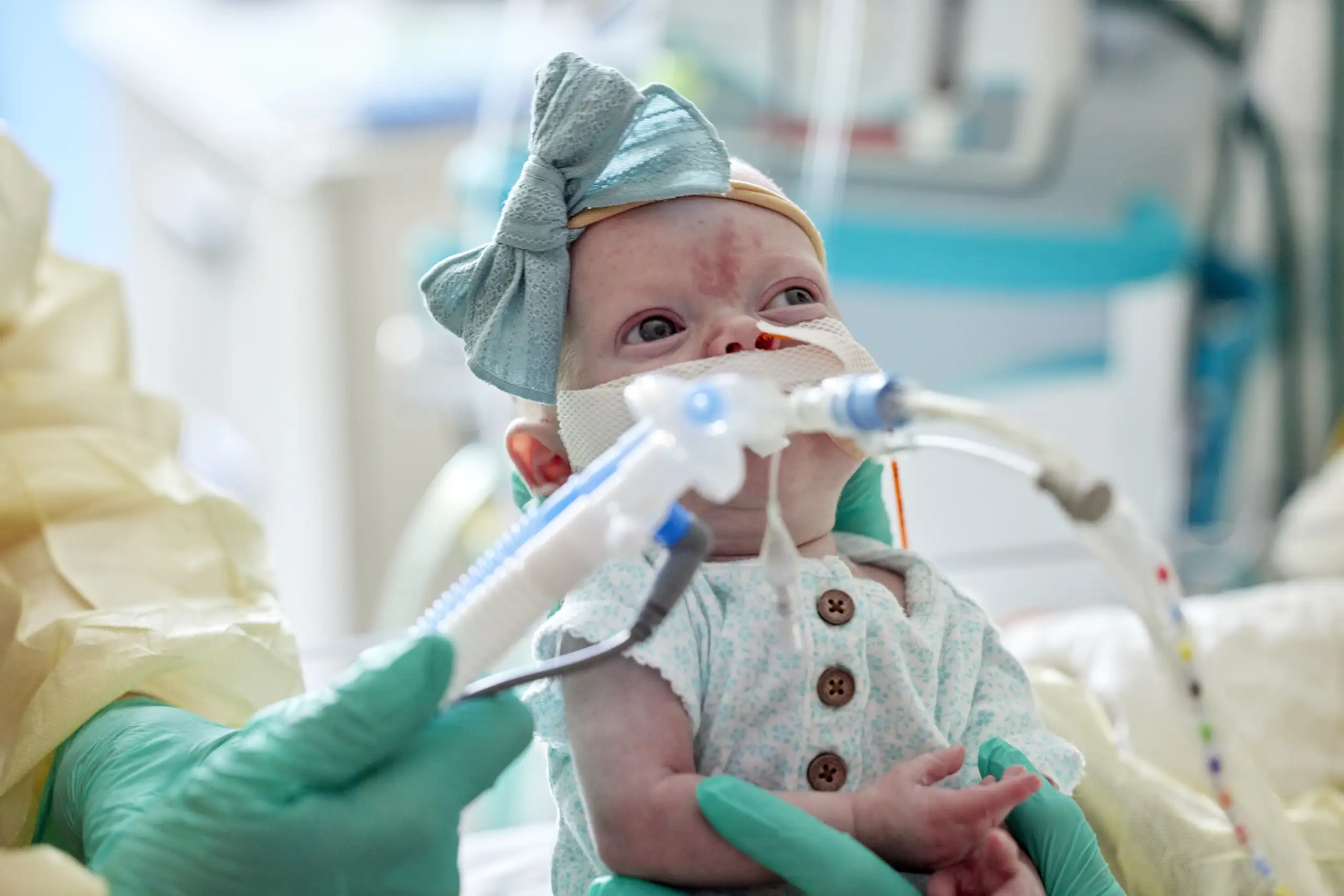
In the years ahead, research launched at Cincinnati Children’s may help more preterm infants survive bronchopulmonary dysplasia (BPD) and grow up with healthier lungs
A team of scientists based at Cincinnati Children’s and UCLA has discovered a promising new approach to treating bronchopulmonary dysplasia (BPD), a chronic lung disease that affects thousands of premature infants each year.
Their findings, published Dec. 24, 2025, in Cell Stem Cell, reveal how restoring the balance of key proteins expressed in newborn lung tissue can promote healthy blood vessel growth that becomes disrupted when BPD occurs.
“This research opens a new chapter in our understanding of BPD,” says co-corresponding author Minzhe Guo, PhD, an investigator with the Perinatal Institute at Cincinnati Children’s. “By targeting the molecular mechanisms that disrupt vascular repair, we can envision therapies that go beyond symptom management and actually restore lung function for these vulnerable infants.”
What is BPD?
Bronchopulmonary dysplasia is a serious threat to infants before 28 weeks of gestation with under-developed lungs. The condition arises when the mechanical ventilation and oxygen therapy needed to help the infants breathe also damages their still-developing lungs.
In the United States, BPD affects up to 10,000 preemies each year. Once these newborns who survive long stays in intensive care, many grow up with impaired development of the lung’s delicate network of tiny blood vessels and alveoli (air sacs). Outcomes can include chronic respiratory problems, increased risk of pulmonary hypertension, and lifelong limitations in exercise capacity.
Jeffrey Whitsett, MD, a global authority on lung development in preterm infants and co-director of the Perinatal Institute at Cincinnati Children’s, says the recent findings have far-reaching implications.
“Despite many advances in neonatal care, current treatments for BPD and other life-threatening lung diseases affecting infants remain largely focused on early survival and do not address the underlying causes and life-long consequences of injury to the developing lung.” Whitsett says. “This discovery is exciting because it offers the potential to develop new therapies that promote true lung regeneration.”
Decoding a Vascular Repair Mechanism
The study, initiated at Cincinnati Children’s by corresponding author Mingxia Gu, MD, PhD—now with UCLA—focuses on how changes to a protein called neurotrophic receptor tyrosine kinase 2 (NTRK2) can drive lung blood vessel formation and repair in BPD. The research team used an array of advanced techniques to analyze human tissue, stem cell-derived organoids, and mouse models. Ultimately, they pinpointed a critical switching point between two forms of the NTRK2 protein: the full-length (NTRK2-FL) and a truncated (NTRK2-T1) isoform.
Their work shows that an imbalance favoring the truncated isoform leads to impaired vascular regeneration and persistent lung injury. Conversely, restoring the full-length NTRK2-FL isoform—using a gene therapy involving nanoparticle-delivered mRNA—promoted blood vessel growth and reversed lung damage in mice exposed to high oxygen levels to mimic BPD.
“Our work shows that BPD is more than a complication of premature birth. The disease progresses when the lung’s natural repair system is shut down,” Gu says in an announcement from UCLA. “If we can restore the healthy version of this gene, we can turn the repair process back on and help the lung rebuild the blood vessel network that infants need for healthy breathing.”
Read the UCLA announcement
Cincinnati Children’s Expertise Drives Discovery
Cincinnati Children’s experts played pivotal roles throughout the study.
The Perinatal Institute and Division of Pulmonary Biology provided critical resources, including patient tissue samples and technical expertise in confocal microscopy and image processing.
The Center for Stem Cell and Organoid Medicine (CuSTOM) helped develop and analyze human stem cell-derived vessel organoids, which were essential for modeling the disease and testing therapeutic strategies.
The collaboration among experts skilled in neonatology, developmental biology, and computational analysis combined to integrate a vast amount of data—down to the genetic information contained in a single cell— into a potential pathway for improved care.
Another Contribution from LungMAP
A key resource for this study was the LungMAP project, a national initiative with deep involvement from experts at Cincinnati Children’s, that provides a massive atlas of genetic and mechanistic data about lung development and disease.
The research team used LungMAP’s ultra-detailed datasets to pinpoint the cellular origins and molecular pathways involved in BPD, including new information about the expansion of general capillary endothelial cells (gCaps) marked by NTRK2.
Funded by the National Heart, Lung, and Blood Institute (NHLBI), the LungMAP project dates back to 2014. The project is creating the world’s first comprehensive map of the dynamic molecular and cellular architecture of the developing lung. Researchers predict this information will help drive new treatments for a variety of respiratory diseases, including BPD, asthma, COPD, and cystic fibrosis.
Whitsett has been involved with LungMAP from the beginning. Whitsett, along with Yan Xu, PhD, Jichao Chen, PhD, MHS, and Kathryn Wikenheiser-Brokamp, MD, PhD, at Cincinnati Children’s are continuing work to expand this widely-shared scientific resource.
Learn more about LungMAP.
What’s Next: Toward Isoform-Specific RNA Therapies
Building on these discoveries, the research team is now exploring isoform-specific RNA therapies as a new frontier in regenerative medicine for neonatal lung disease. Their successful use of lipid nanoparticle-delivered NTRK2-FL mRNA in mouse models demonstrates the feasibility of precision treatments that restore vascular integrity and alveolar development.
Future studies will focus on refining delivery methods, evaluating long-term efficacy, and expanding the approach to other forms of vascular injury. The team also plans to investigate the upstream regulators of NTRK2 isoform switching, such as the transcription factor HOXA5 and splicing factor RBFOX2, to identify additional therapeutic targets.
About the study
Cincinnati Children’s co-authors included Cheng Tan, MD, Ziyi Liu, MD, Xiaolei Li, MS, Nicole Pek, BS, and Yifei Miao, MBBS, PhD. In addition to the UCLA team, collaborators included experts from Northwestern University, the University of Arizona College of Medicine-Phoenix, the University of Rochester Medical Center, and the Houston Methodist Research Institute.
This work was supported by the Cincinnati Children’s Research Foundation, the National Institutes of Health and the American Heart Association.
Don’t Miss a Post:
- Subscribe to the Research Horizons Newsletter
- Follow Cincinnati Children’s Research Foundation on Bluesky, X and LinkedIn
| Original title: | Rebalancing NTRK2 isoforms promotes vascular regeneration in bronchopulmonary dysplasia |
| Published in: | Cell Stem Cell |
| Publish date: | Dec. 24, 2025 |
Research By

My research interests include developing novel computational methods and software tools to support single cell multi-omics data analysis and integration for scientific discovery or to facilitate data management, access, and visualization.

Latest Posts

About this blog
The Research Horizons blog features news and insights about the latest discoveries and innovations developed by the scientists of Cincinnati Children's. This blog does not provide medical advice, diagnosis, or treatment. Email researchnews@cchmc.org with questions or ideas.
Subscribe to Our Newsletter