

Study Identifies Key Step That Could Help Adult Hearts Regrow Muscle
Research By: Shijie Liu, PhD
Post Date: October 12, 2026 | Publish Date: Sept. 8, 2026

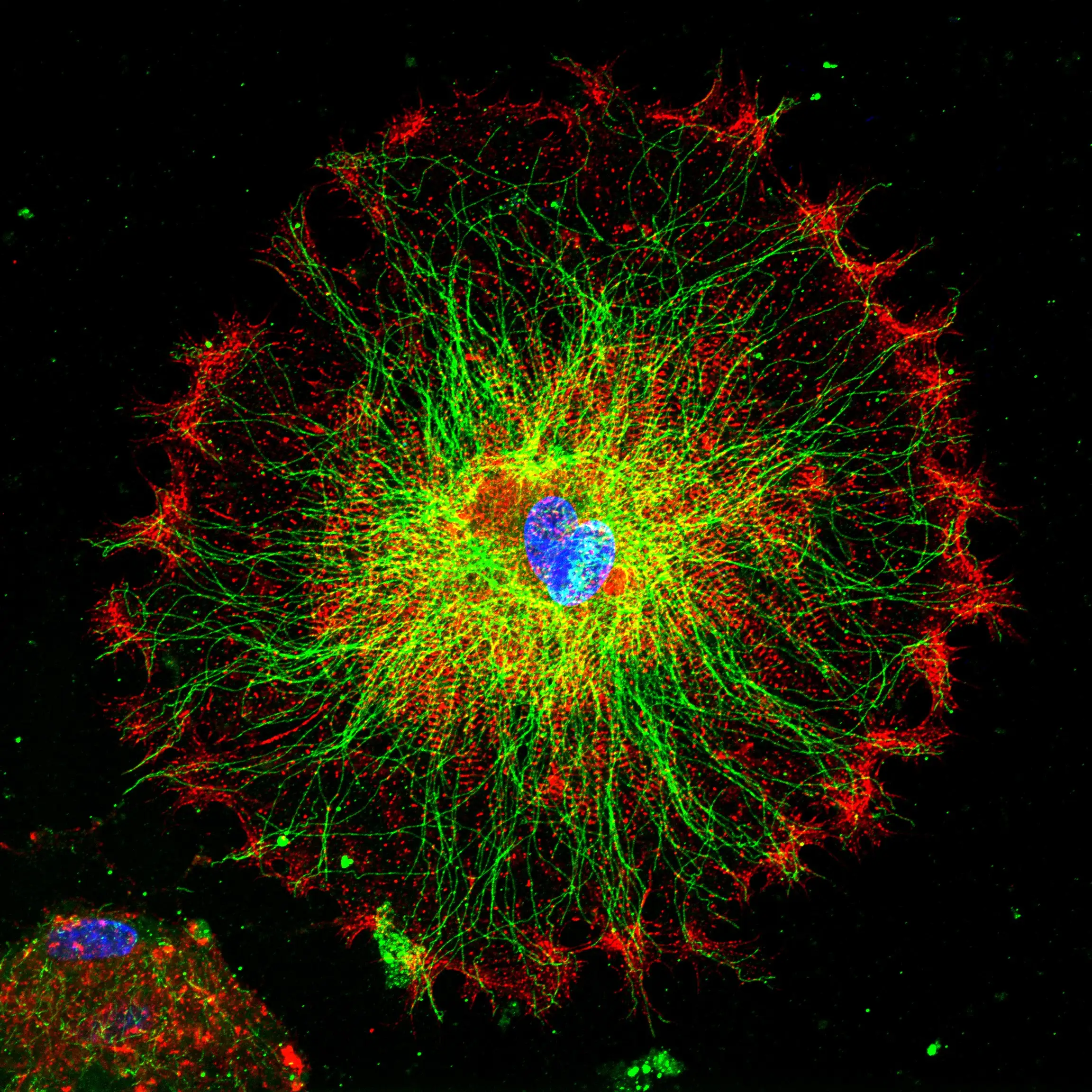
Growing a cell’s internal scaffolding enables heart muscle cells to take apart their contractile machinery and re-enter the cell cycle
Key Takeaways
- Microtubule remodeling is required before mature cardiomyocytes can re-enter the cell cycle.
- YAP-TEAD signaling activates the structural program that dismantles mature sarcomeres.
- TUBA1B links YAP activation to microtubule growth and sarcomere disassembly.
- The pathway offers a potential control point for future cardiac regeneration therapies.
The adult human heart has almost no ability to repair itself. When heart muscle cells (cardiomyocytes) die after a heart attack, they don’t regenerate. Instead, the heart scars. For decades, researchers have looked for ways to get heart cells to do what they did briefly in infancy—divide and generate new muscle.
A study published Aug. 11, 2026, in Circulation—led by researchers at the Heart Institute, Division of Molecular Cardiovascular Biology and Reproductive Sciences Center at Cincinnati Children’s—identifies a previously overlooked structural step required for heart muscle generation and offers a possible way to keep it under control.
A Cell Built to Contract Is Not Built to Divide
Cardiomyocytes are packed with sarcomeres, the highly organized, rigid protein structures that let heart muscle contract. That same rigidity is thought to physically block cell division. Before a mature heart cell can proliferate, it must first “dedifferentiate,” partially reversing its maturation and dismantling its sarcomeres before it can divide and rebuild them in daughter cells.
“YAP activity is high in the developing heart before birth and declines as cardiomyocytes mature after birth,” explains Shijie Liu, PhD, the study’s corresponding author and researcher at the Heart Institute. “Because YAP is a key regulator of cell proliferation and differentiation, reactivating YAP in the adult heart gives us a way to ask whether mature cardiomyocytes can be pushed back toward a regenerative state—and what structural changes are required for that transition.”
Liu and colleagues have previously shown in preclinical models that YAP-based gene therapy can promote cardiac regeneration after heart injury. The developmental decline in YAP activity provides an important rationale for reactivating this pathway in adult cardiomyocytes.
The new study addresses a key unanswered question: How does YAP enable mature cardiomyocytes to remodel their contractile architecture and dismantle sarcomeres to allow cardiomyocyte division for therapeutic regeneration?
Microtubules Do the Physical Work
Using live-cell imaging, gene-editing tools and preclinical models, the research team found that YAP acts on the cell’s microtubule network, required for sarcomere disassembly. Microtubules provide the internal scaffolding that cells use for structure and transport.
Microtubule levels and density naturally decline as cardiomyocytes mature after birth, which the team observed across several species. Turning on an active form of YAP reversed that decline, dramatically increasing tubulin protein levels and stabilizing microtubule growth in adult cardiomyocytes.
As microtubules grew, their tips made direct contact with ⍺-actinin, a protein that anchors the sarcomere, and physically displaced it, contributing to sarcomere breakdown.
“We could see the growing microtubule tips pushing directly against the sarcomere structure and knocking pieces of it loose,” says Liu. “It’s a much more mechanical, physical process than we expected.”
When the researchers blocked microtubule growth with colchicine, a widely used anti-inflammatory drug, it prevented both sarcomere disassembly and cell cycle re-entry. YAP’s regenerative benefit significantly reduced after a simulated heart attack in preclinical models. The team also traced the effect to specific genes YAP switches on, including AJUBA and TUBA1B. In fact, reducing TUBA1A in heart muscle cells alone was enough to blunt YAP-driven sarcomere disassembly.
Why This Research Matters
The findings from this study reframe microtubule growth as a required active step in cardiac regeneration, rather than a side effect of YAP activation, and identify it as a potential control point for future therapies.
“This work moves the field beyond the idea that we only need to turn on proliferative signaling,” Liu says. “A mature cardiomyocyte is structurally built to contract, not to divide. Our data suggest that turning on proliferative signals is not enough. The cell also has to remodel its microtubule network and dismantle its contractile machinery to divide.”
“Findings also suggest that colchicine, a drug that’s already used clinically and has been tested in cardiovascular trials, could eventually have a role in fine-tuning how much regeneration you get, and for how long,” Liu adds.
Liu notes that questions remain, including how microtubule growth is coordinated with other cellular events during cardiomyocyte division, and whether we can reactivate the same mechanism after injury in species that don’t naturally regenerate heart tissue.
About the Study
In addition to Liu, co-authors from Cincinnati Children’s included Feng Zhang, Jenna Cusick, Jie Liang, Fangfei Wang, Andrew Fernandes, Jacob Gafranek, Joshua Waxman, PhD, and Katherine Yutzey, PhD. The Bio-Imaging and Analysis Facility at Cincinnati Children’s also supported this research.
Funding sources for this project include: the American Heart Association Postdoctoral Fellowship (24POST1201408); the National Institutes of Health (R01HL172839, R00HD104902, R01HD118540); and the American Heart Association Career Development Award (849706).
Don’t Miss a Post:
- Subscribe to the Research Horizons Newsletter
- Follow Cincinnati Children’s Research Foundation on Bluesky, X and LinkedIn
| Original title: | YAP Promotes Microtubule Growth to Facilitate Sarcomere Disassembly in Adult Cardiomyocytes |
| Published in: | Circulation |
| Publish date: | Sept. 8, 2026 |
Research By

We are working on developing therapeutic strategies to stimulate CM proliferation, reverse cardiac remodeling, reduce cardiac fibrosis, and improve cardiac function.


Latest Posts
About this blog
The Research Horizons blog features news and insights about the latest discoveries and innovations developed by the scientists of Cincinnati Children's. This blog does not provide medical advice, diagnosis, or treatment. Email researchnews@cchmc.org with questions or ideas.
Subscribe to Our Newsletter