

MEG Virtual Sensors Advance Epilepsy Surgery Planning
Research By: Jeffrey Tenney, MD, PhD | Hansel Greiner, MD
Post Date: December 30, 2024 | Publish Date: Dec. 30, 2024

Neurology | Top Scientific Achievement

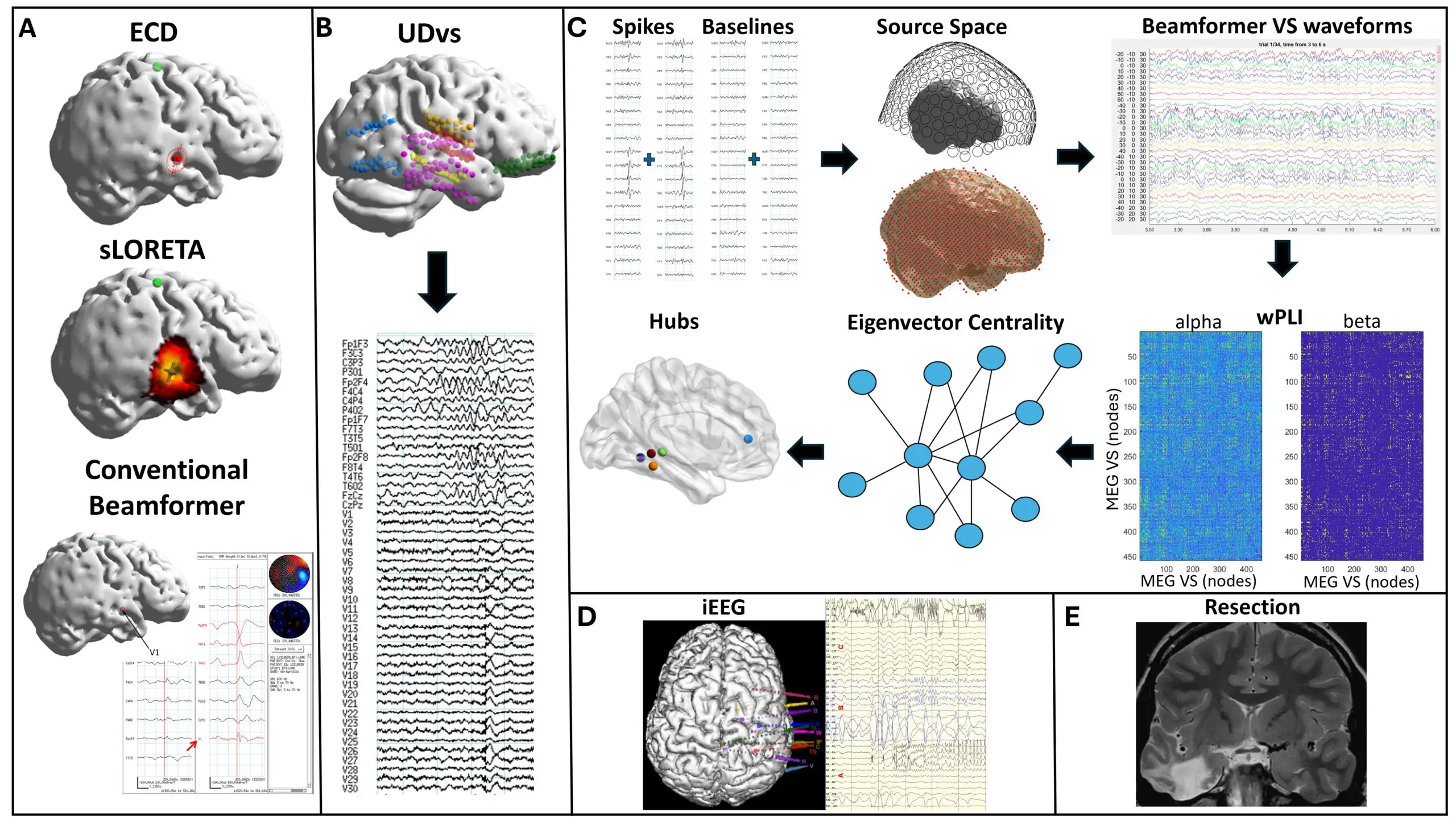
User-defined virtual sensors (UDvs) in magnetoencephalography (MEG) can significantly improve how neurologists identify and classify seizure sources in the brain, particularly in distinguishing patients with temporal lobe epilepsy (TLE) vs. temporal plus epilepsy (TLE+).
Findings were published December 2024 in Epilepsia. Jeffrey Tenney, MD, PhD, was lead author and Hansel Greiner, MD, was senior author.
Children with TLE+ have a five-fold increased risk of failing to achieve seizure control even after temporal lobectomy. However, traditional tools for identifying the locations of seizure often cannot distinguish patients with TLE+ from those with more-manageable TLE.
“This approach allows us to better localize complex epileptic networks, which can lead to more effective surgical planning and improved patient outcomes,” Greiner says. “The main findings of this study support the use of this MEG method in clinical practice as a complementary approach to enhance standard ECD (equivalent current dipole) analysis.”
UDvs “beamforming” uses advanced software to reconstruct neural activity, which can go beyond physical sensors to pinpoint seizure-causing brain regions in difficult-to-access locations. The Cincinnati Children’s research team reports that UDvs shows strong sensitivity for predicting abnormal brain activity and was closely linked to both presurgical classification and postsurgical seizure outcomes.
Next steps for this research include prospective, multicenter clinical trials to determine whether UDvs beamforming adds unique value to planning that relies on invasive electrode placements. Future studies will also explore optimal connectivity measures and other refinements to the UDvs method.
About the study
Co-authors from Cincinnati Children’s and the University of Cincinnati also included Hisako Fujiwara, PhD, Jesse Skoch, MD, Paul Horn, PhD, Seungrok Hong, MD, Olivia Lee, Kelly Kremer, MD, Ravindra Arya, MD, DM, Katherine Holland, MD, PhD, and Francesco Mangano, DO.
Funding sources for this study included a grant from the National Institute of Neurological Disorders and Stroke (5R21NS123630).
Explore the 2025 Research Annual Report
Don’t Miss a Post:
- Subscribe to the Research Horizons Newsletter
- Follow Cincinnati Children’s Research Foundation on Bluesky, X and LinkedIn
| Original title: | User-defined virtual sensors: A new solution to the problem of temporal plus epilepsy sources |
| Published in: | Epilepsia |
| Publish date: | Dec. 30, 2024 |
Research By

In my research, I focus on trying to better understand how seizures start and spread in the brain.
Through my research, I want to find a better way to identify areas of cortical dysplasia that causes seizures. I also want to find a better way to identify important language areas in children who need surgery.
Latest Posts



About this blog
The Research Horizons blog features news and insights about the latest discoveries and innovations developed by the scientists of Cincinnati Children's. This blog does not provide medical advice, diagnosis, or treatment. Email researchnews@cchmc.org with questions or ideas.
Subscribe to Our Newsletter