

‘Mono’ Virus Found to Broadly Influence Human Genes
Research By: Leah Kottyan, PhD | Matthew Weirauch, PhD
Post Date: July 15, 2026 | Publish Date: July 15, 2026

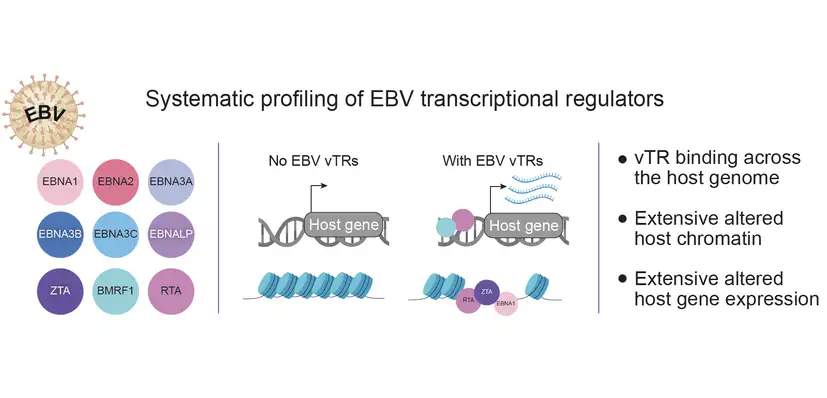
Researchers at Cincinnati Children’s have completed one of the most comprehensive studies to date examining how Epstein-Barr virus, a common virus carried by most adults, impacts human gene regulation.
Epstein-Barr virus, or EBV, is best known as the cause of infectious mononucleosis (often referred to as “mono”). After infection, the virus can persist for life in immune cells, especially B cells. EBV also has also been associated with several cancers and immune-mediated diseases.
However, a key question has remained: how much, and through what means, does a virus that lives inside human cells alter the activity of the human genome?
To address this question, a research team in the Division of Allergy and Immunology and The Center for Autoimmune Genomics and Etiology, published a study on July 15, 2026 in Cell Genomics, reveal that EBV can exert extensive influence over the human genome by engaging regulatory regions that help control when and where human genes are turned on and off.
EBV has been studied for decades, but most studies have focused on one viral protein, one gene, or one disease context at a time. “This first-ever comprehensive resource of EBV-induced changes to human gene regulation enables the discovery of new mechanisms contributing to human diseases,” says Weirauch.
PUTTING EBV ACTIVITY IN CONTEXT
The study provides a genome-wide resource for understanding how EBV may reshape the behavior of infected cells.
To build this resource, the research team systematically studied EBV regulatory proteins, examining how individual viral proteins interact with human DNA to influence gene activity. Rather than treating EBV infection as a single, complex event, this approach allowed the team to ask which regions of the human genome are contacted by specific viral proteins and which cellular pathways may be affected. They then integrated these maps with gene regulation and disease-relevant analyses to identify the human genes and biological programs most likely to be influenced by EBV.
The results suggest that EBV regulatory proteins do not act at just a small number of sites. Instead, they appear to engage a broad network of human genomic regions involved in immune cell function, gene regulation and disease-relevant pathways. This broader view helps explain how a common lifelong virus could, in certain cellular or genetic contexts, contribute to changes in a person’s immune system.
Importantly, the findings do not suggest that EBV alone causes any single disease. Instead, they offer a mechanistic framework for understanding how EBV infection may interact with host genetics, immune cell states, and environmental contexts to influence disease risk.
“Most people carry EBV without developing EBV-associated disease. These findings help us ask a more precise question: in which contexts might EBV regulation of the human genome become clinically important?” says Kottyan.
LOOKING AHEAD
The work is especially relevant for researchers studying autoimmune diseases such as multiple sclerosis and lupus, and cancers such as Hodgkin lymphoma and Burkitt lymphoma, where EBV plays an important but poorly understood role. By mapping where EBV regulatory proteins interact with the human genome, the team created a foundation for future studies to test how these viral-human interactions affect immune cell behavior and disease susceptibility.
The study also reflects a growing strength at Cincinnati Children’s: combining computational genomics, functional genomics, molecular biology and disease genetics to understand how genetic and environmental factors converge inside human cells to impact human health.
“This project is a strong example of how team science allows us to connect basic viral biology with human genetics and disease mechanisms,” say Kottyan and Weirauch.
The team expects the dataset to serve as a resource for investigators studying EBV biology, gene regulation, cancer, autoimmunity, and other immune-mediated diseases.
Explore the dataset
ABOUT THE STUDY
Phil Dexheimer, Matt Hass, and Lee Edsall are the co-first authors of the study. Additional Cincinnati Children’s co-authors included Arame Diouf, Sydney Jones, Omer Donmez, Cailing Yin, Katelyn Dunn, Carmy Forney, Hayley Hesse, Andrew VonHandorf, Xiaoting Chen, Sreeja Parameswaran, Olivia Gittens, Kenyatta Viel, and Lucinda Lawson.
This research was funded by multiple grants to Weirauch and Kottyan from the National Institutes of Health.
Don’t Miss a Post:
- Subscribe to the Research Horizons Newsletter
- Follow Cincinnati Children’s Research Foundation on Bluesky, X and LinkedIn
| Original title: | Systematic investigation reveals extensive Epstein-Barr virus transcriptional regulation of the human genome |
| Published in: | Cell Genomics |
| Publish date: | July 15, 2026 |
Research By

My laboratory studies the genetic etiology of diseases that have an immunological component.

I am a bioinformatician geneticist who works to achieve a thorough understanding of human and viral transcriptional regulation mechanisms in complex diseases.

Latest Posts


About this blog
The Research Horizons blog features news and insights about the latest discoveries and innovations developed by the scientists of Cincinnati Children's. This blog does not provide medical advice, diagnosis, or treatment. Email researchnews@cchmc.org with questions or ideas.
Subscribe to Our Newsletter