

Limited Experience, High Stakes in Pediatric Emergency Care
Research By: Allan Joseph, MD, MPH
Post Date: July 6, 2026 | Publish Date: July 2, 2026

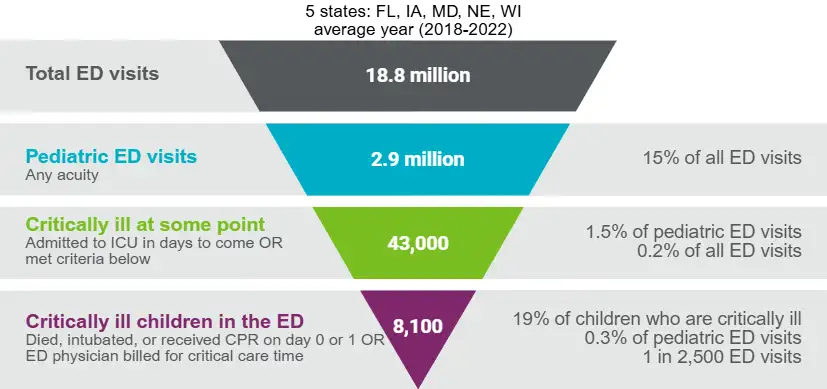
Critically ill children are rarely seen in most emergency departments, and few can be redirected to higher-volume centers, highlighting the need for targeted training and system support.
Even for experienced emergency physicians, caring for a critically ill child is a rare event. Yet when it happens, decisions in the first minutes can shape outcomes.
This creates a persistent challenge for the healthcare system: how to ensure high-quality care for conditions that most emergency departments don’t frequently encounter.
One proposed solution is to direct these patients to high-volume centers. But whether that approach is feasible at scale has remained unclear.
A study published on July 2, 2026 in Annals of Emergency Medicine examines how often emergency departments care for critically ill children and whether those children could realistically be treated at higher-volume centers. The authors found that most emergency departments see very few critically ill children, and relatively few of these patients could be redirected to higher-volume centers.
“These findings suggest we need to rethink how we approach care for critically ill children,” says Allan Joseph, MD, MPH, first and corresponding author of the study. “Because most emergency departments see very few of these patients—and many cannot be redirected—we need approaches that support care across all settings.”
Identifying the problem
Using data from more than 14 million pediatric emergency department visits across five states, the study identified just over 40,000 encounters that met criteria for critical illness—about 0.3% of all emergency visits.
At the level of individual emergency departments, exposure to these cases was limited. The median department treated five critically ill children each year. Nearly one-third of departments had at least one year with no such cases at all, and more than 70% treated fewer than 12 critically ill children annually.
These findings highlight a structural challenge for pediatric emergency care. While higher patient volume is consistently linked to better performance on quality measures, most departments simply do not see enough critically ill children to build experience through routine practice. This creates a gap between expectations for high-quality care and the reality of clinical exposure in many settings.

Regionalization has limits
One possible solution to address gaps in experience is directing critically ill children to higher-volume emergency departments with more specialized resources. The study assessed how often this approach would be feasible based on travel time between hospitals.
Among critically ill children treated at lower-volume emergency departments, only about 17% were within 15 minutes of a higher-volume center, though this varied widely by state.
“While regionalized prehospital triage may benefit some patients, our findings show that it’s only a suitable solution in specific geographic areas,” says Joseph. “In many parts of the country, hospitals and patients are simply too spread out to make that a feasible option.”
In practice, some degree of regionalization may already be occurring, as families and emergency medical services frequently route the most severely ill children to specialized centers when possible. However, access to these centers varies widely by region, particularly in less densely populated areas and many patients are not close enough for this to be a realistic option.
Additional factors further limit redirection. Patients may present from locations other than home, and their clinical condition at the time of transport may not allow for longer travel distances. Together, these realities reduce the number of cases that can be safely and efficiently rerouted.
Implications for Pediatric Emergency Care
The findings point to the need for approaches that support all emergency departments—not just higher-volume centers. These may include targeted training for high-acuity, low-frequency events and systems that extend expertise beyond individual sites.
Potential strategies include:
- simulation-based training
- telemedicine support during critical cases
- readiness efforts tailored to the capabilities and needs of different hospitals
“These approaches can help reinforce skills and support decision-making in settings where clinicians rarely see critically ill children, ensuring they are better prepared when these rare but high-stakes cases occur,” says Joseph.
Future work may clarify how patients are directed to specific hospitals and how those patterns influence care. Efforts to improve pediatric emergency care will need to focus on both where care is delivered and how clinicians are supported across the system.
About the Study
Maya Dewan, MD, MPH, Ellen Lipstein, MD, MPH, and Lynn Babcock, MD, MS were Cincinnati Children’s co-authors.
External co-authors include experts from Ann & Robert H. Lurie Children’s Hospital and University of Pittsburgh School of Medicine.
Funding for the study was supported by the Eunice Kennedy Shriver National Institute of Child Health and Human Development (R01HD112321).
Don’t Miss a Post:
- Subscribe to the Research Horizons Newsletter
- Follow Cincinnati Children’s Research Foundation on Bluesky, X and LinkedIn
| Original title: | Variation in Emergency Department Experience With Pediatric Critical Illness |
| Published in: | Annals of Emergency Medicine |
| Publish date: | July 2, 2026 |
Research By

Latest Posts
About this blog
The Research Horizons blog features news and insights about the latest discoveries and innovations developed by the scientists of Cincinnati Children's. This blog does not provide medical advice, diagnosis, or treatment. Email researchnews@cchmc.org with questions or ideas.
Subscribe to Our Newsletter