

Risky Agitation Can Be Predicted in Emergency Departments
Research By: Lynn Babcock, MD, MS
Post Date: July 28, 2026 | Publish Date: July 21, 2026

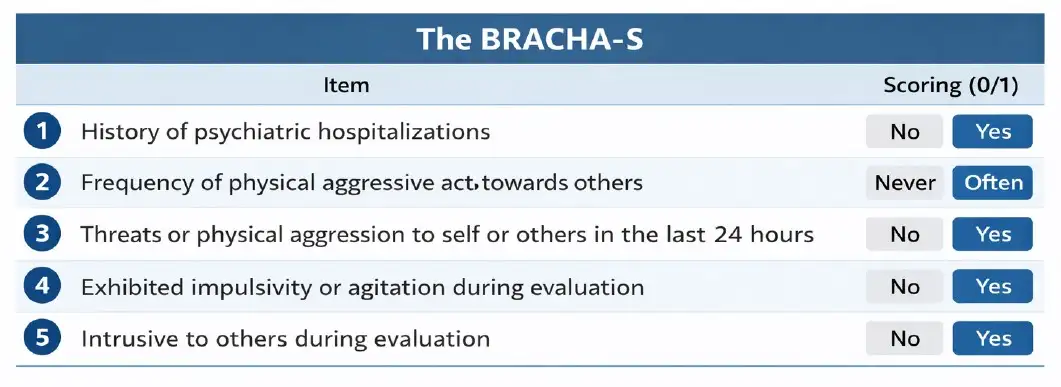
A new 5-item BRACHA-S tool can identify many of the youth most likely to become aggressive during emergency psychiatric visits, potentially improving staff safety while reducing needs for medications and restraints
Every pediatric hospital has experienced the situation: A child or teen is brought in for an emergency psychiatric visit. The patient appears relatively calm at first, but as time passes, the patient becomes more and more agitated, with some becoming threats to themselves and the staff working to help them.
Overall, about 10% of psychiatric visits to emergency departments (EDs) wind up involving the use of pharmacologic agents or physical restraints to manage agitation or aggression. Experts in pediatric mental health care have been working for years to reduce these potentially dangerous situations. Now, researchers at Cincinnati Children’s report developing a tool that can help predict the likelihood of aggressive behavior and help prepare staff to mitigate problems before they escalate.
The study, published July 21, 2026, in Pediatrics, describes the predictive ability of the “BRACHA-S” risk-rating tool. The new 5-step version is derived from the original 14-item Brief Rating of Aggression by Children and Adolescents (BRACHA) tool. But instead of being administered later in the admission and treatment process, this tool is designed to be used by nurses in emergency departments during triage shortly after patients arrive.
“We found that it was feasible for the nurses to complete the BRACHA-S shortly after arrival within a median of 17 minutes. In comparison, the median time for the first ARI event (agitation requiring intervention) was 162 minutes after arrival,” says corresponding author Lynn Babcock, MD, MS, associate division director for research, Division of Emergency Medicine, at Cincinnati Children’s.
The research team studied 472 patient encounters at two Cincinnati Children’s emergency departments to assess the tool’s abilities. Of the total encounters, 55 ultimately involved an ARI event. Those patients who had ARI events were more likely to spend longer hours in the emergency department and were much more likely to require hospital admission compared to patients who did not have ARI events.
About the BRACHA-S tool
The BRACHA-S tool assigned point values from 0 to 5 based on how nurses answered the tool’s five questions:
- Is there a history of psychiatric hospitalizations?
- What has been the frequency of physical aggressive acts towards others?
- Have any threats or physical aggression occurred to self or others in the last 24 hours?
- Did patient exhibit impulsivity or agitation during evaluation?
- Was patient intrusive to others during evaluation?
Patients scoring 4 or 5 showed a 33% risk of an ARI event, compared to 5.3% for those scoring 2 or below.
“We then translated these tiers into this simple stop light framework: green for low risk, yellow for intermediate risk, and red for high risk,” Babcock says.
Importantly, as scores increased, the proportion of encounters with ARI also increased. As expected, lower scores were more sensitive but less specific, while higher scores were less sensitive but more specific.
Why predicting agitation matters
Pediatric emergency department visits for mental health concerns have increased dramatically over the past decade, now accounting for more than 13% of all pediatric ED encounters nationally.
Agitation or aggression poses safety risks and psychological distress to both the patient and care teams. ARI events consume substantial resources and prolong lengths of stay. However, if a tool like BRACHA-S can provide more warning time, care teams can make plans to both de-escalate situations before they become severe and be better prepared for the events that still occur.
The new study was co-authored by 11 experts at Cincinnati Children’s from the divisions of Emergency Medicine, Psychiatry and Biostatistics and Epidemiology. Some of the co-authors helped develop both the BRACHA-S and the original 14-item BRACHA tool.
While previous studies have shown the effectiveness of the original BRACHA tool, it was designed to be completed by trained mental health specialists after patients have been medically cleared and next steps need determination. The new tool can be administered by nurses during triage, a well-established workflow for emergency departments.
The new BRACHA-S tool appears to function best as an early risk-stratification tool to identify patients who may benefit from safety measures rather than as a rule-out screen. Low scores do not guarantee that a patient might not later have an ARI event. But high scores suggest that a patient may warrant enhanced observation, earlier engagement with trained support staff, or anticipatory medication planning.
Similar to suicide risk screening performed early in ED evaluation, agitation risk assessment is not intended to determine diagnosis or disposition but to guide the intensity of early safety planning, the co-authors state.
What’s next?
With BRACHA-S now validated, the team has secured funding through Cincinnati Children’s new Spread of Innovations in the Clinical Ecosystem (SpICE) initiative to put it into practice. Over the next two years, they plan to roll out the PEACE (Pediatric Emergency Agitation Care Enhancement) bundle across both emergency departments, linking BRACHA-S risk tiers to standardized, least-restrictive calming measures, with a goal of reducing agitation events and minimizing injuries.
About the study
In addition to Babcock, Cincinnati Children’s co-authors include Lily Klein, BS, Yin Zhang, MS, Nancy Daraiseh, PhD, Ryan Siders, BSN, Beatrice Thomas, MD, Ryan Murphy, BS, Holly Hanson, MD, MS, Bijan Ketabchi, MD, MPH, (now at Children’s Hospital of Philadelphia), Shelby Tanguay, MD, Drew Barzman, MD, and Wendy Pomerantz, MD, MS.
This study was primarily supported by the PLACE Outcomes Research Award from the Cincinnati Children’s Research Foundation. The BRACHA-S is protected intellectual property of Cincinnati Children’s.
Don’t Miss a Post:
- Subscribe to the Research Horizons Newsletter
- Follow Cincinnati Children’s Research Foundation on Bluesky, X and LinkedIn
| Original title: | A Brief Tool to Predict Agitation in Pediatric Emergency Psychiatric Patients |
| Published in: | Pediatrics |
| Publish date: | July 21, 2026 |
Research By

Latest Posts


About this blog
The Research Horizons blog features news and insights about the latest discoveries and innovations developed by the scientists of Cincinnati Children's. This blog does not provide medical advice, diagnosis, or treatment. Email researchnews@cchmc.org with questions or ideas.
Subscribe to Our Newsletter