

What Makes Some Naïve T Cells Better Responders?
Research By: Koichi Araki, DVM, PhD
Post Date: August 31, 2026 | Publish Date: Aug. 31, 2026

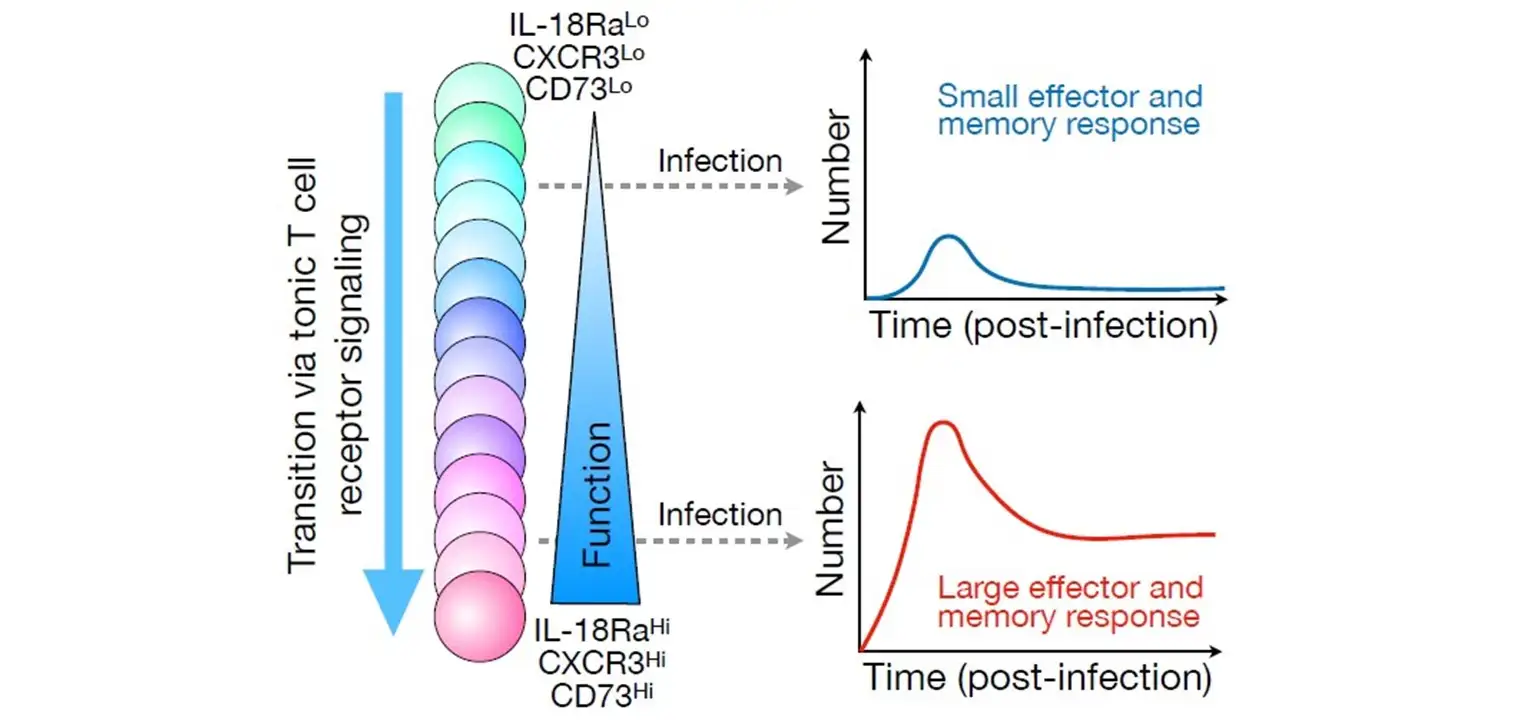
Researchers at Cincinnati Children’s identified naïve CD8 T cell subsets with different abilities to generate protective immune responses and discovered these states can change over time
Every infection, vaccine response and many cancer-fighting immune responses begin with a naïve CD8 T cell.
Scientists have learned a great deal about the specialized T cells that emerge after activation, including effector, memory and exhausted populations. Yet a fundamental question has remained: how much of a T cell’s future success is determined before it ever encounters a virus, tumor or vaccine?
In a new study, published Aug. 31, 2026, in the Journal of Experimental Medicine, researchers at Cincinnati Children’s identified naïve CD8 T cell subsets with varying capacities to generate effector and memory responses. They also found that less potent naïve CD8 T cells can transition into more functionally capable states before infection occurs, revealing an unexpected degree of flexibility within the naïve CD8 T cell pool.
“Our findings suggest that the quality of a CD8 T cell response may be influenced long before infection or vaccination occurs,” says corresponding author Koichi Araki, DVM, PhD, Division of Infectious Diseases. “We found that a naïve T cell’s functional potential is not fixed. That flexibility adds an important new dimension to our understanding of how protective immune responses are generated.”
Understanding T cell States
CD8 T cells help protect the body against viral infections and cancer, and they play an important role in the immune responses generated by many vaccines. When activated, they can develop into effector T cells that respond to immediate threats and memory T cells that provide longer-term protection.
Before activation, CD8 T cells exist in a naïve state, meaning they have not yet encountered the specific target they are designed to recognize. Whether differences within this naïve population influence future immune responses has remained less clear.
The researchers set out to answer a key question: Are some naïve CD8 T cells naturally better at generating protective immune responses, and can those advantages be acquired before infection occurs?
Distinct Naïve T Cells, Distinct Immune Responses
Researchers used a series of mouse models to follow naïve CD8 T cells that recognize a specific viral target and examine how they responded to infection. The study followed these cells both before and after exposure to viral and bacterial pathogens, allowing the team to compare immune responses across different naïve T cell populations.
Additional gene expression analyses and genetic approaches helped identify the mechanisms underlying the observed differences. Together, these experiments revealed important differences in how naïve CD8 T cells respond to infection and how those differences develop over time.
Key findings included:
- Researchers identified several naïve CD8 T cell subsets with different capacities to respond to infection.
- Cells expressing IL-18Rα, CXCR3 and CD73 generated the strongest effector and memory T cell responses and provided better protection against infection.
- Less effective naïve CD8 T cells could transition into these more functionally capable states over time.
- Signals received by naïve CD8 T cells under normal, non-infectious conditions helped drive the transition to more functionally capable states.
- The stronger immune responses were linked to improved survival of effector T cells and the activity of Ly6C.
“One of the most exciting findings was the degree of flexibility we observed within the naïve CD8 T cell population,” says Araki. “That flexibility suggests the immune system may have ways to improve the quality of the cells available to combat future infections.”
Looking Ahead
The findings suggest that differences within the naïve CD8 T cell pool may influence how effectively the immune system responds to future infections and vaccines. They also raise new questions about how these functionally superior cells develop and whether similar subsets exist in humans.
Researchers plan to further investigate the mechanisms that allow less effective naïve CD8 T cells to transition into more capable states. They also plan to explore whether these insights can be used to strengthen vaccine responses, enhance cancer immunotherapies and improve protection against infectious diseases.
“If we can learn how the immune system generates these functionally superior naïve T cells, it may eventually help us develop strategies to strengthen protective immune responses against both infectious diseases and cancer,” says Araki.
About the Study
Yamato Sajiki was the first author of the study. Additional Cincinnati Children’s co-authors included members of the divisions of Infectious Diseases, Comparative Medicine, and Immunobiology.
The study was supported by Cincinnati Children’s Research Foundation Startup funds, the National Institutes of Health (R01AI139675, R01AI184466, and T32AI165396), and the Japan Society for the Promotion of Science Overseas Research Fellowships.
Don’t Miss a Post:
- Subscribe to the Research Horizons Newsletter
- Follow Cincinnati Children’s Research Foundation on Bluesky, X and LinkedIn
| Original title: | Functional heterogeneity and plasticity in naïve CD8 T cells drive superior effector and memory responses |
| Published in: | Journal of Experimental Medicine |
| Publish date: | Aug. 31, 2026 |


Latest Posts


About this blog
The Research Horizons blog features news and insights about the latest discoveries and innovations developed by the scientists of Cincinnati Children's. This blog does not provide medical advice, diagnosis, or treatment. Email researchnews@cchmc.org with questions or ideas.
Subscribe to Our Newsletter