

Where You Live Can Nudge CF Lung Health — for Better or Worse
Research By: Emrah Gecili, PhD
Post Date: January 7, 2026 | Publish Date: August 2025

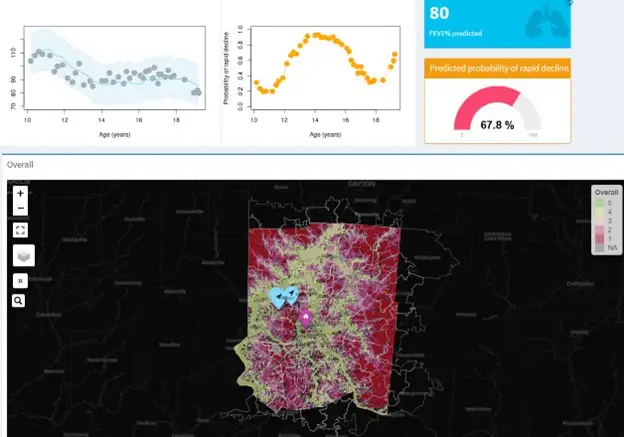
Experts at Cincinnati Children’s create a dashboard that can help clinicians and families of children with cystic fibrosis learn about their place-based risks.
Cystic fibrosis (CF) is well-known as an inherited genetic disease, but that’s only part of the story for understanding long-term lung health. It turns out that local environmental factors also play important roles.
“Every breath a person takes also carries the imprint of place—the streets, air, and neighborhoods that shape daily life. These local factors can leave measurable fingerprints on lung health, influencing who experiences faster decline and who stays stable for longer,” says Emrah Gecili, PhD, a member of the Division of Biostatistics and Epidemiology at Cincinnati Children’s.
Gecili and colleagues recently published a report in BMC Medical Informatics and Decision Making that details a dynamic prediction model that allows users to explore how predicted lung function and environmental risks vary across neighborhoods. The work uses an advanced “hypercube” model to address the complex variables involved in blending patient data and environmental information.
“This data-driven model does more than predict—it helps uncover which of many environmental and clinical factors truly matter,” Gecili says.
The researchers applied the hypercube framework to two large datasets: national registry data from more than 27,000 people with CF and a regional dataset from 152 children and teens treated at Cincinnati Children’s, where the team could link each participant’s exact home location to local environmental measures. The team also tested the model on simulated data to make sure it consistently finds the true drivers of disease progression even when predictors overlap.
The result: a public, interactive dashboard that brings the results to life.
This tool places the home address of a person with CF on a highly detailed county map built from data about air quality, tree cover, and other measures of health risk. Based on the person’s existing health status, the tool offers customized charts that predict the probability of rapid decline as the person with CF ages.
On one hand, an individual family might receive such information and decide to move, because the maps show that the environmental risk factors can vary significantly within even a single county.
On a wider scale, the maps also highlight locations that may need government-level interventions to reduce health risks—risks that may extend beyond the population coping with cystic fibrosis.
“Across all analyses, we saw the same signals resurfacing,” Gecili says. “Neighborhoods with denser road networks and heavier traffic showed faster lung function decline. Air pollutants such as ozone and fine particulate matter contributed to the pattern. In contrast, greener neighborhoods—those with more tree canopy and park space—appeared protective.”
Social factors also mattered. Communities with higher material deprivation and higher crime risk were linked to poorer lung outcomes. The level of spatial detail mattered, as well. “When we used exact residential addresses, subtle signals like tree canopy and local crime risk became visible, while analyses using ZIP-code summaries tended to highlight broader traffic-related patterns. The message is that precision of place data changes what we can see about disease risk,” Gecili says.
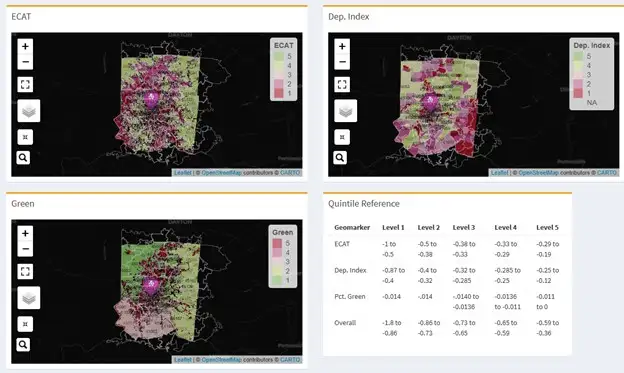
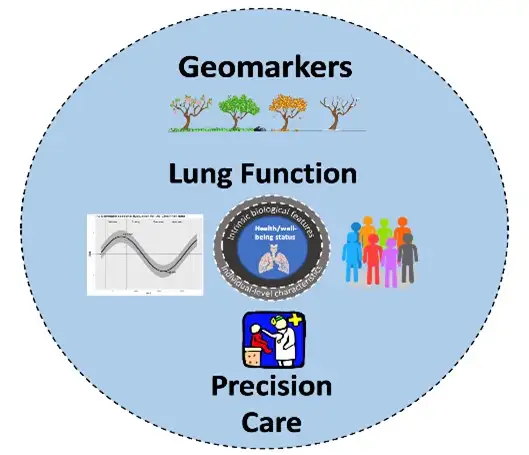
Looking forward, clinicians who incorporate geomarker indicators into patient dashboards could identify those who might benefit from closer monitoring.
For health systems and policymakers, the work underscores the potential of cleaner air, safer streets, and greener communities to make tangible differences in respiratory health.
In recent years, cystic fibrosis survival has been extended considerably with widespread use of CFTR modulator therapies. But this tool suggests that environmental exposures may help explain why some people still experience decline despite new treatments.
Next steps for this research include re-evaluating the prediction model using data that better reflects the uses of CFTR modulators. The team also is working to make the open-source hypercube tool available for other CF centers to explore.
“In the end, this study reminds us that precision medicine must also involve precision geography,” Gecili says. “Genes may set the stage, but the neighborhood helps script the story.”
About the Study
Cincinnati Children’s co-authors included first author Yizi Cheng, PhD, Cole Brokamp, PhD, Erika Rasnick Manning, MS, Elizabeth Kramer, MD, PhD, Patrick Ryan, PhD, MS, and Rhonda Szczesniak, PhD.
Funding sources for the study included the National Heart, Lung and Blood Institute (R01HL141286) and the Cystic Fibrosis Foundation (GECILI20F0, 005412A123, and STATNET KRAMER25Y7]).
Don’t Miss a Post:
- Subscribe to the Research Horizons Newsletter
- Follow Cincinnati Children’s Research Foundation on Bluesky, X and LinkedIn
| Original title: | Hypercubes to identify geomarkers of rapid cystic fibrosis lung disease progression |
| Published in: | BMC Medical Informatics and Decision Making |
| Publish date: | August 2025 |
Research By

I strive to build advanced prediction models incorporating clinical and demographic characteristics, omics and imaging as predictors of rapid disease progression.

Latest Posts

About this blog
The Research Horizons blog features news and insights about the latest discoveries and innovations developed by the scientists of Cincinnati Children's. This blog does not provide medical advice, diagnosis, or treatment. Email researchnews@cchmc.org with questions or ideas.
Subscribe to Our Newsletter