

A New Link Between Metabolism and Liver Inflammation
Research By: Kei Sawada, PhD | Senad Divanovic, PhD
Post Date: September 18, 2026 | Publish Date: September 16, 2026

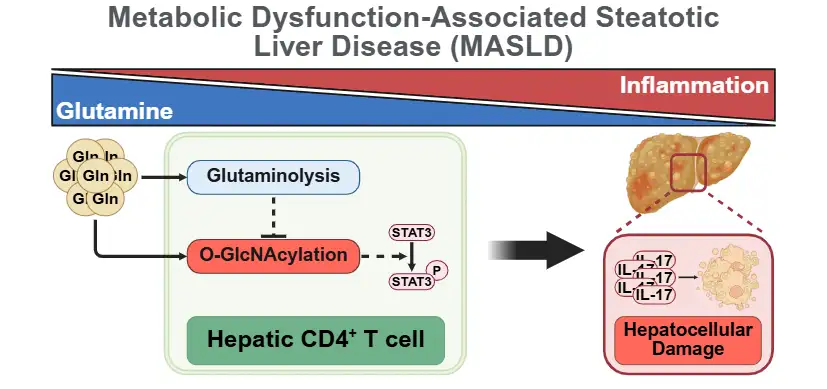
Researchers at Cincinnati Children’s identify glutamine as a key regulator of inflammatory T cells in MASLD
Metabolic dysfunction-associated steatotic liver disease (MASLD) affects nearly one-third of adults worldwide and is becoming increasingly common in children and adolescents. While researchers have uncovered many factors linked to the disease, they still do not fully understand why some people develop worsening liver inflammation and injury while others experience less severe disease.
A growing body of evidence suggests that changes in the liver’s metabolic environment can influence the immune system in ways that worsen disease. Now, a study published on Sept. 18, 2026 in Cell Metabolism identifies a previously unrecognized role for glutamine, an amino acid, in regulating immune activity in the liver. Researchers found that glutamine levels in the liver decline as MASLD becomes more severe, and that increasing hepatic glutamine levels reduced immune-driven liver injury across multiple experimental models of MASLD.
“The study shows that metabolic changes within diseased tissues are not simply a consequence of disease. They can actively influence the immune cells that drive inflammation,” says Senad Divanovic, PhD, corresponding author of the study. “Understanding that relationship could help researchers identify new ways to limit disease-promoting inflammation.”
The Intersection Of Immune Cells And Metabolism
MASLD is often viewed as a metabolic disease, but adaptation of immune cells to such environment also play an important role in determining disease progression. Previous research has shown that inflammatory CD4+ T cells are critical contributors to liver damage observed as MASLD becomes more severe. Although these immune cells help coordinate the body’s response to injury and infection, they can also adapt to metabolic stress to promote chronic inflammation that worsens tissue damage in diseases such as MASLD.
Like all cells, T cells rely on nutrients from their environment to fuel their activity. Changes in the availability and use of those nutrients can alter how cells function, including whether they adopt more inflammatory behaviors. Researchers have increasingly recognized that this relationship, known as immunometabolism, may be important in a range of diseases.
What remained unclear was whether and how metabolic changes within T cells specifically in the liver impact MASLD progression. In particular, researchers wanted to understand whether changes to how glutamine is utilized in hepatic CD4+ T cells may regulate their functions to ultimately worsen disease.
Lower Glutamine, Greater Liver Disease
The research team examined liver samples from adolescents living with MASLD alongside human liver organoids and multiple mouse models. Using these complementary systems, they tracked changes in glutamine levels and explored how those changes affect immune cell function.
One finding was remarkably consistent: glutamine levels declined as liver disease became more severe. Across all three systems, lower glutamine levels were associated with greater liver injury.
The researchers then focused on CD4+ T cells. They found that T cells isolated from diseased livers contained less glutamine than those from healthy livers, suggesting that changes in the liver environment may directly affect immune cell behavior.
“What stood out was how consistently glutamine depletion appeared across patient samples, mouse models and human organoids,” says Keisuke Sawada, first author of the study. “That suggested we were looking at something that was more than a marker of disease severity and led us to investigate how glutamine availability was affecting T cell function.”
To investigate whether restoring glutamine levels may reverse disease, the researchers then treated mice with MASLD with glutamine. Interestingly, glutamine supplementation was enough to decrease disease severity and T cell inflammatory behavior.
The findings also extended to human systems. CD4+ T cells from individuals with MASLD produced fewer inflammatory cytokines and caused less liver injury in human liver organoids when glutamine availability was increased.
Mode of Glutamine utilization Is Key
The team next explored what happens when T cells cannot properly process glutamine.
Their attention turned to glutaminolysis, a metabolic pathway that allows cells to use glutamine. The pathway appeared to act as a brake on inflammatory T cell activity. When the researchers disrupted GLS1, a key enzyme involved in glutaminolysis, T cells produced more inflammatory signals, such as IL-17, and caused greater liver damage.
Further experiments identified a role for O-GlcNAcylation, a protein modification involving glutamine that regulates cellular signaling. Impaired glutaminolysis led to increased O-GlcNAcylation and more inflammatory T cell responses. Blocking O-GlcNAcylation reversed many of those effects, revealing a molecular link between glutamine metabolism and liver inflammation.
Looking Ahead
The study adds to growing evidence that metabolism and immune function are closely connected in chronic disease. By identifying a mechanism linking glutamine availability to tissue-specific inflammatory T cell activity, the study provides new insight into how liver inflammation develops during MASLD progression.
Researchers are now investigating why glutamine levels decline in the liver and whether targeting this pathway could help limit harmful inflammation.
“Ultimately, the goal is to support development of therapies that specifically target disease-promoting immune responses while minimizing unintended effects on the broader immune system,” says Divanovic.
About the Study
Cell Metabolism also provided an editorial for this study.
Additional Cincinnati Children’s co-authors included members of the division of Immunobiology, Gastroenterology, Hepatology, and Nutrition, Allergy and Immunology, Biomedical Informatics, Pathology, and Pediatric General and Thoracic Surgery and the centers for Autoimmune Liver Disease, Inflammation and Tolerance, and Stem Cell & Organoid Medicine.
External co-authors included experts from the University of Cincinnati, University of Colorado Anschutz Medical Campus, the University of Chicago, the University of Osaka, and the Institute of Science Tokyo.
This study was supported by multiple grants from the National Institutes of Health, the U.S. Department of Defense, the American Diabetes Association, Cincinnati Children’s, the American Liver Foundation, the American Heart Association and the American Association for the Study of Liver Diseases Foundation.
Don’t Miss a Post:
- Subscribe to the Research Horizons Newsletter
- Follow Cincinnati Children’s Research Foundation on Bluesky, X and LinkedIn
| Original title: | Glutamine Metabolism as a Rheostat of CD4+ T cell Pathogenic Function in Metabolic Dysfunction-Associated Steatotic Liver Disease |
| Published in: | Cell Metabolism |
| Publish date: | September 16, 2026 |
Research By


Our research program focuses on the role of immune response in inflammation and metabolism.
Latest Posts


About this blog
The Research Horizons blog features news and insights about the latest discoveries and innovations developed by the scientists of Cincinnati Children's. This blog does not provide medical advice, diagnosis, or treatment. Email researchnews@cchmc.org with questions or ideas.
Subscribe to Our Newsletter