

Mobile Tool Shows Promise for Helping Teens Manage Type 1 Diabetes Stress
Research By: Avani Modi, PhD
Post Date: August 26, 2026 | Publish Date: August 2026

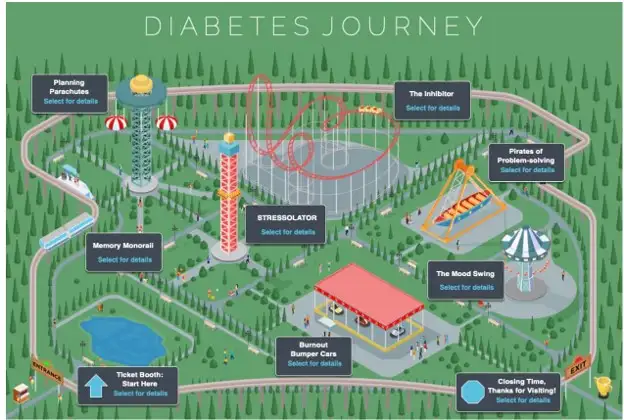
Pilot study suggests the Diabetes Journey intervention may help adolescents build self-management skills, with benefits lasting for months after treatment.
For teens with type 1 diabetes, managing their health is not simply knowing what to do—it is finding ways to keep doing it amid competing priorities.
Daily care requires constant attention to blood glucose, insulin dosing, meals, and more, all while juggling school schedules, sports, and social life. It’s a recipe for added stress and increased risk of health complications when life interferes with these important self-management behaviors.
Now, a multicenter pilot study led by researchers at Cincinnati Children’s reports positive results from a mobile health program called Diabetes Journey, which was designed to help reduce barriers tied to stress, burnout and time management. The study findings, published online May 22, 2026, also appeared in the August issue of The Journal of Pediatrics.
Diabetes Journey was designed to teach executive-function skills through problem-solving strategies. The mobile intervention is designed to present information via amusement park-themed modules.
Sessions focused on topics such as planning (Planning Parachutes module), working memory (Memory Monorail module), emotional control (Mood Swing module), inhibition (Inhibition Rollercoaster module), stress (Stressolator module) and burnout (Burnout Bumper Car module) as the person with diabetes navigates the rides in the virtual amusement park setting.
The comparison group received an enhanced standard of care program covering diabetes-related topics including education on burnout, shared responsibility, pain management, reminders, prioritizing, organization and eating.
For more information, read a Q&A interview at Healio with Dr. Modi
Less stress, but glucose outcomes are difficult to tackle
The trial enrolled 162 adolescents from three academic medical centers: Cincinnati Children’s, the University of Florida and the Barbara Davis Center for Diabetes at the University of Colorado. Participants were followed for nine months, with assessments at baseline, after treatment and at two follow-up points.
The recruitment rate reached 54.6%, exceeding the study team’s 40% goal. Overall retention was 87% at post-treatment and 78% at the first follow-up, both above the team’s 75% target, although retention declined to 62% by the final follow-up.
Teens assigned to Diabetes Journey reported greater perceived gains in self-management skills than those receiving enhanced standard of care at the first follow-up. Caregivers also reported strong satisfaction with the program.
As hypothesized by the study team, some benefits appeared later rather than immediately. After six months of treatment, adolescents in the Diabetes Journey group showed lower diabetes-related stress and burnout and better type 1 diabetes-related quality of life.
“It can be very challenging for adolescents to think about long-term risks,” says Avani Modi, PhD, Director, Division of Behavioral Medicine and Clinical Psychology, and lead author of the study. “This is why diabetes psychologists strive to work with teens to identify short-term, achievable goals for their diabetes management. We were pleased to see a high rate of teens in this pilot study using the Diabetes Journey tool because gradually increasing management skills and strategies over time supports longer-term positive outcomes.”
In addition to Modi, the study included five co-authors from Cincinnati Children’s and collaboration with experts at four other institutions.
Also as expected, neither group of participants showed statistically significant improvements in HbA1c, a common measure of average blood glucose levels. Behavioral interventions rarely show clear impact on HbA1C testing, which is why co-authors did not include it as a primary outcome.
Why addressing stress matters
Many diabetes interventions focus on education, devices or glucose outcomes. This study adds to a growing understanding that stress, burnout and everyday planning demands can shape how well adolescents are able to manage type 1 diabetes.
“Feelings of frustration, burnout, or distress are common for teens with type 1 diabetes,” Modi says. “Acknowledging and normalizing these feelings and barriers is essential.”
Notably, the Diabetes Journey intervention demonstrated a possible “sleeper” effect, in which skills learned during the intervention may take time to consolidate and become useful in daily life. Longer follow-up will be needed to determine whether those gains persist
“For some teens, diabetes management improves as they transition into young adulthood and adulthood. For many others, diabetes management remains a consistent challenge,” Modi says. “If the management benefits suggested in this pilot study continue, perhaps they will translate into broader health benefits.”
Next steps
The authors note that the findings should be considered preliminary.
The trial took place during the COVID-19 pandemic, which may have affected stress levels, caregiver involvement, clinic visits and participant retention. Also, compared to national norms, the study population had better HbA1c levels and had limited racial and ethnic diversity.
Looking ahead, if funding allows, researchers hope to refine the Diabetes Journey intervention and re-test it in a larger clinical trial.
About the study
In addition to Modi, co-authors from Cincinnati Children’s include Sarah Corathers, MD, Laura Smith, PhD, Desireé Williford, PhD, MPH, Erin Flynn, BA, and Constance Mara, PhD. Co-authors also included experts with the University of Colorado Anschutz Medical Campus, the University of Georgia, the University of Windsor (Canada), and the University of Florida.
Educational content used in the study was donated at no cost by Diabetes Toolkit, Inc., a 501(c)3 diabetes education nonprofit organization. Funding included a grant from the National Institute of Diabetes and Digestive and Kidney Diseases (R01DK121295).
Don’t Miss a Post:
- Subscribe to the Research Horizons Newsletter
- Follow Cincinnati Children’s Research Foundation on Bluesky, X and LinkedIn
| Original title: | A Pilot Randomized Controlled Clinical Trial to Improve Adherence Barriers for Adolescents with Type 1 Diabetes |
| Published in: | Journal of Pediatrics |
| Publish date: | August 2026 |
Research By

My research lab focuses on adherence to pediatric medical regimens, including the measurement of adherence, identification of adherence barriers, and the development and testing of adherence interventions.

Latest Posts


About this blog
The Research Horizons blog features news and insights about the latest discoveries and innovations developed by the scientists of Cincinnati Children's. This blog does not provide medical advice, diagnosis, or treatment. Email researchnews@cchmc.org with questions or ideas.
Subscribe to Our Newsletter