

Starvation Triggers Unexpected Gene Activation in Fibroblasts
Research By: Kohta Ikegami, PhD
Post Date: July 22, 2025 | Publish Date: July 22, 2025

Heart Institute: Molecular Cardiovascular Biology | Top Scientific Achievement

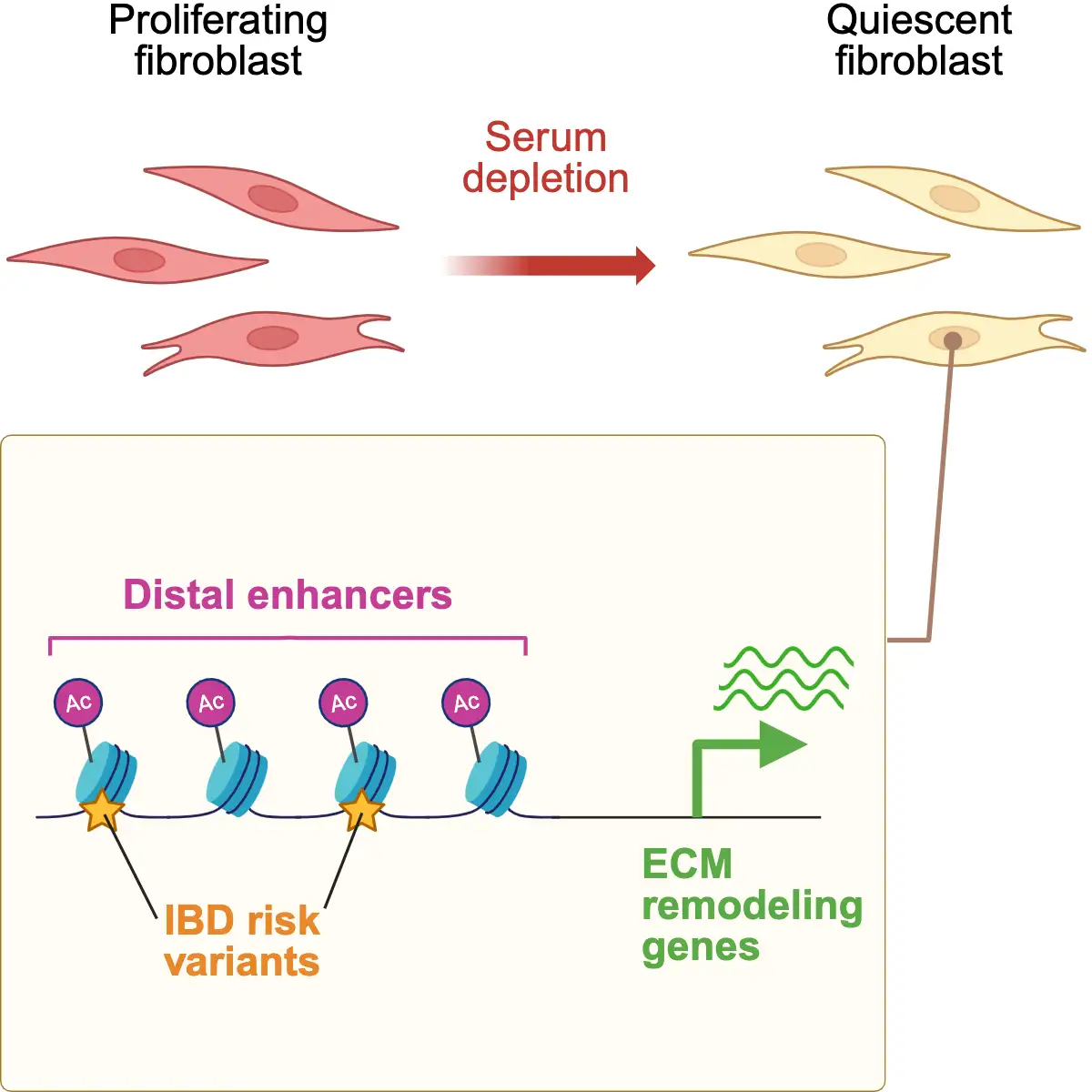
When food runs low, many experts have assumed that the mechanisms driving cell function also slow down. However, new findings indicate that nutrient and growth factor starvation paradoxically activates a broad program of gene transcription linked to extracellular matrix (ECM) remodeling.
Instead of going silent, research published in July 2025 in Cell Reports shows that fibroblasts under serum starvation remain metabolically active, upregulating ECM-related genes by activating genetic ON/OFF switches, called “enhancers.” Notably, many of these enhancers are associated with genetic variants linked to inflammatory bowel disease (IBD).
“Our work overturns the dogma that quiescent cells are transcriptionally silent. By showing that starvation activates ECM-remodeling genes, we open new avenues for understanding disease mechanisms in pathological microenvironments such as tumors and sites of chronic inflammation, where nutrients can be deprived,” says corresponding author Kohta Ikegami, PhD.
Strikingly, starvation-activated enhancer sites were enriched for genetic variants associated with inflammatory bowel disease (IBD), including Crohn’s disease and ulcerative colitis. Using a variety of advanced analytic tools, the study identifies a specific IBD risk variant (at rs2461864) within a starvation active enhancer.
“The enrichment of IBD-associated variants suggests that alteration in the ECM-remodeling gene regulatory network ––potentially due to nutrient or growth factor deprivation–– may contribute to IBD pathogenesis,” Ikegami says. “This warrants further investigation.”
Looking forward, the research team aims to investigate protein-level changes in ECM composition and to analyze how these mechanisms operate across other cell types and disease states. Eventually, these findings could suggest new strategies for treating IBD, fibrosis, tumors, and other conditions.
About the study
Cincinnati Children’s co-authors included Xiaoting Chen, PhD, Melanie Gucwa, PhD, Lee Denson, MD, Emily Miraldi, PhD, and Matthew Weirauch, PhD. Co-authors also included experts from the University of Chicago, and Lund University (Sweden).
Funding sources for this work included grants from the NIH (R21/R33 AG054770, R21HG012423, U24HG013078, R01AI148276, P30AR070549, R01HG010730, U01AI150748, R01AI153442, R01AI173314, R01AI148276, R01DK135479, and P30DK078392); and support from the Cincinnati Children’s Research Foundation the Cincinnati Children’s Center for Pediatric Genomics.
Explore the 2025 Research Annual Report
Don’t Miss a Post:
- Subscribe to the Research Horizons Newsletter
- Follow Cincinnati Children’s Research Foundation on Bluesky, X and LinkedIn
| Original title: | Starvation activates ECM-remodeling gene transcription and putative enhancers in fibroblasts despite inducing quiescence |
| Published in: | Cell Reports |
| Publish date: | July 22, 2025 |
Research By

The Ikegami lab investigates mechanisms of gene regulation, chromosome organization, nuclear envelope functions, cardiovascular diseases, and age-associated diseases.


Latest Posts
About this blog
The Research Horizons blog features news and insights about the latest discoveries and innovations developed by the scientists of Cincinnati Children's. This blog does not provide medical advice, diagnosis, or treatment. Email researchnews@cchmc.org with questions or ideas.
Subscribe to Our Newsletter