

Splicing Dysregulation Reveals New Therapeutic Targets in AML
Research By: Nathan Salomonis, PhD | H. Leighton “Lee” Grimes, PhD | Daniel Starczynowski, PhD
Post Date: May 7, 2025 | Publish Date: May 7, 2025

Biomedical Informatics | Top Scientific Achievement

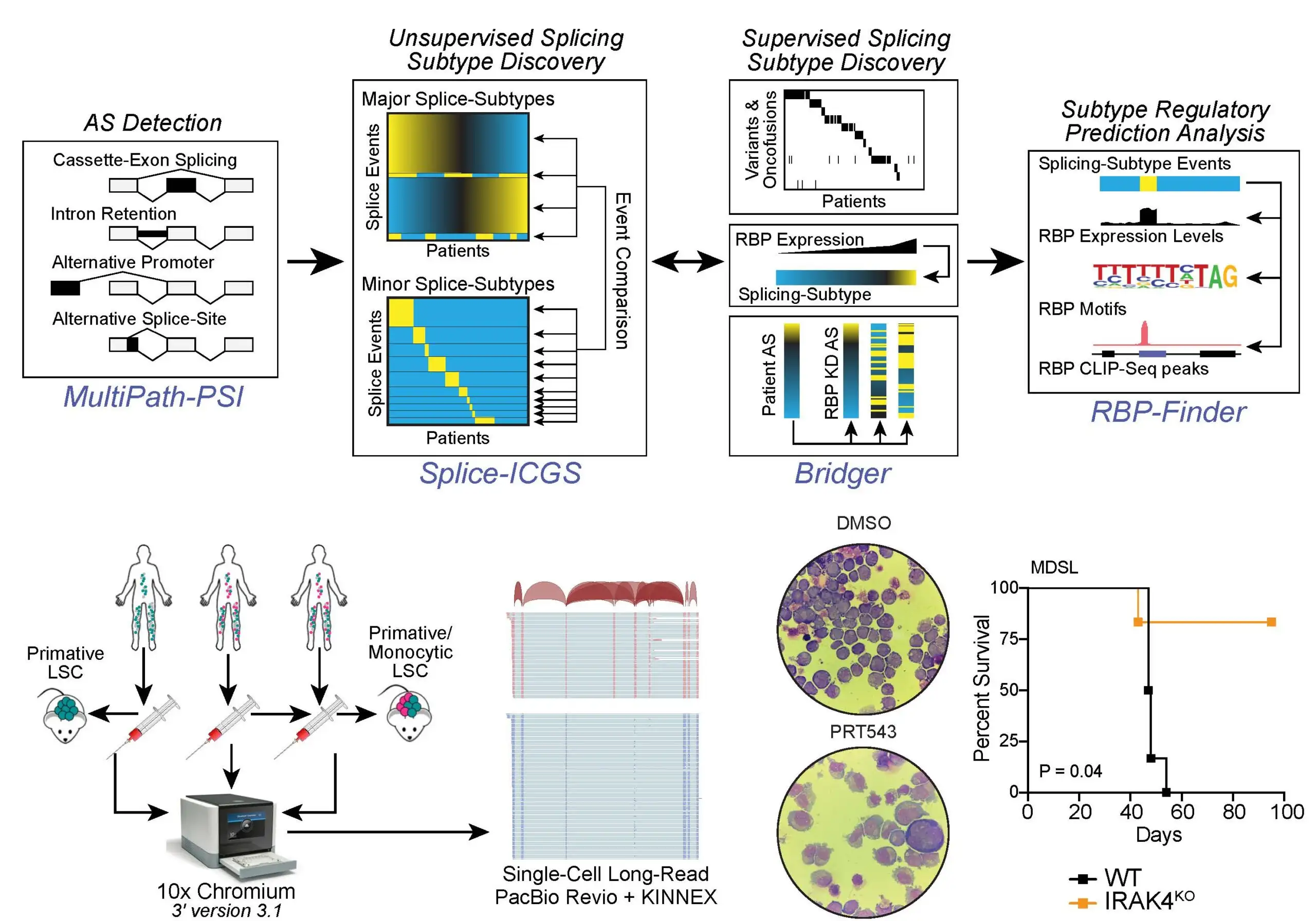
Broad dysregulated splicing in acute myeloid leukemia (AML) can mimic the effects of splicing factor mutations, serving as a prognostic marker and offering new avenues for pharmacological intervention, according to findings published in May 2025 in Science Translational Medicine.
Alternative splicing, a process that increases mRNA and protein diversity, is often altered in cancer, leading to different proteins that drive disease progression and resistance to therapy. The study identifies coordinated splicing events—particularly involving the gene IRAK4—as key mediators in both adult and pediatric AML, independent of direct splicing mutations. To validate their findings, the authors used an innovative single-cell isoform sequencing approach called KINNEX, and collaborated with Prelude Therapeutics to treat AML cells with a splicing inhibitor that partially reversed leukemic splicing. The findings suggest that targeting splicing pathways could improve risk stratification and treatment outcomes for AML patients.
Meenakshi Venkatasubramanian, PhD, Division of Biomedical Informatics at Cincinnati Children’s, along with Leya Schwartz, PhD, and Nandini Ramachandra, PhD, both from the Montefiore Einstein Comprehensive Cancer Center were co-first authors. Nathan Salomonis, PhD, H. Leighton Grimes, PhD, and Daniel Starczynowski, PhD, all with Cincinnati Children’s, served as co-corresponding authors along with Amit Verma, PhD, from the Montefiore Einstein Comprehensive Cancer Center.
“This research highlights how splicing patterns can reveal disease subtypes and therapeutic vulnerabilities that traditional genetic profiling may miss,” Salomonis says.
Next steps include refining models of splicing dysregulation in cell culture and animal studies to better evaluate potential therapies. The team also aims to confirm the role of circadian gene regulation of splicing and to explore the efficacy of PRMT5 and IRAK4 inhibitors in pre-clinical and clinical settings.
About the study
Cincinnati Children’s co-authors also included Joshua Bennett, PhD, Krithika Subramanian, PhD, Xiaoting Chen, PhD, Kashish Chetal, PhD, Aishwarya Kulkarni, PhD, Kasiani Myers, MD, and Matthew Weirauch, PhD. These Cincinnati Children’s core facilities also contributed: Comprehensive Rodent and Radiation Facility, Flow Cytometry, and the Comprehensive Mouse Core.
About the Study
Experts from these institutions also collaborated: University of Cincinnati, Montefiore Comprehensive Cancer Center, Albert Einstein College of Medicine, Prelude Therapeutics, and Pacific Biosciences.
Funding sources included 10 grants from the National Institutes of Health (R01 CA226802, R01 NS099068, R01CA275007, R35HL135787, U54 DK126108, R01 CA253981, U24 HG013078, P30 AR070549, R01 GM108646, and R35 HL135787).
Explore the 2025 Research Annual Report
Don’t Miss a Post:
- Subscribe to the Research Horizons Newsletter
- Follow Cincinnati Children’s Research Foundation on Bluesky, X and LinkedIn
| Original title: | Splicing regulatory dynamics for precision analysis and treatment of heterogeneous leukemias |
| Published in: | Science Translational Medicine |
| Publish date: | May 7, 2025 |
Research By

Our current work aims to integrate diverse single-cell modalities (alternative splicing splicing, genetics, cell surface protein, cell states) using holistic new computational frameworks, to resolve clonal impacts in cancer.

The Grimes Lab at Cincinnati Children’s works on hematopoiesis, response to infection and molecular oncology, including mouse modeling of hematopoiesis, myelopoiesis, marrow failure syndromes including myelodysplastic syndromes (MDS) and severe congenital neutropenia (SCN) and acute myeloid leukemia (AML).

The Starczynowski Laboratory is interested in the molecular, cellular, and genetic basis of hematologic malignancies, with a specific focus on myelodysplastic syndromes (MDS) and acute myeloid leukemia (AML).
Latest Posts

About this blog
The Research Horizons blog features news and insights about the latest discoveries and innovations developed by the scientists of Cincinnati Children's. This blog does not provide medical advice, diagnosis, or treatment. Email researchnews@cchmc.org with questions or ideas.
Subscribe to Our Newsletter