

Gene Editing Strategy Shows Proof-of-Concept for Treating CF Variant
Research By: Patrick Harrison, PhD
Post Date: February 21, 2025 | Publish Date: Feb. 21, 2025

Pulmonary Medicine | Top Scientific Achievement

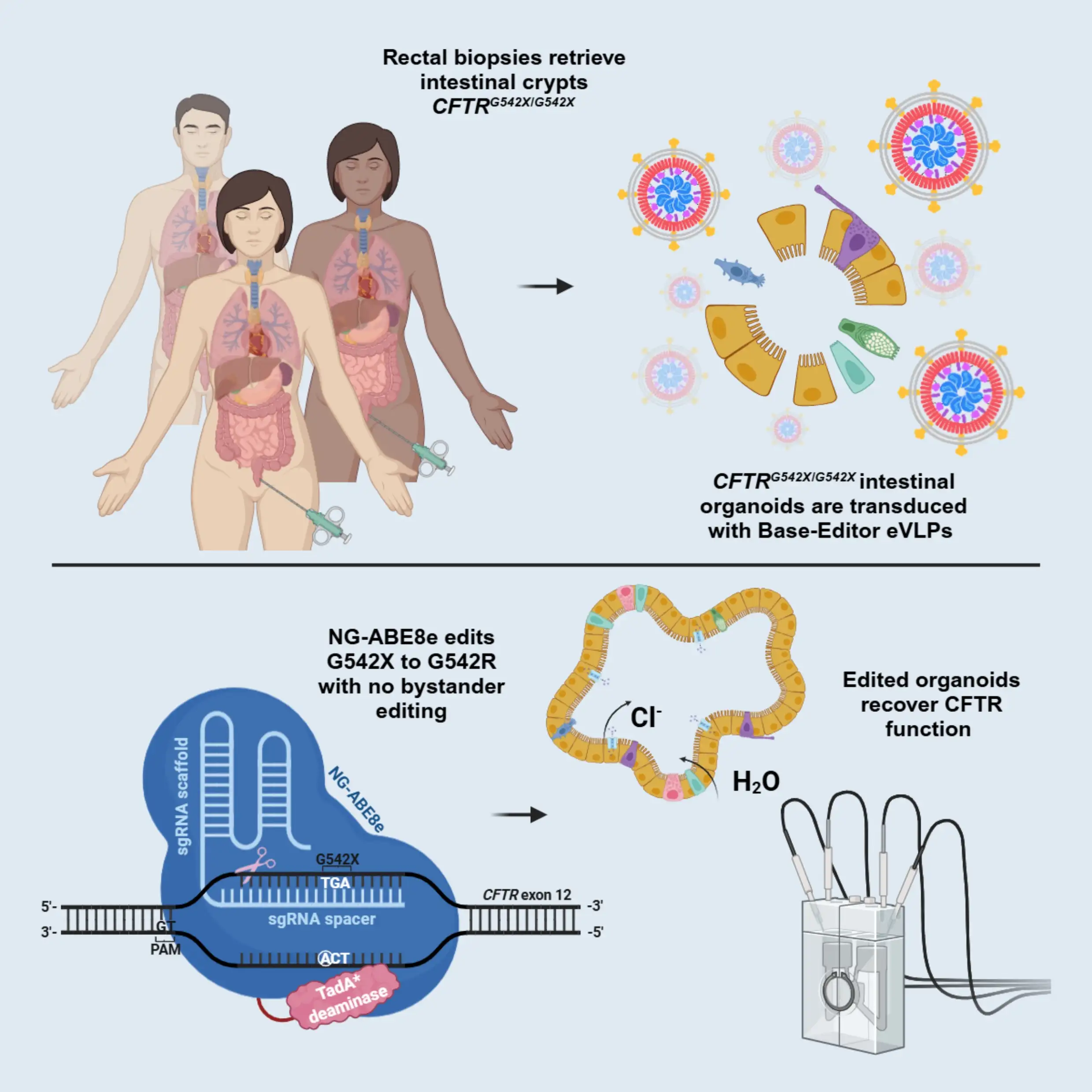
A multicenter study led by an expert at Cincinnati Children’s and collaborators in Ireland, France and Italy, demonstrates that gene editing can restore function to cells containing the second most common gene variant known to cause cystic fibrosis (CF).
The findings, published in February 2025 in iScience, detail how the research team used engineered virus-like particles to deliver a gene editing protein called ABE to convert the CF-causing variant G542X to a functional G542R protein in human intestinal organoid tissues.
Approximately 162,000 people across 94 countries are living with CF. While new drugs have emerged to help many people with a range of CF variants achieve better lung function by restoring ion transfer functions in critical cell types, the G542X variant does not respond to these therapies.
“Using base editor engineered virus-like particles (BE-eVLPs) in patient-derived intestinal organoids, we restored CFTR-mediated chloride transport to approximately 6.4% of wild-type levels,” says corresponding author Patrick Harrison, PhD, a member of the Division of Pulmonary Medicine. “This proof-of-principle study demonstrates the potential of base editing to rescue G542X and provides a foundation for future in-vivo applications.”
Unlike other methods of gene editing, base editing can generate precise single-nucleotide edits that do not involve double-strand breaks (DSBs). Base editing also does not require large packaging capacity for delivery, and it is highly efficient in both replicating and fully differentiated cells.
The international team of collaborators tested their approach in intestinal organoids that were derived from rectal biopsies of three donors with CF caused by the G542X variant. The treatment replaced the variant with an average editing efficiency of about 2% without any detected off-target effects.
“The key to research advances is cooperation between investigators,” Harrison says. “Our proposed strategy proved successful in the intestinal organoids derived from all three donors. We established that significant levels of CFTR function can be restored even at relatively modest levels of CFTR editing.”
Next steps include comparing the base editing approach in airway models and further dose-response studies. One goal is to make engineered virus-like particles that can target specific cell types of interest, which would be valuable for follow-up studies in animal models.
About the study
Collaborators on this study included experts from University College Cork (Ireland), the Institut Necker Enfants Malades and the Université Paris-Cité (France), the University of Verona (Italy) and the European Reference Network, ERN-Lung CF (Germany).
Funding sources included the CF Trust, the CF Foundation, and the Progetti di Rilevante Interesse Nazionale (PRIN).
Explore the 2025 Research Annual Report
Don’t Miss a Post:
- Subscribe to the Research Horizons Newsletter
- Follow Cincinnati Children’s Research Foundation on Bluesky, X and LinkedIn
| Original title: | Adenine base editing with engineered virus-like particles rescues the CFTR mutation G542X in patient-derived intestinal organoids |
| Published in: | iScience |
| Publish date: | Feb. 21, 2025 |


Latest Posts


About this blog
The Research Horizons blog features news and insights about the latest discoveries and innovations developed by the scientists of Cincinnati Children's. This blog does not provide medical advice, diagnosis, or treatment. Email researchnews@cchmc.org with questions or ideas.
Subscribe to Our Newsletter