

Fixation Device Improves Accuracy of EVD Placement
Research By: Francesco Mangano, DO, FACS, FAAP, FACOS
Post Date: December 18, 2024 | Publish Date: Dec. 18, 2024

Neurosurgery | Top Scientific Achievement

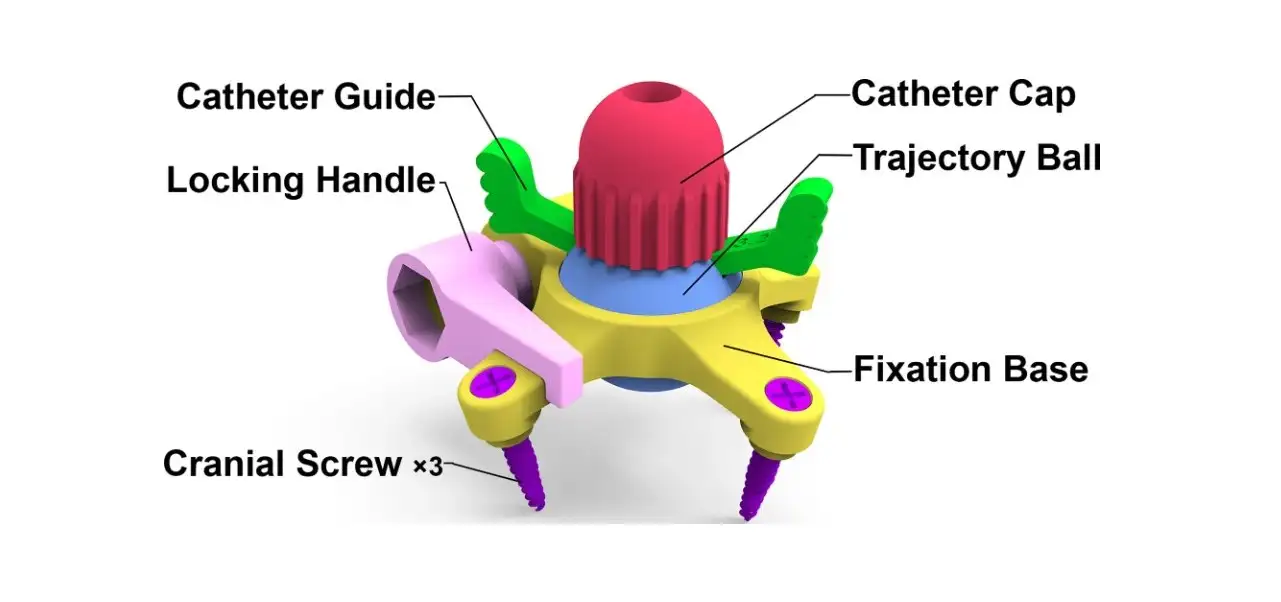
A novel minimally invasive cranial fixation device can improve the precision and safety of intraventricular catheter placement—an essential step when establishing external ventricular drains (EVDs).
An evaluation of the new device was published December 18, 2024, in Patient Safety in Surgery. Atai Daniel, a graduate student at Ben-Gurion University of the Negev, was first author and Francesco Mangano, DO, Director, Division of Neurosurgery at Cincinnati Children’s, was the corresponding author.
Surgeons place EVDs to reduce intracranial pressure for patients experiencing hydrocephalus, severe traumatic brain injury, subarachnoid hemorrhage, brain tumor, and infection. The study evaluated a 3D-printed device with titanium screws that was developed in collaboration with experts at Cincinnati Children’s and mechanical engineers at Ben-Gurion University of the Negev (Israel). Their goal: to reduce complication risks involved in EVD procedures.
“The ability to achieve accurate catheter placement with minimal invasiveness and strong fixation is a major step forward in neurosurgical safety and efficiency,” says Mangano.
The study involved testing animal models to study a variety of catheter entry trajectories. In all cases, the device reached the targeted ventricle and provided strong fixation even when skull thickness was limited. These results suggest that reduced reliance on freehand techniques and fewer placement‑related complications can be achieved.
Next steps include continued design refinement for broader neurosurgical applications, and evaluation of long‑term outcomes. Clinical trials to validate device performance in human patients will be forthcoming.
About the study
Cincinnati Children’s co‑authors also included Soner Duru, Jose Peiro, James Leach, and Carolyn Doerning. The Imaging Research Center and Neurosurgery Research Laboratory at Cincinnati Children’s also contributed. Experts from these institutions also collaborated: Ben‑Gurion University of the Negev (Israel) and the Jesús Usón Minimally Invasive Surgery Centre (Spain).
Explore the 2025 Research Annual Report
Don’t Miss a Post:
- Subscribe to the Research Horizons Newsletter
- Follow Cincinnati Children’s Research Foundation on Bluesky, X and LinkedIn
| Original title: | A novel minimally invasive neurosurgical cranial fixation device for improved accuracy of intraventricular catheter placement: an experimental animal study |
| Published in: | Patient Safety in Surgery |
| Publish date: | Dec. 18, 2024 |
Research By


Latest Posts


About this blog
The Research Horizons blog features news and insights about the latest discoveries and innovations developed by the scientists of Cincinnati Children's. This blog does not provide medical advice, diagnosis, or treatment. Email researchnews@cchmc.org with questions or ideas.
Subscribe to Our Newsletter