

Dupilumab Improves Outcomes for EoG in Phase 2 Clinical Trial
Research By: Marc Rothenberg, MD, PhD | Maurizio Macaluso, MD, DPH
Post Date: June 26, 2026 | Publish Date: June 23, 2026

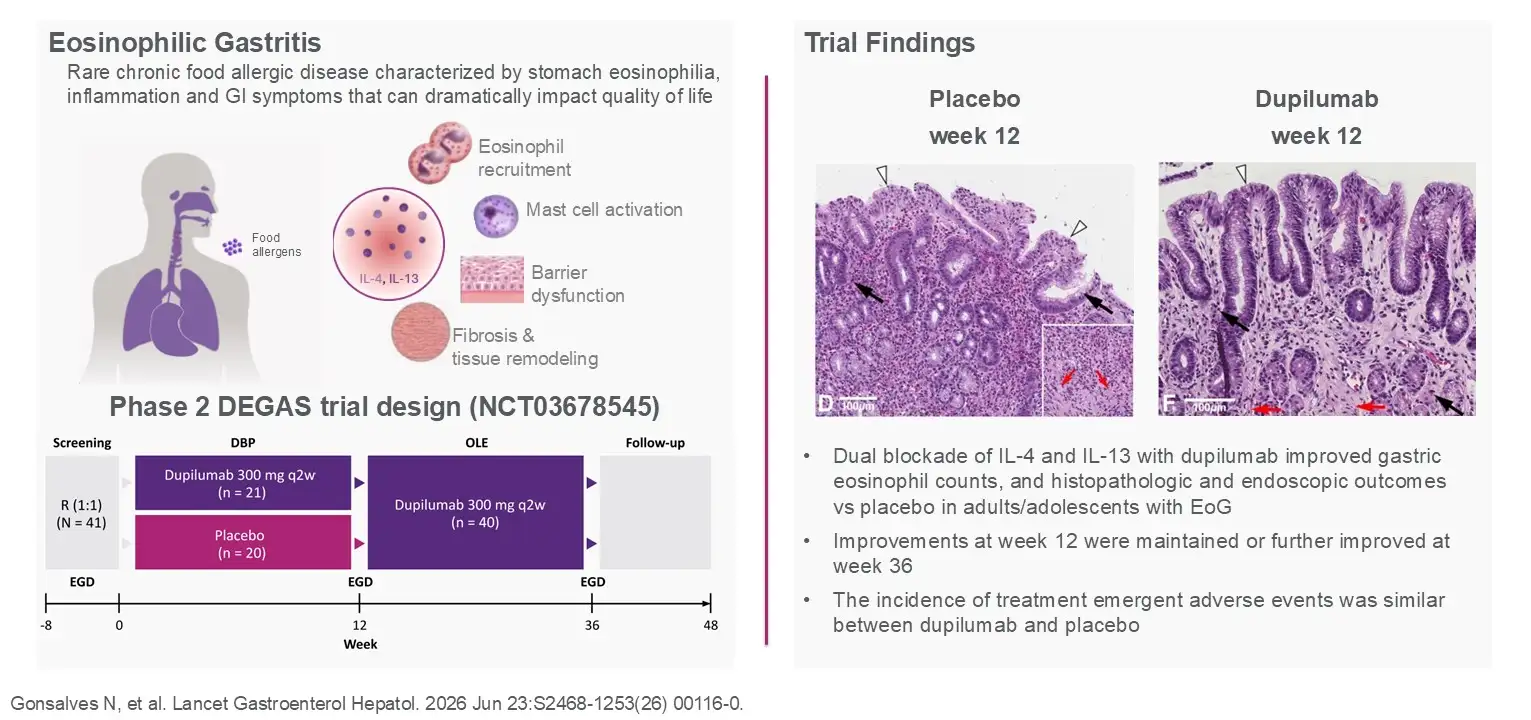
11-center CEGIR network study advances our understanding of eosinophilic gastritis — a rare inflammatory food allergic disease of the stomach — and potentially opens promising avenues for development of new therapeutic approaches.
When people have the rare disease eosinophilic gastritis (EoG), many common foods can trigger severe stomach reactions including dairy, wheat, gluten, egg, soy, fish and nuts. Flare-ups can strike with little warning, resulting in nausea, vomiting, abdominal pain and fatigue. Over time, chronic difficulty feeding can lead to poor growth, anemia and other problems.
Life with this condition typically involves skipping restaurants and trying to follow strict, life-long food-elimination diets. This symptom management approach has been the primary option for patients for years because so far, there are no approved medications to slow the inflammatory allergic response occurring in the stomach—a distinctive response marked by a surge in eosinophils (a type of white blood cell).
Now, a study published June 23, 2026 in The Lancet Gastroenterology & Hepatology reports significant improvements for people with EoG after receiving investigational treatment with the monoclonal antibody dupilumab. The phase 2 clinical trial, involving 41 teens and adults treated at 11 participating medical centers, was conducted by the Consortium of Eosinophilic Gastrointestinal Disease Researchers (CEGIR). The consortium, founded in 2014, is led by Marc Rothenberg, MD, PhD, director of the Division of Allergy and Immunology at Cincinnati Children’s.
The study represents a major step forward for potentially helping people with EoG while also illustrating the challenges involved with chasing cures for very rare diseases.
“For many rare diseases, the small numbers of people affected makes it extremely difficult for pharmaceutical companies to conduct the clinical studies needed to secure U.S. FDA approval,” Rothenberg says. “But for some conditions, investigational evaluation of an already-approved therapy in a new, relevant disease setting can become a vital pathway to improved outcomes. That’s what we are hoping for with EoG. Though no treatment is yet approved for EoG, this approach could potentially serve as a model to address EoG and even more of the 7,000+ rare diseases out there that still need effective treatments.”
Building on prior approvals
The Dupilumab Eosinophilic Gastritis Study (DEGAS)—a phase 2 trial conducted across 11 U.S. centers—evaluated dupilumab, a monoclonal antibody that stops signaling from interleukin‑4 and interleukin‑13—key cytokines involved in type 2 inflammation. It was first approved as a treatment for adult atopic dermatitis (eczema) in 2017. Since then, it also has been approved for eight more conditions—including eosinophilic esophagitis (EoE).
Rothenberg and colleagues with the CEGIR group were deeply involved in the studies that led to dupilumab’s initial approval for EoE in 2022, which was extended in 2024 to include children as young as 1 year old, weighing at least 15 kg.
The latest data estimate that up to 500,000 people in the U.S. may have EoE. The stomach disease EoG is about 10 times less common, occurring in an estimated 5 to 7 people in a population of 100,000.
Researchers and clinicians have long suspected that if dupilumab is effective in EoE, it may also have the potential to be effective in EoG and other eosinophilic conditions affecting the lower portions of the digestive tract (collectively called eosinophilic gastrointestinal diseases or EGIDs).
Key findings of the DEGAS clinical trial
The DEGAS study involved 41 teens and adults with EoG. Adolescents and adults with active EoG were randomly assigned to receive dupilumab or placebo for 12 weeks. After that, all participants received dupilumab during an open‑label extension.
Those who received the medication instead of a placebo during an initial 12-week test period showed improvements in objective measures, including reduced stomach eosinophil counts, improved results from endoscopy exams and improved scores on pathology of stomach tissue samples. These tissue‑level improvements continued through 36 weeks, which includes a period when all participants received the treatment during the extension. Importantly, these improvements were observed along with a safety profile consistent with prior studies of dupilumab.
“These findings are important because the study not only evaluated a potential treatment for EoG, but also improved our understanding of the biological processes that drive the disease,” says Nirmala Gonsalves, MD, an esophageal expert and Professor of Medicine at Northwestern University School of Medicine, Chicago, who served as co-lead author of the study with Evan Dellon, MD, MPH, a gastroenterology expert and Professor at University of North Carolina, Chapel Hill. “While this study focused on changes seen in stomach tissue, the results provide important groundwork for larger trials that can better assess symptoms and long-term effects,” Gonsalves says.
The co-authors say their findings merit taking further steps to seek FDA approval.
Looking Ahead
By confirming the role of type 2 immune signaling in EoG, the DEGAS trial helps clarify the focus for future research. The findings support continued study of targeted, immune-based approaches and raise questions about optimal dosing, treatment duration and how tissue‑level improvements relate to patient experience.
“Ongoing and future studies will be critical for building on this work and translating biological insight into more clearly defined treatment goals for EoG,” says Rothenberg.
The study was conducted as part of the Consortium of Eosinophilic Gastrointestinal Disease Researchers (CEGIR), a collaboration within the NIH‑supported Rare Diseases Clinical Research Network. By bringing together investigators with expertise in eosinophilic gastrointestinal diseases, the network supports rigorous, investigator‑initiated trials in rare conditions like EoG. This collaborative approach may help guide future research in other rare diseases and enables studies to be conducted more efficiently through shared research infrastructure.
About the Study
Cincinnati Children’s co-authors of the DEGAS study included Kara Kliewer, PhD, Tetsuo Shoda, MD, Regina Yearout, John Besse and Julie Caldwell, PhD, of the Division of Allergy and Immunology; Margaret Collins, MD, Department of Pathology and Laboratory Medicine; and Lisa Martin, PhD, Division of Human Genetics.
Co-authors also included experts from Northwestern University Feinberg School of Medicine, University of North Carolina School of Medicine, Rady Children’s Hospital, Nationwide Children’s Hospital, Icahn School of Medicine at Mount Sinai, National Institute of Allergy and Infectious Diseases, Baylor College of Medicine, University of Pennsylvania Perelman School of Medicine, University of Alabama at Birmingham, Vanderbilt University Medical Center, Columbia University Irving Medical Center, Boston Food Allergy Center, Children’s Hospital Colorado, University of Colorado School of Medicine, University of Utah, Ann and Robert H. Lurie Children’s Hospital of Chicago, Phoenix Children’s, Regeneron Pharmaceutical Inc., Sanofi and Mayo Clinic (Arizona).
The study was conducted as part of the Consortium of Eosinophilic Gastrointestinal Disease Researchers (CEGIR), a collaboration within the National Institutes of Health-supported Rare Diseases Clinical Research Network (RDCRN). CEGIR is supported by the National Institutes of Health through a collaboration between the National Center for Advancing Translational Sciences (NCATS), the National Institute of Allergy and Infectious Diseases (NIAID), and the National Institute of Diabetes and Digestive and Kidney Diseases (NIDDK) under grant number U54AI117804. Additional funding sources for the study included Regeneron Pharmaceutical Inc. and Sanofi.
Don’t Miss a Post:
- Subscribe to the Research Horizons Newsletter
- Follow Cincinnati Children’s Research Foundation on Bluesky, X and LinkedIn
| Original title: | Dupilumab Versus Placebo in Adults and Adolescents with Eosinophilic Gastritis: A Double-blind Placebo-controlled Phase 2 Multicentre Randomised Controlled Trial |
| Published in: | The Lancet Gastroenterology & Hepatology |
| Publish date: | June 23, 2026 |
Research By

The Rothenberg CURED Research Laboratory, supported by the Campaign Urging Research for Eosinophilic Diseases (CURED), is focused on elucidating the mechanisms of allergic responses, especially in mucosal tissues such as the gastrointestinal tract and lung.

Latest Posts


About this blog
The Research Horizons blog features news and insights about the latest discoveries and innovations developed by the scientists of Cincinnati Children's. This blog does not provide medical advice, diagnosis, or treatment. Email researchnews@cchmc.org with questions or ideas.
Subscribe to Our Newsletter