

Study Links Inflammation to Barrier Failure in EoE
Research By: Nurit Azouz, PhD | Marc Rothenberg, MD, PhD
Post Date: August 6, 2026 | Publish Date: April 28, 2026

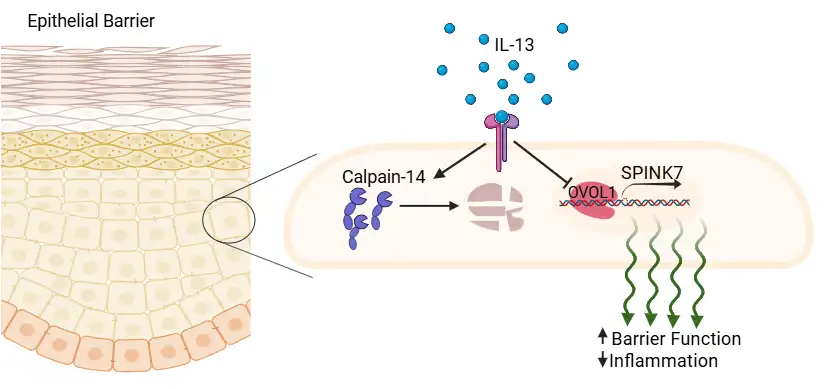
Researchers identified a pathway that helps explain barrier dysfunction in eosinophilic esophagitis, providing support for current therapies and highlighting potential future treatment targets
Many questions remain about why the esophageal lining breaks down in eosinophilic esophagitis (EoE), even as researchers have identified key inflammatory drivers of the disease. Clinicians and scientists know that barrier dysfunction plays a central role in allowing food antigens and inflammatory signals to penetrate the tissue. However, the molecular steps that connect inflammation to this barrier failure have not been fully defined.
In April 2026, researchers in the Division of Allergy and Immunology published a study in JCI Insight to help close that gap. Using laboratory models and patient samples, researchers identified a pathway linking the inflammatory protein IL-13 to reduced expression of SPINK7, a key regulator of epithelial barrier function. The findings show that IL-13 disrupts the activity of OVOL1, a protein that controls SPINK7 expression, providing new insight into how barrier dysfunction develops in EoE.
“The findings provide new insight into how inflammation contributes to barrier dysfunction in EoE by identifying a pathway that regulates epithelial barrier health,” says Allergy and Immunology’s Nurit Azouz, PhD, first and co-corresponding author of the study. “They also provide additional support for current treatment approaches while pointing to new opportunities for therapeutic development.”
How Barrier Function Breaks Down
The esophageal epithelium acts as both a physical barrier and an active participant in the immune response. In EoE, this barrier is weakened, allowing allergens and inflammatory mediators to interact more directly with underlying tissue.
SPINK7 has been recognized as an important regulator of epithelial barrier integrity. It helps maintain barrier function and protect tissue from excessive inflammation. Prior work has shown that SPINK7 is reduced in EoE, but the mechanisms controlling its expression have not been fully understood.
This study helps explain why SPINK7 levels are reduced in EoE. The researchers found that IL-13, an inflammatory protein linked to the disease, and calpain-14, an enzyme that is elevated in EoE, disrupt the function of OVOL1—a protein that helps regulate epithelial cell maturation and supports SPINK7 expression. When this pathway is disrupted, epithelial cells are less able to form and maintain a healthy barrier.
The research team used a combination of laboratory and clinical approaches to examine how this pathway operates, including:
- Biochemical assays to evaluate interactions among key proteins
- Experiments using esophageal epithelial cell models
- Analysis of tissue samples from patients with EoE
The researchers uncovered an important distinction between gene expression and protein function. The OVOL1 protein itself was altered by IL-13 and calpain-14. These changes impaired OVOL1’s ability to support SPINK7 expression, ultimately weakening the epithelial barrier.
“We found that the barrier function is governed by multiple layers of regulation, including gene expression and protein localization and stability, and that disruption at any of these levels can drive barrier breach and promote EoE,” says Azouz.
Together, the results provide a clearer picture of how inflammation contributes to damage in the esophageal lining.
Looking Ahead
The findings reinforce the rationale for targeting IL-4 and IL-13 signaling in EoE and provide additional support for therapies such as dupilumab. The study also identifies calpain-14 as a potential therapeutic target because of its role in OVOL1 dysfunction and reduced SPINK7 expression.
Future studies will explore ways to restore OVOL1 and SPINK7 activity, including through pathways that may be influenced by diet or the microbiome, while continuing to investigate how calpain-14 contributes to barrier dysfunction and inflammation.
“As we continue to learn more about the mechanisms that regulate OVOL1 and SPINK7, we may uncover new ways to restore barrier function and improve outcomes for people with EoE,” says Azouz.
About the Study
Marc Rothenberg, MD, was the senior and co-corresponding author of the study. Additional Cincinnati Children’s co-authors included members of the Division of Allergy and Immunology, the Division of Human Genetics and the Center for Autoimmune Genomics and Etiology.
Funding for the study was provided by National Institutes of Health grants (NIH R01 AI045898, U19 AI070235, R01 DK140127), the Cincinnati Children’s Hospital Medical Research Foundation, Campaign Urging Research for Eosinophilic Disease (CURED) and Sunshine Charitable Foundation and its supporters, Denise and David Bunning.
Don’t Miss a Post:
- Subscribe to the Research Horizons Newsletter
- Follow Cincinnati Children’s Research Foundation on Bluesky, X and LinkedIn
| Original title: | IL-13 and calpain-14 suppress the expression of SPINK7 by regulating OVOL1 in eosinophilic esophagitis |
| Published in: | JCI Insight |
| Publish date: | April 28, 2026 |
Research By


The Rothenberg CURED Research Laboratory, supported by the Campaign Urging Research for Eosinophilic Diseases (CURED), is focused on elucidating the mechanisms of allergic responses, especially in mucosal tissues such as the gastrointestinal tract and lung.
Latest Posts


About this blog
The Research Horizons blog features news and insights about the latest discoveries and innovations developed by the scientists of Cincinnati Children's. This blog does not provide medical advice, diagnosis, or treatment. Email researchnews@cchmc.org with questions or ideas.
Subscribe to Our Newsletter