

Deep Learning Halves MRI Breath-Hold Time
Research By: Amol Pednekar, PhD
Post Date: August 1, 2024 | Publish Date: August 2024

Radiology | Top Scientific Achievement

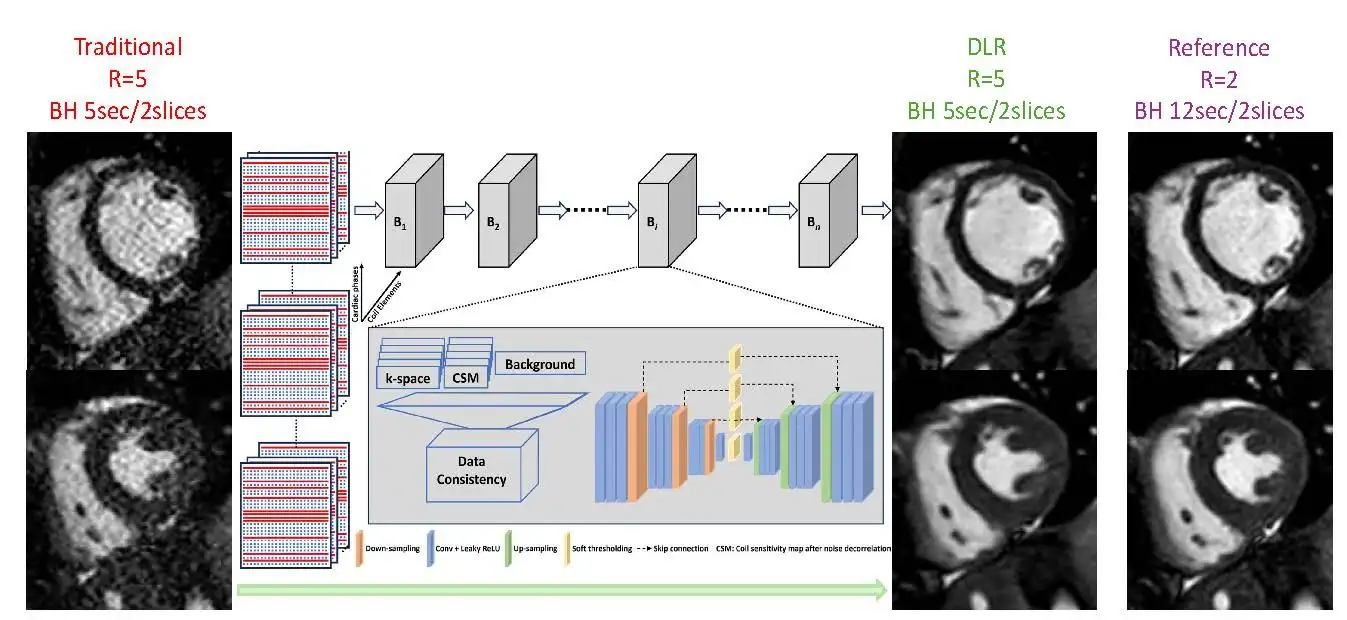
A deep learning computer algorithm can substantially shorten cardiac MRI scan times without compromising diagnostic precision, according to research led by experts at Cincinnati Children’s.
In a retrospective study of 15 adolescents with normal cardiac anatomy—published in August 2024 in the Journal of Magnetic Resonance Imaging—researchers evaluated a deep learning–based reconstruction (DLR) technique to accelerate cine balanced steady-state free precession (bSSFP) imaging.
For traditional cardiac MRI, patients hold their breath for multiple 10- to 12-second intervals—an especially difficult task for children and those with heart or lung conditions. By applying a DLR algorithm to undersampled MRI data, the team found that they could safely increase the acceleration factor (R) up to five—reducing breath-hold duration by 57%—while preserving clinically reliable image quality and accurately measuring heart function and volume.
“Reducing breath-hold duration directly improves patient comfort and scan success, particularly in children and others with limited breath-hold capacity,” says corresponding author Amol Pednekar, PhD. “What’s most encouraging is that deep learning can accelerate cine imaging substantially while maintaining the diagnostic fidelity clinicians depend on, ensuring comfort for patients and confidence for clinical decision-making.”
The study confirmed that DLR provided diagnostic image quality with only minor reductions in edge definition. These findings suggest deep learning reconstruction can be used in routine pediatric cardiac MRI, offering the potential to streamline workflows and expand access to advanced imaging for patients who cannot sustain long breath-holds.
The research team plans to extend this evaluation to patients with complex congenital heart disease and to test DLR performance in free-breathing and real-time MRI acquisitions.
About the study
Cincinnati Children’s co-authors also included Murat Kocaoglu, MD; Hui Wang, PhD; Aki Tanimoto, MD; Jean Tkach, PhD; Sean Lang, MD; and Michael Taylor, MD, PhD. Additional collaborators were from Philips.
Explore the 2025 Research Annual Report
Don’t Miss a Post:
- Subscribe to the Research Horizons Newsletter
- Follow Cincinnati Children’s Research Foundation on Bluesky, X and LinkedIn
| Original title: | Accelerated Cine Cardiac MRI Using Deep Learning-Based Reconstruction: A Systematic Evaluation |
| Published in: | Journal of Magnetic Resonance Imaging |
| Publish date: | August 2024 |

Latest Posts


About this blog
The Research Horizons blog features news and insights about the latest discoveries and innovations developed by the scientists of Cincinnati Children's. This blog does not provide medical advice, diagnosis, or treatment. Email researchnews@cchmc.org with questions or ideas.
Subscribe to Our Newsletter