

How Precision Dosing Became Part of Routine Pediatric Care
Research By: Tomoyuki Mizuno, PhD, FCP | Zachary Taylor, PhD, MS
Post Date: May 25, 2026 | Publish Date: May 21, 2026

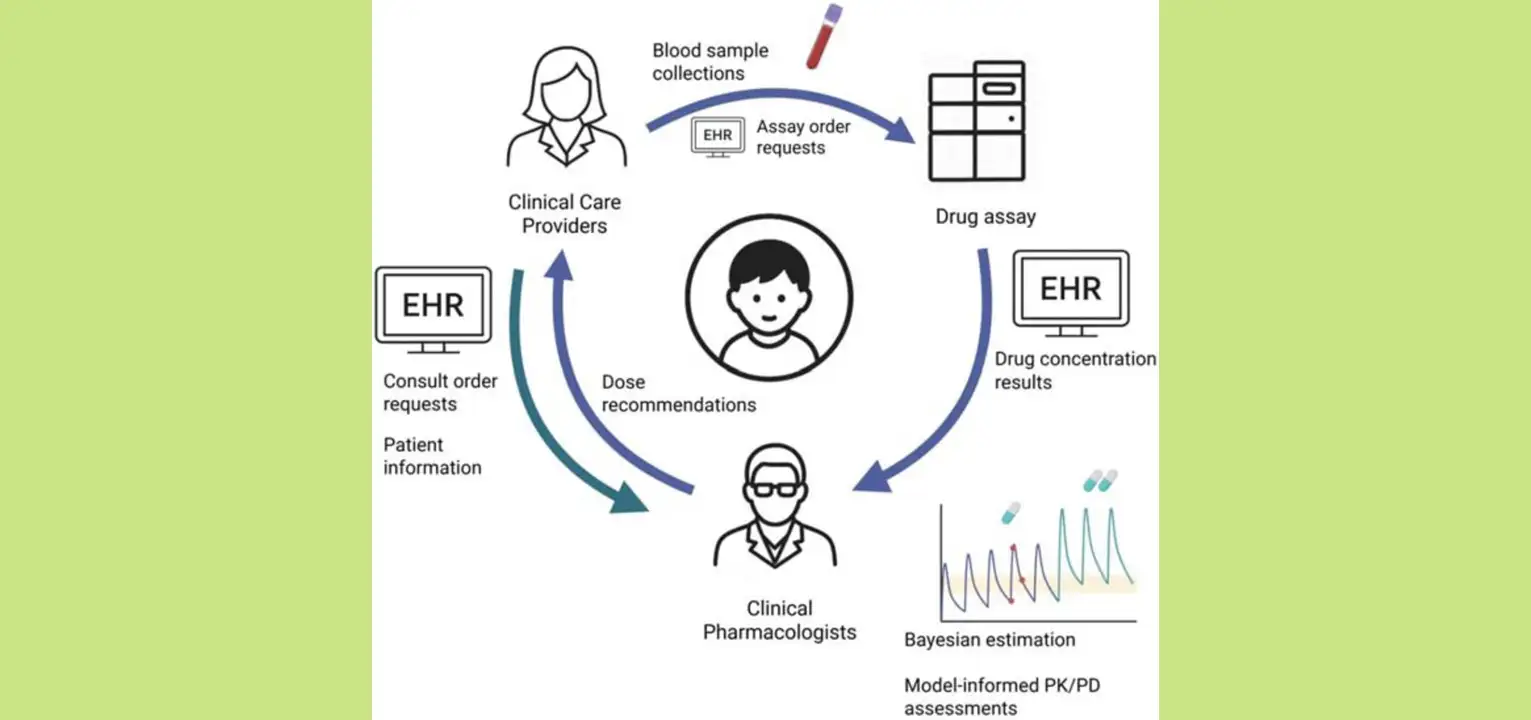
After more than two decades of implementation, a multidisciplinary team at Cincinnati Children’s identifies the four pillars needed to build a successful precision dosing program
Recommended pharmaceutical dosages often depend on general factors such as a patient’s age, weight or body mass. Children can vary greatly in how they absorb, process and respond to medications. These differences can affect both the safety and efficacy of treatment, especially for medications with a narrow therapeutic index.
One approach that addresses this challenge is model-informed precision dosing (MIPD), which combines population pharmacokinetic (PK) models with individual patient characteristics to identify personalized dosing recommendations. Rather than seeking to determine what dose a typical patient should receive, MIPD calculates the precise dose that is most likely to achieve the desired exposure and clinical effect for a particular patient.
In a study published in May 2026 in Clinical Pharmacology & Therapeutics, Tomoyuki Mizuno, PhD, FCP, and Zachary L. Taylor, PhD, MS, describe the implementation strategies that helped move MIPD from concept to clinical practice at Cincinnati Children’s.
“We want to show other institutions how successful this type of service can be and share key considerations for developing their own MIPD service,” says Taylor.
Bringing MIPD into Clinical Practice
While the science behind MIPD is well-established, implementing it in clinical settings often faces barriers. Cincinnati Children’s began implementing an MIPD consultation service in 2003. The program became an official clinical service between 2014 and 2016. Mizuno currently serves as director of the Clinical Pharmacokinetics Consultation Service at Cincinnati Children’s.
In the study, the team identified four critical pillars for successfully bringing MIPD into a hospital setting:
- Analytical capabilities for measuring drug concentrations quickly, while patients remain hospitalized.
- Clinical pharmacology expertise to interpret data.
- Clinician and pharmacist buy-in and engagement.
- Institutional support and funding.
To help establish MIPD as a clinical service, the team also increased physician education about MIPD and program visibility through pediatric grand rounds and interdivisional collaboration.
Impact Across Multiple Clinical Areas
Over time, MIPD supported individualized treatment across a range of conditions.
- Alemtuzumab monitoring helped more than 80% of stem-cell transplant patients achieve the target drug-concentration range, with approximately 60% requiring an additional dose
- Cefepime modeling helped clinicians optimize antibiotic exposure while balancing treatment efficacy and toxicity
- Individualized mycophenolic acid monitoring improved the assessment of total drug exposure in kidney and liver transplant patients
- Personalized infliximab dosing addressed persistently low drug concentrations in patients with Crohn’s disease
- Precision dosing helped patients reach their maximum tolerated dose of hydroxyurea faster
Expanding Precision Dosing Across the Health System
At Cincinnati Children’s, MIPD services have expanded beyond bedside consultations to automated digital tools that extend the reach and impact of MIPD across medical specialties, including:
- The NeoRelief, an EHR-integrated precision dosing dashboard for individualized morphine dosing in neonates.
- The RoadMAB™ dashboard for physician-driven precision dosing of inflammatory bowel disease medications.
- The MTXPK.org website, a specialized tool that facilitates model-informed decision making to guide supportive care interventions and glucarpidase use for patients receiving high-dose methotrexate for malignant conditions.
Today, the MIPD consulting team collaborates with physicians, pharmacists, pharmacologists and a range of pediatric healthcare providers across a broad range of clinical divisions at Cincinnati Children’s. Ongoing collaboration will support efforts to expand the roster of medications available for modeling via MIPD and further improve patient outcomes through the implementation of precision dosing.
Mizuno and Taylor encourage providers who are interested in championing MIPD interdepartmentally to contact them directly.
About the Study
Takanobu Nadai, Kei Irie, Wen Rui Tan, Sanjana Parikh, Anhar Hosawi, Matthijs W. van Hoogdalem, Ronaldo Morales Junior, Sonya Tang Girdwood, Abbie D. Leino, Kana Mizuno, Alexander A. Vinks
This study was supported in part by the Cincinnati Children’s Research Foundation and the Crohn’s and Colitis Foundation. The authors gratefully acknowledge their clinical collaborators for helping establish and sustain the MIPD services and for continuing to integrate MIPD into clinical practice and clinical trials.
Don’t Miss a Post:
- Subscribe to the Research Horizons Newsletter
- Follow Cincinnati Children’s Research Foundation on Bluesky, X and LinkedIn
| Original title: | Clinical Model-Informed Precision Dosing Consult Service for Accelerating Personalized Medication in Pediatric Patients |
| Published in: | Clinical Pharmacology & Therapeutics |
| Publish date: | May 21, 2026 |



Latest Posts
About this blog
The Research Horizons blog features news and insights about the latest discoveries and innovations developed by the scientists of Cincinnati Children's. This blog does not provide medical advice, diagnosis, or treatment. Email researchnews@cchmc.org with questions or ideas.
Subscribe to Our Newsletter