

MRI Tech Helps ID Preemies Most in Need of PDA Closure
Research By: Paul Critser, MD, PhD
Post Date: August 5, 2024 | Publish Date: August 2024

Heart Institute: Cardiology | Top Scientific Achievement

Thousands of preterm infants are born every year with a condition called persistent patent ductus arteriosus (PDA), which occurs when a temporary fetal blood vessel connecting the aorta and pulmonary artery fails to close shortly after birth.
In many cases this extra vessel ultimately closes on its own, which has led to a running debate among experts about which newborns need treatment and when. Now researchers at Cincinnati Children’s have used advanced MRI techniques to identify a group of preterm infants that appear most likely to benefit from prompt intervention.
Their findings, led by first author Kurt Bjorkman, MD, and corresponding author Paul Critser, MD, PhD, were published in August 2024 in the American Journal of Respiratory and Critical Care Medicine. Their analysis reveals that for infants with bronchopulmonary dysplasia associated pulmonary hypertension (BPD–PH) the longer a PDA remains open the higher the risk of mortality for some and of changes in lung structure for survivors.
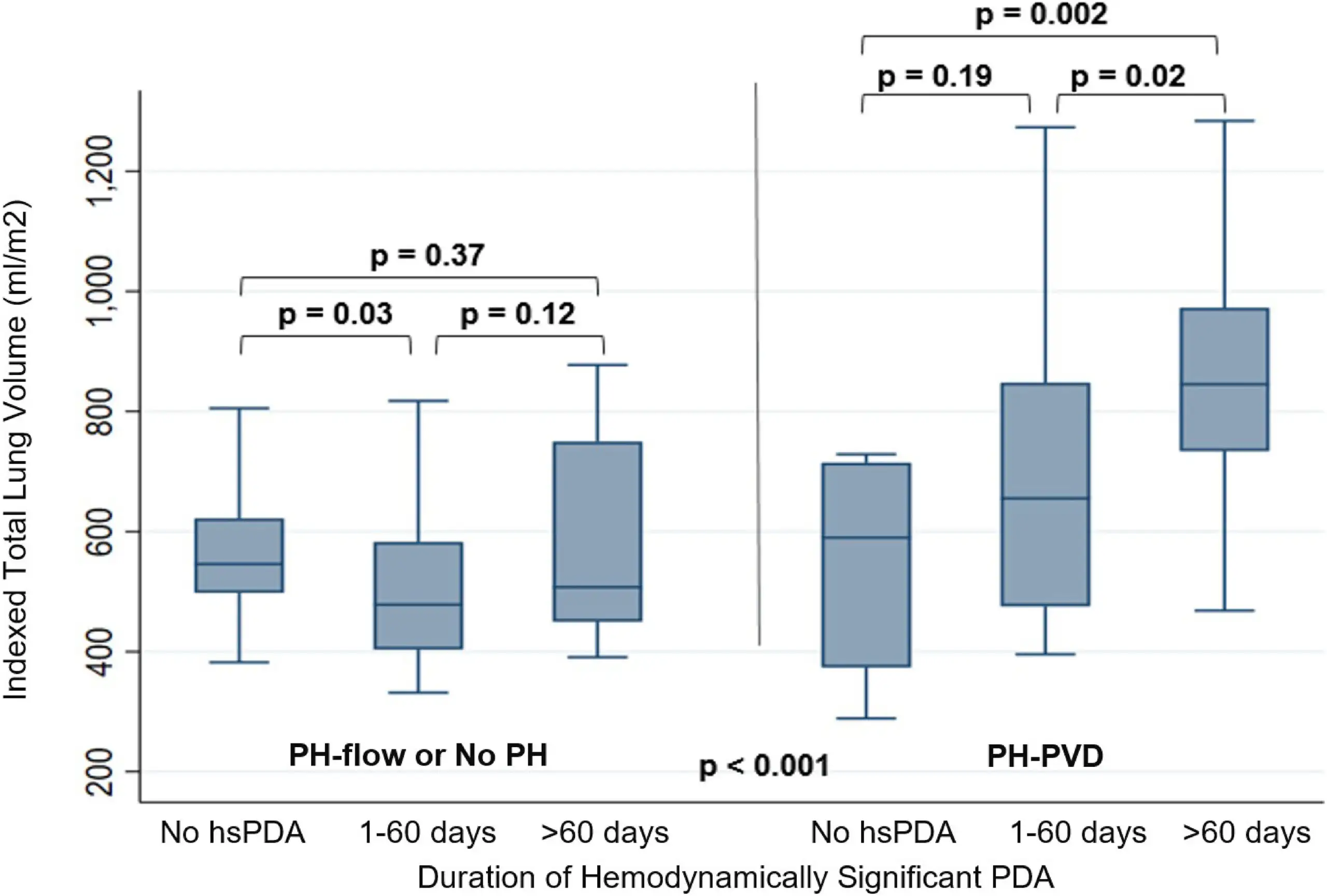
Typically, clinicians use echocardiography to detect and monitor PDA. In this study, researchers used MRI to gather key measures of lung structure and function for 133 infants diagnosed with BPD, most of whom also had a PDA. The testing involved using an MRI within the neonatal intensive care unit developed with input from experts at Cincinnati Children’s.
Whenever a PDA was present, infants with BPD-PH consistently had elevated total lung volume (TLVI)—a key measure of air trapping and overinflation of the lungs. TLVI was highest when infants were exposed to “hemodynamically significant” PDA (hsPDA) for more than 60 days.
These findings are important because the overall trend in treating PDA has been toward delaying interventions.
“This is the first study in the BPD population to show that demonstrable advanced pulmonary alterations on imaging are associated with a prolonged exposure to hsPDA,” Critser says. “As the debate about indications and timing of PDA closure continues, the pulmonary consequences of prolonged hsPDA exposure in the most at-risk infants must be considered. Further study is necessary to determine if definitive hsPDA closure before 60 days could improve outcomes.”
Other experts agreed in an accompanying editorial about the findings, written by Eduardo Villamor, MD, PhD, of the Maastricht University Medical Centre (Netherlands), and Gema Gonzalez-Luis, MD, PhD, of the Hospital Universitario Materno-Infantil de Canarias (Spain).
“The data from Bjorkman and colleagues confirm that PDA is not an ‘innocent bystander,’ at least for a subset of extremely preterm infants,” they write. “Therefore, another goal of personalized neonatology would be to identify those preterm infants who will not have a late PDA closure or who will have significant cardiopulmonary injury by the time the PDA closes. These are the infants who would benefit from definitive PDA closure by surgery or catheter occlusion.”
About the study
Cincinnati Children’s co-authors included, Kimberley Miles, MD, Laura Bellew, MSN, RN, CPN, Kristin Schneider, MD, S. Melissa Magness, MSN, APRN, CNP‑AC, Nara Higano, PhD, Nicholas Ollberding, PhD, Hoyos Cordon, MSc, BS, Russel Hirsch, MBChB, Erik Hysinger, MD, MS, and Jason Woods, PhD.
Funding sources for this study included NHLBI grants( R01 HL 164420 and R01 HL 1446689) and the Parker B. Francis Fellowship Program.
Explore the 2025 Research Annual Report
Don’t Miss a Post:
- Subscribe to the Research Horizons Newsletter
- Follow Cincinnati Children’s Research Foundation on Bluesky, X and LinkedIn
| Original title: | Patent Ductus Arteriosus and Lung Magnetic Resonance Imaging Phenotype in Moderate and Severe Bronchopulmonary Dysplasia–Pulmonary Hypertension |
| Published in: | American Journal of Respiratory and Critical Care Medicine |
| Publish date: | August 2024 |

Latest Posts


About this blog
The Research Horizons blog features news and insights about the latest discoveries and innovations developed by the scientists of Cincinnati Children's. This blog does not provide medical advice, diagnosis, or treatment. Email researchnews@cchmc.org with questions or ideas.
Subscribe to Our Newsletter