

The Esophagus: More Than Just a Food Conduit
Research By: Marc Rothenberg, MD, PhD
Post Date: July 17, 2025 | Publish Date: June 18, 2025

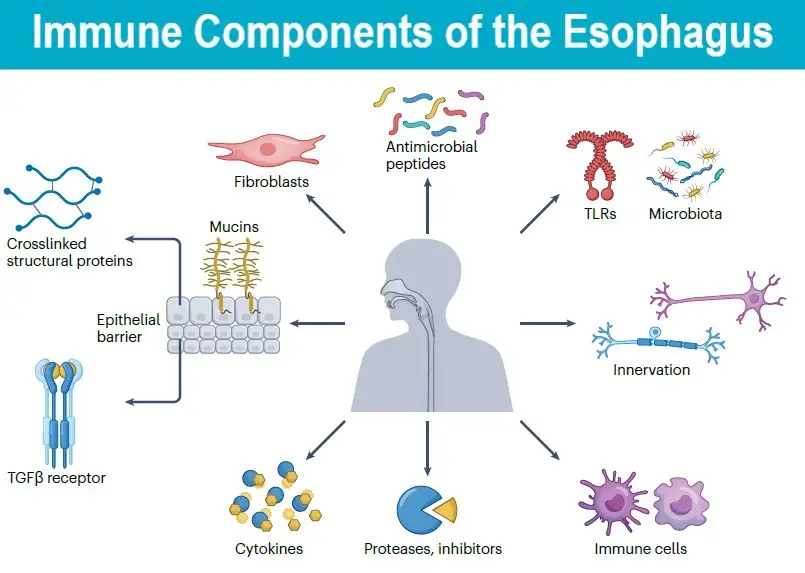
The esophagus has long been considered a simple passageway for food, but research from experts at Cincinnati Children’s proposes a new paradigm—that the esophagus is an immunological organ.
Details were published June 18, 2025, in Nature Reviews Gastroenterology & Hepatology. Mark Rochman, PhD, was lead author and Marc Rothenberg, MD, PhD, was the corresponding author.
“This publication synthesizes two decades of research from my lab, which has led me to propose that the esophagus should be considered as an immunological organ,” Rothenberg says. “When I first learned about the esophagus in medical school, it was considered a simple conduit for transporting food from the mouth to the stomach. However, there is now compelling evidence that the esophagus has a critical role in maintaining homeostasis, including immune tolerance to food, and that perturbations in its innate function can lead to a variety of diseases, most convincingly eosinophilic esophagus.”
This article examines the esophagus’s role in confronting a continuous influx of foreign antigens and stimuli from food textures and temperatures. It details elements of the organ’s thick, multilayered protective barrier, including information about desmosomal junctions, memory T cells, mast cells, dendritic cells, IL-1 family cytokines and more. The esophagus also hosts unique microbiota that help maintain barrier function and contribute to immune regulation.
The article recaps key genetic studies that show how mutations in esophageal barrier proteins can lead to barrier dysfunction and increased disease risk.
“The esophagus is an immune organ with extensive sensing properties designed to tolerate and mount defenses against antigenic and biophysical challenges,” Rochman says. “Disruptions in these innate immune functions, whether acquired or genetically inherited, contribute to disease onset in a number of conditions, including allergies, eosinophilic esophagitis, inflammatory diseases, certain cancers and other rare diseases.”
About the study
Cincinnati Children’s co-authors on this publication also included MD/PhD student Kendall Kellerman and Michael Jankowski, PhD.
Funding sources for this work include the National Institutes of Health (R01 AI045898, R01 AI124355, R01 NS105715, U19 AI070235 and P30 DK078392); the Campaign Urging Research for Eosinophilic Disease (CURED); the Buckeye Foundation; the Sunshine Charitable Foundation and its supporters, D. A. Bunning and D. G. Bunning.
Don’t Miss a Post:
- Subscribe to the Research Horizons Newsletter
- Follow Cincinnati Children’s Research Foundation on Bluesky, X and LinkedIn
| Original title: | The oesophagus as an immune organ |
| Published in: | Nature Reviews Gastroenterology & Hepatology |
| Publish date: | June 18, 2025 |
Research By

The Rothenberg CURED Research Laboratory, supported by the Campaign Urging Research for Eosinophilic Diseases (CURED), is focused on elucidating the mechanisms of allergic responses, especially in mucosal tissues such as the gastrointestinal tract and lung.
Latest Posts


About this blog
The Research Horizons blog features news and insights about the latest discoveries and innovations developed by the scientists of Cincinnati Children's. This blog does not provide medical advice, diagnosis, or treatment. Email researchnews@cchmc.org with questions or ideas.
Subscribe to Our Newsletter