
A Population Health Approach to Whole Child Health
Post Date: December 15, 2025 | Publish Date:

Case study highlights integrated behavioral health, school-based care and statewide collaborations improving outcomes for children
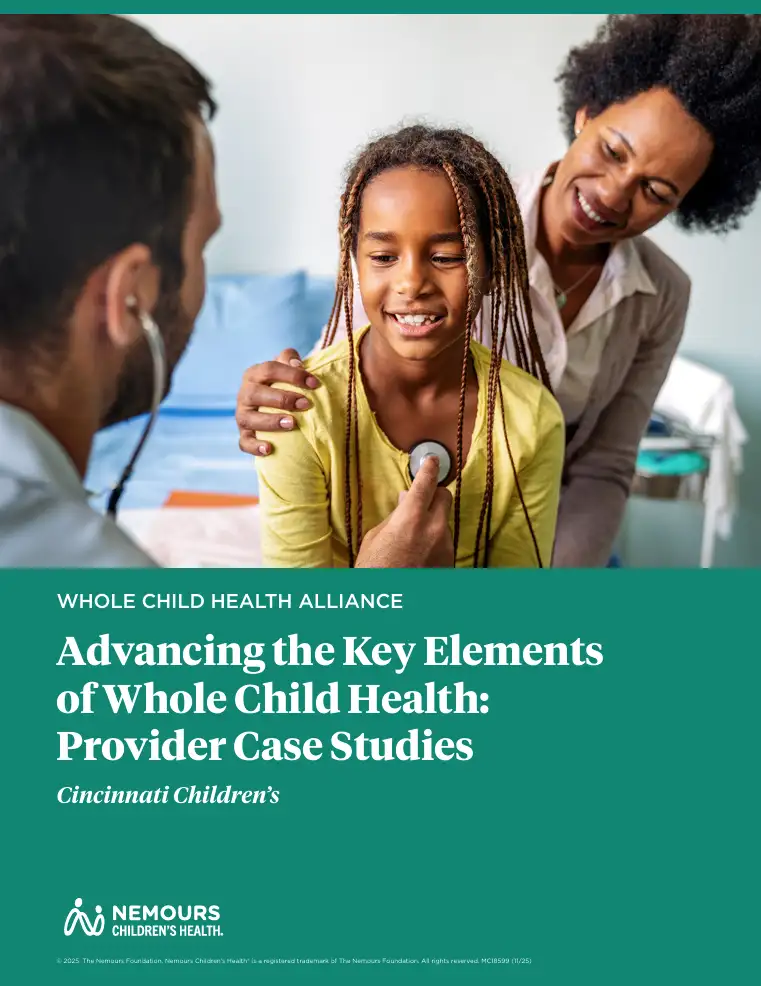
A new case study from the Whole Child Health Alliance spotlights Cincinnati Children’s as a national leader in applying population health science to improve child health outcomes.
Launched by Nemours Children’s Health in 2021, the Alliance is a national collaboration of children’s hospitals, health insurers, think tanks, advocacy organizations and other partners working together to advance whole child well-being through policy, payment reform and care models that align healthcare systems, payers and community resources. Its work emphasizes that children’s health is shaped not only by clinical care, but also by broader social factors, including access to nutritious foods, quality childcare, education, safe housing and supportive communities.
The Alliance’s case study examines how Cincinnati Children’s is putting these principles into practice. Informed by interviews and program data from the Office of Population Health, the report highlights integrated care models, multisector collaborations and community-based programs that are reshaping the pediatric care ecosystem across Ohio.
Population health is increasingly recognized as essential for addressing the complex medical, behavioral and social factors that drive child health. Yet few pediatric systems have operationalized these principles at scale.
“A population health approach allows us to advance our mission to transform care delivery through collaboration, education and innovation,” says Jessica McClure, PsyD, associate chief population health officer. “By aligning clinical care with community-driven strategies, we can meaningfully improve whole child health.”
Addressing the Root of Child Health Challenges
Cincinnati Children’s grounds its work in five core population health principles:
- Excellent primary care close to home
- Healthier children through more effective and affordable care
- Improved outcomes for children with medical and behavioral health needs
- Closing equity gaps
- Leading pediatric population health research and innovation
Translating these principles into practice requires models that extend beyond clinic walls, integrate behavioral and social needs, and deepen partnerships across schools, neighborhoods, and state agencies.
“The science is clear—addressing behavioral health, social determinants and equitable access to care is central to improving child outcomes,” McClure says. “Our programs are designed to intervene upstream, where the impact is greatest.”
How the Approach Works
The case study highlights several integrated strategies that directly influence clinical outcomes and population-level trends:
Integrated Behavioral Health (IBH)
Primary care practices screen universally for behavioral health concerns during well-child visits. Children identified with needs are connected to co-located or integrated behavioral health clinicians who collaborate in real time with pediatricians.
Early evidence shows that IBH-participating practices experience fewer depression-related behavioral health ED admissions, underscoring the value of upstream, embedded mental health care.
Early Childhood Health and Infant Mortality Prevention
Partnerships with Cradle Cincinnati and an adapted HealthySteps model support families from pregnancy through early childhood—strengthening caregiver-child relationships, mitigating early risk factors, and addressing preventable contributors to infant mortality.
Screening for Health-Related Social Needs
A standardized screening tool identifies needs related to housing, food access, transportation, utilities, and safety. Multidisciplinary teams connect families to resources, while a psychosocial task force is building an institutional framework for four-domain screening: social needs, depression, suicide risk and substance use.
School-Based Health Programs
Health services delivered via school-based centers, mobile units and telehealth bring care directly to students. Children receive preventive visits, sick care, behavioral health assessments, chronic condition management and specialty developmental-behavioral services—reducing common access barriers.
Clinical-Community Partnerships
Collaborations with regional food banks; the Keeping Infants Nourished and Developing (KIND) program; and the Cincinnati Child Health-Law Partnership (HeLP) address nonmedical needs that drive health outcomes, from nutrition to housing stability.
A New Avenue for Advancing Population Health
The case study also highlights statewide initiatives built on aligned incentives and shared accountability.
Ohio Outcomes Acceleration for Kids (OAK) unites Ohio’s children’s hospitals, Medicaid managed care organizations, and the Ohio Department of Medicaid to improve outcomes for asthma, sickle cell disease, mental health and well-child care.
HealthVine, Cincinnati Children’s pediatric accountable care organization, partners with four of Ohio’s seven Medicaid-managed care plans and OhioRISE to improve outcomes for more than 100,000 children. HealthVine has expanded telehealth services—achieving more than $610,000 in cost savings—and significantly increased care management outreach and enrollment.
“Integrated, preventive programs paired with strong community partnerships create conditions for children to thrive,” says Kim Kaas, senior vice president and chief population health officer. “We ground our work in continuous learning and improvement, ensuring our models are effective and scalable.”
Looking Ahead
Cincinnati Children’s is continuing to build evidence for population health interventions and refine strategies that improve behavioral health, reduce infant mortality, strengthen school-based access and address social needs.
Future priorities include scaling integrated behavioral health to more primary care sites, expanding school-based services, advancing standardized psychosocial screening across the institution, and evaluating statewide collaborations such as HealthVine and OAK through robust data analytics.
These efforts reflect a long-term commitment to transforming how child health is supported—moving from reactive care toward proactive, prevention-driven models that address the full context of children’s lives.
Read the full case study
Don’t Miss a Post:
- Subscribe to the Research Horizons Newsletter
- Follow Cincinnati Children’s Research Foundation on Bluesky, X and LinkedIn
Latest Posts

About this blog
The Research Horizons blog features news and insights about the latest discoveries and innovations developed by the scientists of Cincinnati Children's. This blog does not provide medical advice, diagnosis, or treatment. Email researchnews@cchmc.org with questions or ideas.
Subscribe to Our Newsletter