

Molecular Clues Help Distinguish Eosinophilic Colitis and IBD
Research By: Tetsuo Shoda, MD, PhD
Post Date: November 13, 2026 | Publish Date: October 28, 2026

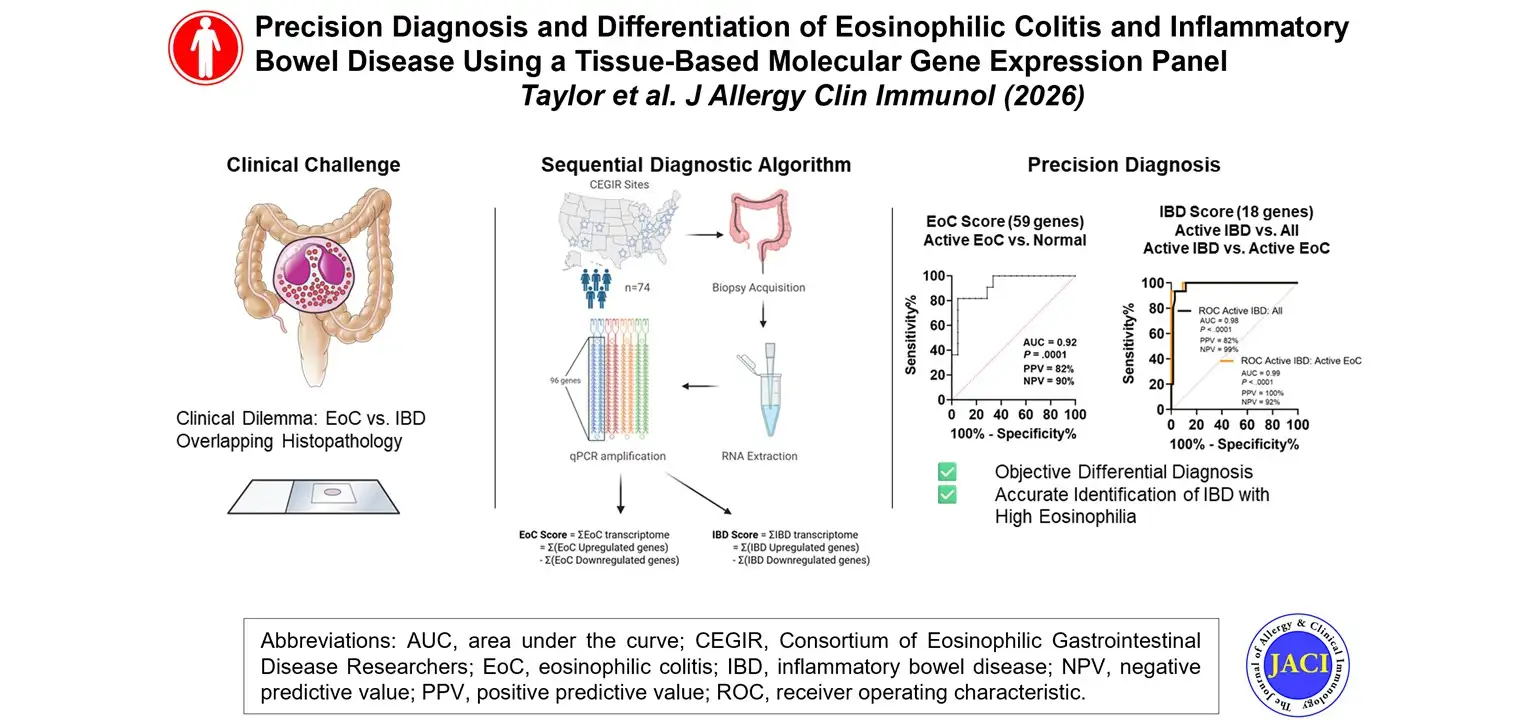
A multicenter Cincinnati Children’s-led study uses gene expression patterns to help distinguish two inflammatory diseases that can appear similar under the microscope
Key Takeaways
- Eosinophilic colitis (EoC) and inflammatory bowel disease (IBD) can look similar in colon biopsy samples, making diagnosis difficult in some patients.
- Researchers developed a gene expression panel that uses molecular signatures in colon tissue to help distinguish EoC from IBD when traditional pathology findings overlap.
- The test evaluates two different biological signals: one linked to eosinophilic inflammation and another linked to IBD-associated inflammatory pathways.
- By providing information beyond eosinophil counts alone, the approach may help clinicians and pathologists better understand the cause of colonic inflammation in challenging cases.
Diagnosing inflammatory diseases of the colon is not always straightforward. In some patients, eosinophilic colitis (EoC) and inflammatory bowel disease (IBD) can produce similar symptoms and biopsy findings, making it difficult for clinicians and pathologists to determine which condition is present. A study, published on October 28, 2026, in The Journal of Allergy and Clinical Immunology describes a molecular approach designed to add another layer of information to the diagnostic process.
“Eosinophils can tell us that inflammation is present, but they do not always tell us which disease is driving it,” says Tetsuo Shoda, MD, PhD, corresponding author of the study. “Our goal is not to replace the pathologist, endoscopy or clinical assessment. It is to add molecular information when conventional findings leave uncertainty.”
Why Diagnosis Can Be Difficult
EoC is a rare inflammatory condition characterized by increased eosinophils, a type of white blood cell, in the colon. IBD, which includes Crohn disease and ulcerative colitis, can also be associated with elevated eosinophils. In some cases, the two diseases can appear remarkably similar under the microscope.
That overlap presents an important challenge because EoC and IBD are distinct diseases that may require different treatment approaches. While pathologists evaluate biopsy findings and clinicians consider symptoms, endoscopy and other testing, there are situations in which the diagnosis remains unclear despite these combined results.
Previous research has shown that EoC and IBD have different underlying molecular signatures. The new study sought to translate those biological differences into a practical diagnostic tool.
A New Framework
Researchers analyzed 88 colonic biopsy samples from 74 patients with EoC, Crohn disease, ulcerative colitis or non-disease controls. They developed a 96-gene gene panel tool called the Colonic Eosinophilia Diagnostic Panel (CEDP) that generates two complementary molecular scores.
The first score measures eosinophilic inflammation:
- Distinguished active EoC from non-disease controls
- Correlated with peak eosinophil counts
- Reflected molecular disease activity in the colon
The second score focuses on molecular pathways associated with IBD:
- Distinguished active IBD from EoC with very high accuracy
- Correlated with endoscopic measures of IBD activity
- Identified IBD-associated molecular signatures even in patients whose biopsies contained high levels of eosinophils
Together, the two scores provide what the researchers describe as a two-component molecular framework. Rather than relying only on eosinophil counts, the panel evaluates distinct biological pathways associated with each disease.
Looking Ahead
The researchers emphasize that the CEDP is intended to complement, not replace, established clinical, endoscopic and histologic evaluation. The CEDP may offer additional evidence when conventional diagnostic approaches do not provide a clear answer.
The CEDP remains a research-stage tool and will require prospective validation in larger independent cohorts before clinical implementation. Future studies will also examine whether molecular scores could help monitor disease activity or treatment response over time.
About the Study
The work was led by Richard J. Taylor, MD, during his pediatric gastroenterology fellowship at Cincinnati Children’s. Taylor is now a faculty member at Cincinnati Children’s. Tetsuo Shoda, MD, PhD, served as corresponding author.
The study also highlights the collaborative research environment surrounding eosinophilic gastrointestinal diseases at Cincinnati Children’s. Taylor led the project as a GI fellow while working with senior faculty across gastroenterology and allergy/immunology, including Lee Denson, MD, Vincent Mukkada, MD, and Marc Rothenberg, MD, PhD. The study also drew on samples and expertise from the national Consortium of Eosinophilic Gastrointestinal Disease Researchers (CEGIR).
Together with the recent EoG proteomics study led by fellow Molly Ahye, MD, this work illustrates how fellows, faculty mentors and multidisciplinary research programs can work together to advance precision approaches for eosinophilic gastrointestinal diseases.
Don’t Miss a Post:
- Subscribe to the Research Horizons Newsletter
- Follow Cincinnati Children’s Research Foundation on Bluesky, X and LinkedIn
| Original title: | Precision Diagnosis and Differentiation of Eosinophilic Colitis and Inflammatory Bowel Disease Using a Tissue-Based Molecular Gene Expression Panel |
| Published in: | The Journal of Allergy and Clinical Immunology |
| Publish date: | October 28, 2026 |
Research By

The Shoda Lab at Cincinnati Children’s is working to identify the key genes and genetic regulatory mechanisms that predispose patients to eosinophilic conditions, especially eosinophilic gastrointestinal diseases (EGID).

Latest Posts

About this blog
The Research Horizons blog features news and insights about the latest discoveries and innovations developed by the scientists of Cincinnati Children's. This blog does not provide medical advice, diagnosis, or treatment. Email researchnews@cchmc.org with questions or ideas.
Subscribe to Our Newsletter