

Study Challenges ‘Good Cop, Bad Cop’ View of Heart Immune Cell Roles
Research By: Rajesh Kasam, PhD | Jeffery Molkentin, PhD
Post Date: August 6, 2026 | Publish Date: June 9, 2026

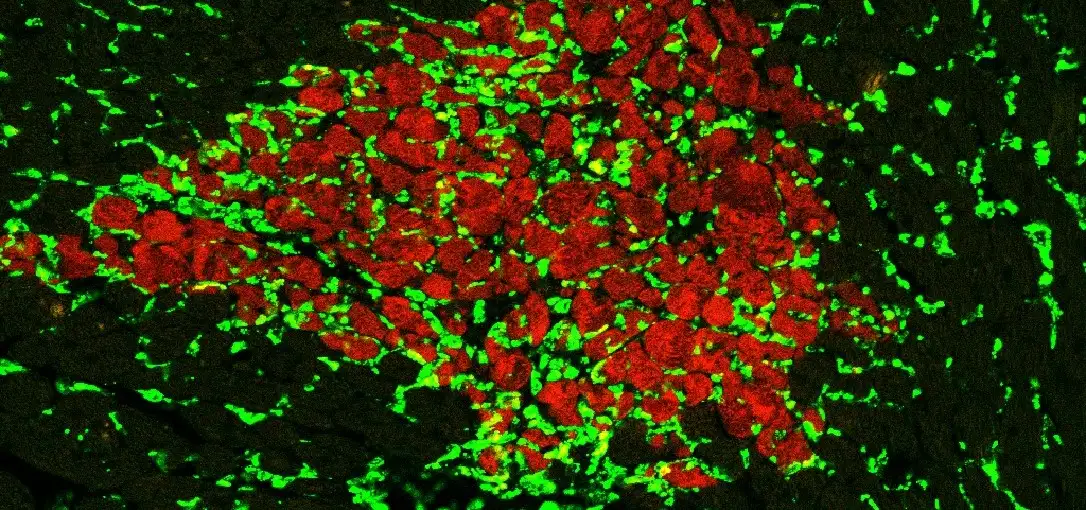
Cincinnati Children’s experts suggest that better control of timing and targeting of macrophage activity after cardiac injury could provide therapeutic advantage
Immune cells that live in the heart may not be as simply “helpful” or “harmful” as scientists once thought.
In a study published June 9, 2026, in The Journal of Clinical Investigation, scientists at Cincinnati Children’s report that two major types of cardiac macrophages—immune cells that help maintain and repair heart tissue—can each produce mixed effects depending on the timing and type of heart stress. The findings complicate a long-standing view that resident macrophages are mostly repair-oriented while recruited macrophages are mostly inflammatory.
“The unexpected results from our study are that expansion of either of these macrophage subtypes in the heart can have both positive and negative ramifications,” says corresponding author Jeffery Molkentin, PhD, director, Division of Molecular Cardiovascular Biology, and executive co-director of the Heart Institute at Cincinnati Children’s. “This suggests a need to develop greater temporal regulation toward achieving a therapeutic advantage that depends on the local and systemic disease processes in play.”
Why cardiac macrophages matter
Heart disease remains the No. 1 cause of death in the United States, with more than 683,000 deaths occurring in 2024, according to the federal Centers for Disease Control and Prevention (CDC).
Macrophages help clear debris, coordinate inflammation, support tissue repair and influence fibrosis—the stiffening and scarring that can worsen heart disease. While a variety of existing therapies aim to reduce harmful inflammation, this study suggests that future approaches should consider which macrophages are being targeted, where they are acting and when during disease progression the intervention occurs.
In experiments led by first author Rajesh Kasam, PhD, and colleagues, the team used mouse models to selectively increase either tissue-resident CX3CR1+ macrophages or monocyte-derived CCR2+ macrophages specifically within the heart. While tissue-resident macrophages are generally found at consistent levels in heart tissue, monocyte-derived macrophages are typically recruited in large numbers to the location of injured heart tissue. These cells arrive via the bloodstream, including from a storage pool in the spleen.
The team measured how differing levels of these macrophages behaved under “pressure overload,” an experimental model of chronic stress that can lead to cardiac hypertrophy and heart failure.
- Unexpectedly, the study shows that recruited CCR2+ macrophages are not disease-causing within the heart on their own, unless there is an underlying stress response, in which case they worsen chronic disease.
- Also unexpectedly, increased tissue resident CX3CR1+ macrophages that normally reduce fibrosis and promote healing, can contribute to greater cardiac hypertrophy in some instances, suggesting these cells also need to be controlled over time.
This means that methods used to manage either immune cell type should be considered more carefully based on the objectives of treatment.
Time for a macrophage reassessment?
The new insights prompted an accompanying editorial, published Aug. 3, 2026, in the same journal. The commentary was co-authored by three experts with McGill University in Montreal.
“These findings suggest that simplistic classification of CMs as either beneficial or harmful underestimates their complex roles in cardiac pathology, highlighting the need to reassess current views of macrophage function in heart injury.”
A track record of questioning dogma
Molkentin is a globally recognized scientist who across three decades of research has authored or co-authored over 450 peer-reviewed publications. In 2025, the University of Cincinnati College of Medicine awarded him its highest honor—the Daniel Drake Medal.
The new findings about macrophage function do not represent the first time Molkentin has challenged the status quo.
His work includes a major finding published in 2014 in Nature showing that injecting c-kit positive heart stem cells into damaged hearts as a strategy to regenerate cardiomyocytes doesn’t work. Then in 2020, also in Nature, Molkentin and colleagues explained what cardiac stem cell therapy was actually doing.
About the study
In addition to Kasam and Molkentin, Cincinnati Children’s co-authors included Ronald Vagnozzi, PhD (now with the University of Colorado), Yasuhide Kuwabara, PhD, Anne Katrine Johansen, PhD, N. Scott Blair, MS, Vikram Prasad, PhD, Suh-Chin J. Lin, PhD, Akanksha Rajput, PhD, and Michelle Nieman, MS.
The Cincinnati Children’s Research Flow Cytometry Facility, Comparative Medicine Division, Single Cell Genomics Facility and Integrated Pathology Research Facility contributed to this research.
Funding sources include several grants from the National Institutes of Health (1R01HL156852, 1R01HL160765, 1P01HL160488) and support from the American Heart Association.
Learn more about recent heart research at Cincinnati Children’s
Don’t Miss a Post:
- Subscribe to the Research Horizons Newsletter
- Follow Cincinnati Children’s Research Foundation on Bluesky, X and LinkedIn
| Original title: | Selective expansion of cardiac macrophage subtypes distinguishes their functional roles in disease and homeostasis |
| Published in: | The Journal of Clinical Investigation |
| Publish date: | June 9, 2026 |
Research By


Our laboratory investigates a range of focus areas, all of which center on understanding the molecular mechanisms of heart and skeletal muscle disease.
Latest Posts
About this blog
The Research Horizons blog features news and insights about the latest discoveries and innovations developed by the scientists of Cincinnati Children's. This blog does not provide medical advice, diagnosis, or treatment. Email researchnews@cchmc.org with questions or ideas.
Subscribe to Our Newsletter