

$5 Million Gift Aims to Speed the Next Era of TSC Research
Post Date: August 6, 2026 | Publish Date:

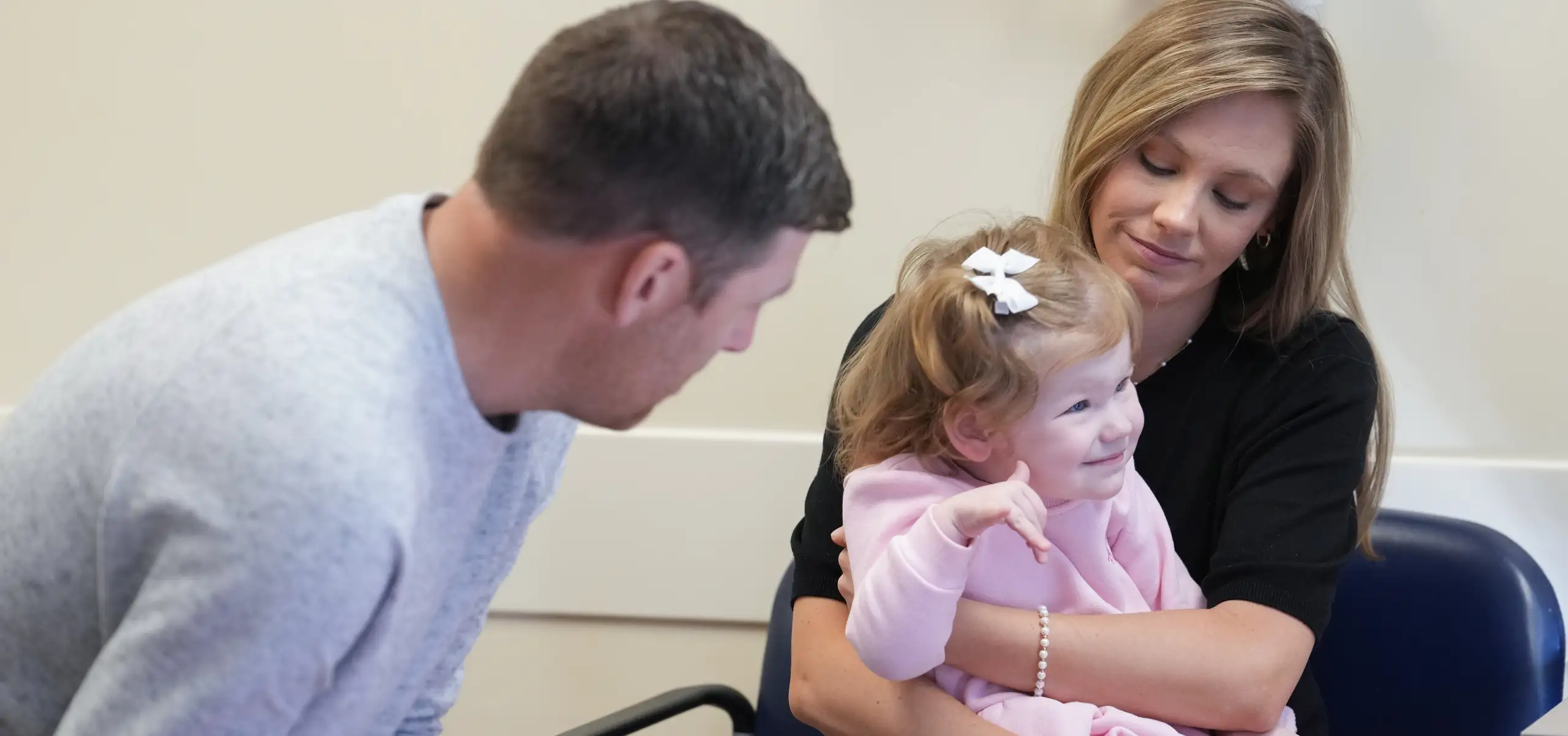
Inspired by one family’s journey, Cincinnati Children’s researchers are preparing to launch a more precise, data-driven push to improve care for children with tuberous sclerosis complex
When Aaron and Kelsey Clausen learned before birth that their daughter, Colette, had tuberous sclerosis complex (TSC), the diagnosis came with a frightening amount of uncertainty.
TSC can involve the brain, heart, kidneys, lungs, skin, and eyes. It can cause seizures, developmental delays, autism-related features, behavioral challenges, and organ complications. And while doctors can identify the genetic cause, they still cannot predict with confidence how the condition will unfold for each child.
Accelerating research to help reduce that uncertainty is a key goal behind a transformational $5 million gift from the Clausen family to Cincinnati Children’s (see related announcement). The gift will help experts at one of the world’s largest centers for treating this complex condition to combine decades of patient data with the most-advanced research tools to bring a new era of precision medicine to people with TSC.
“We are deeply grateful to the Clausen family for their extraordinary generosity and for the trust they have placed in our team,” says Darcy Krueger, MD, PhD, director of the Tuberous Sclerosis Clinic at Cincinnati Children’s. “This gift will help us bring together clinical data, genetic insights and translational research in ways that can move us closer to more precise predictions, earlier interventions and more individualized care for people living with TSC.”
What is tuberous sclerosis complex?
TSC is a rare genetic disorder that affects an estimated 1 in 6,000 people. The condition is caused by changes in either the TSC1 or TSC2 gene. Those genes help regulate the mTOR pathway, which helps control cell growth and division. When this pathway is overactive, benign tumors or tumor-like growths can develop in multiple organs.
The clinical burden is often driven by the brain. Seizures affect a large majority of people with TSC and can be difficult to control. TSC-associated neuropsychiatric disorders, known as TAND, can include autism spectrum disorder, ADHD, anxiety, depression, learning difficulties, intellectual disability, executive function challenges and family stress.
Kidney angiomyolipomas and cysts, lung disease in some adults, and other organ findings add to the need for coordinated care.
Cincinnati Children’s leading role in changing TSC care
Cincinnati Children’s has been a global leader in TSC care and research since 1992. Over that time span, the TSC clinic here has had more than 60,000 patient encounters with individuals diagnosed with TSC. Patient care and research have touched people from prenatal months to age 80 and beyond
In fact, Kreuger and colleagues helped lead studies that have changed how TSC is treated. One landmark trial showed that the mTOR inhibitor everolimus could shrink subependymal giant cell astrocytomas, a type of brain tumor that can develop in TSC. That work helped lead to the first FDA-approved treatment for TSC.
Cincinnati Children’s investigators also helped advance research showing that targeted mTOR inhibition can shrink kidney angiomyolipomas and reduce complications. They also have contributed to studies of mTOR inhibitors for seizures, tumor recurrence, white matter changes, and other TSC manifestations.
More recently, Jamie Capal, MD, has expanded Cincinnati Children’s focus on TSC-associated neuropsychiatric disorders. The TAND Clinic provides dedicated support for developmental, behavioral, and mental health needs that often shape daily life for patients and families. The team also is piloting remote behavioral interventions, including adaptations of Regulating Together, to help families who cannot easily travel for repeated in-person therapy.
Looking forward, the field is moving toward precision medicine to better address the individualized complexity of so many cases.
How the Clausen gift could accelerate discovery
With this philanthropic support, Cincinnati Children’s will launch a new Center for Tuberous Sclerosis Complex Individualized Medicine, Prediction, and Care Transformation (TSC IMPACT).
TSC IMPACT will consist of three research activity hubs:
- A Data Harmonization and Prediction Modeling Hub to integrate multiple streams of clinical patient data into a unified, actionable resource to support analyses involving modern machine learning and artificial intelligence tools.
- A Clinical and Translational Research Hub to provide bioinformatic analysis of TSC patient genotypes and patient-sourced biospecimens. This work would support a development pipeline for individualized treatment approaches, including future genetic therapies, identifying druggable signaling targets, and predicting treatment responses that inform clinical decision making.
- A Personalized Clinical Trial Hub to build a new methodological framework for individualized randomized, controlled, multiple crossover clinical trials to evaluate the safety and effectiveness of existing and novel treatments for single TSC patients.
A family’s hope translated into momentum
For the Clausen family, the gift is both personal and forward-looking. Colette’s care brought them to Cincinnati Children’s. Their philanthropy is designed to help researchers move faster for Colette and for families around the world who live with the same uncertainty.
“Colette’s diagnosis opened our eyes to a condition we had never known existed and to the challenges so many families face every day,” says Colette’s grandparents Doug and Joanie Clausen. “We are honored to support research that offers hope—not only for Colette, but for every child and family affected by TSC. Our hope is that the discoveries made today will lead to a better tomorrow for generations to come.”
Krueger says the family’s gift could help compress the research-to-treatment timeline. “Instead of asking what might be possible over 20 years, this new support allows the team to ask what can be learned in 10 years, five years, or sooner.”
How you can help
The Clausen family gift highlights the powerful role philanthropy plays in advancing medicine and serves as a powerful reminder that when families, clinicians, researchers and donors come together with a shared purpose, extraordinary progress is possible. Learn more about how to make a transformational gift to support research at Cincinnati Children’s.
Don’t Miss a Post:
- Subscribe to the Research Horizons Newsletter
- Follow Cincinnati Children’s Research Foundation on Bluesky, X and LinkedIn
Latest Posts

About this blog
The Research Horizons blog features news and insights about the latest discoveries and innovations developed by the scientists of Cincinnati Children's. This blog does not provide medical advice, diagnosis, or treatment. Email researchnews@cchmc.org with questions or ideas.
Subscribe to Our Newsletter