

Zinc-Iron Alloy Shows Promise in Nerve Repair
Research By: Kevin Little, MD
Post Date: November 7, 2023 | Publish Date: Nov. 7, 2023

Orthopaedics | Top Scientific Achievement

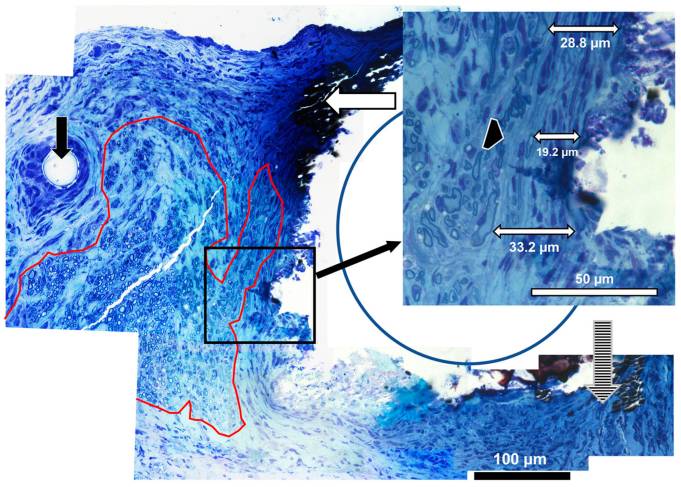
Worldwide, surgeons perform approximately 560,000 procedures a year to repair nerve injuries in limbs. When gaps between severed fibers are too large for nerves to re-connect themselves, autografts have served as the gold standard approach. Yet these repairs often do not support full functional recovery and come with donor site morbidity.
Researchers are exploring various scaffolding approaches to support nerve repairs across wider gaps, with the hope of reducing immune risks from donated human tissues. One line of options has focused on using bio-absorbable metallic products to support nerve fiber regeneration.
In this rodent-based study, a team from Cincinnati Children’s, the University of Cincinnati, and Ben-Gurion University of the Negev compared tiny microfilaments made of magnesium (Mg) to similar tubes made from a proprietary alloy of zinc (Zn) and iron (Fe). The team found that both metals helped re-connect sciatic nerves across a 6 mm injury gap, but the Zn-Fe material showed fewer adverse effects.
“Absorbable metals are exciting materials for tissue engineering because they prevent long-term tissue irritation and avoid the need for surgical removal,” says co-author Kevin Little, MD, director of the Pediatric Hand and Upper Extremity Center at Cincinnati Children’s.
The zinc alloy’s potential advantages include fewer adverse effects than standard autografts, a slower degradation rate that offers better support across longer nerve gaps, and fewer hydrogen bubbles that can disrupt tissue attachment.
“The future of nerve repair is moving towards combinations of therapies rather than single therapies. Benign absorbable metals could provide the physical guidance that can then be readily combined with other strategies to achieve excellent functional return,” Little says.
Co-authors included experts with the UC College of Engineering & Applied Sciences and the departments of Orthopedic Surgery and Pharmacology & Systems Physiology. This study also was supported by a collaboration between Cincinnati Children’s and Ben-Gurion University of the Negev.
Explore the 2024 Research Annual Report
| Original title: | Nerve Regeneration with a Scaffold Incorporating an Absorbable Zinc-2% Iron Alloy Filament to Improve Axonal Guidance |
| Published in: | Pharmaceutics |
| Publish date: | Nov. 7, 2023 |
Research By



Latest Posts

About this blog
The Research Horizons blog features news and insights about the latest discoveries and innovations developed by the scientists of Cincinnati Children's. This blog does not provide medical advice, diagnosis, or treatment. Email researchnews@cchmc.org with questions or ideas.
Subscribe to Our Newsletter