

Machine Learning Sharpens Dosing for Pediatric Crohn’s Disease
Research By: Kei Irie, PhD | Tomoyuki Mizuno, PhD, FCP
Post Date: June 2, 2025 | Publish Date: June 2025

Translational and Clinical Pharmacology | Top Scientific Achievement

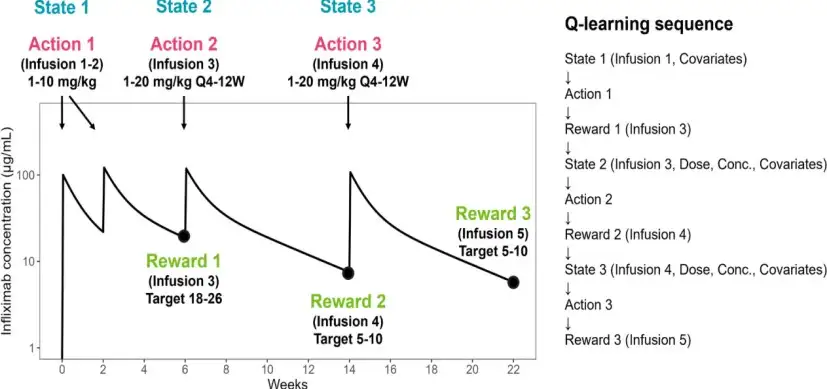
Researchers at Cincinnati Children’s have developed an innovative machine learning (ML) approach that could transform how infliximab dosing is optimized for pediatric and young adult patients with Crohn’s disease.
The study, published online in June, 2025, in Clinical Pharmacology and Therapeutics, was led by Kei Irie, PhD, and Tomoyuki Mizuno, PhD. Their work demonstrates how combining simulated and real-world data can improve the precision of pharmacokinetic predictions.
Infliximab is a biologic therapy used to reduce inflammation and promote remission in Crohn’s disease. However, achieving the right drug concentration varies from patient to patient. To address this, the team first created an ML model using more than 560,000 simulated data points derived from an established population pharmacokinetic (PK) model. Then, they refined it with real-world data from 93 pediatric patients to correct prediction errors. The resulting “ensemble model” achieved a 33% improvement in accuracy over the initial ML model and performed comparably to traditional Bayesian estimation methods.
“Our work shows how machine learning can complement clinical pharmacology by learning from both models and patients,” Mizuno says. “This approach moves us closer to truly personalized dosing—helping clinicians make faster, data-driven decisions that improve care for children with Crohn’s disease.”
The team plans to next integrate this ensemble ML model into RoadMAB™ electronic precision-dosing dashboards, which are already used in clinical settings. By allowing the model to continuously learn from new patient data, they aim to make dosing even more adaptive and reliable across diverse patient populations.
About the study
Cincinnati Children’s co-authors also included Phillip Minar, MD, MS, and Jack Reifenberg, MD. Additional collaborators were from University of Cincinnati College of Medicine, Nationwide Children’s Hospital, Children’s Hospital of Wisconsin, and Connecticut Children’s Medical Center.
This research study was supported by the National Institute of Diabetes and Digestive and Kidney Diseases (DK132408), the Crohn’s and Colitis Foundation, and the Cincinnati Children’s Research Foundation.
Explore the 2025 Research Annual Report
Don’t Miss a Post:
- Subscribe to the Research Horizons Newsletter
- Follow Cincinnati Children’s Research Foundation on Bluesky, X and LinkedIn
| Original title: | Model-Informed Deep Q-Networks to Guide Infliximab Dosing in Pediatric Crohn’s Disease |
| Published in: | Clinical Pharmacology and Therapeutics |
| Publish date: | June 2025 |
Research By


Latest Posts

About this blog
The Research Horizons blog features news and insights about the latest discoveries and innovations developed by the scientists of Cincinnati Children's. This blog does not provide medical advice, diagnosis, or treatment. Email researchnews@cchmc.org with questions or ideas.
Subscribe to Our Newsletter