

Shared Facilities Spotlight: Magnetoencephalography (MEG) Research Facility
Post Date: August 28, 2025 | Publish Date:

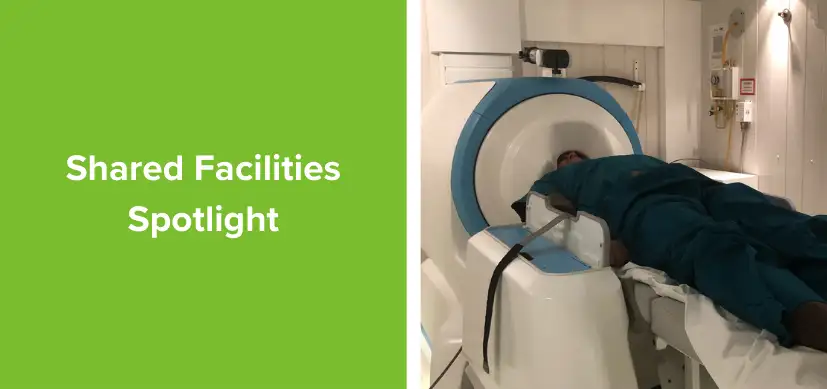
Since 2014, the Magnetoencephalography (MEG) Research Facility has been advancing our understanding of both normal and abnormal brain function, providing investigators with access to state-of-the-art MEG technology and enabling high-precision insights into brain activity in health and disease.
At the heart of the MEG Facility’s work is a superconducting quantum interference device (SQUID) paired with advanced computing. This system measures the tiny magnetic fields generated by the brain’s electrical currents, capturing real-time brain activity. The approach can pinpoint both the timing and location of abnormal brain function—critical for studying conditions such as epilepsy.
“The mission of the facility is to facilitate the study of normal and pathological brain processes,” said Jeffrey Tenney, MD, PhD, pediatric epileptologist and clinical director of the facility.
Research applications extend well beyond epilepsy. For example, in neonatology, MEG is being used to explore language development in children born prematurely. Maria Barnes-Davis, MD, PhD, and Stephanie Merhar, MD, in the Division of Neonatal and Pulmonary Biology, have leveraged MEG in multiple funded studies and peer-reviewed publications such as Brain Sciences, Developmental Science and NeuroImage: Clinical.
The MEG facility welcomes collaborations with external institutions and industry partners. In addition to research, it also serves as a clinical resource, accepting referrals from epilepsy specialists nationwide.
Contact hisako.fujiwara@cchmc.org to discuss your project and research goals.
Learn more about our Shared Facilities in this video.
Don’t Miss a Post:
- Subscribe to the Research Horizons Newsletter
- Follow Cincinnati Children’s Research Foundation on Bluesky, X and LinkedIn

Latest Posts

About this blog
The Research Horizons blog features news and insights about the latest discoveries and innovations developed by the scientists of Cincinnati Children's. This blog does not provide medical advice, diagnosis, or treatment. Email researchnews@cchmc.org with questions or ideas.
Subscribe to Our Newsletter