

Commercializing Innovation at Cincinnati Children’s
Post Date: July 23, 2025 | Publish Date:

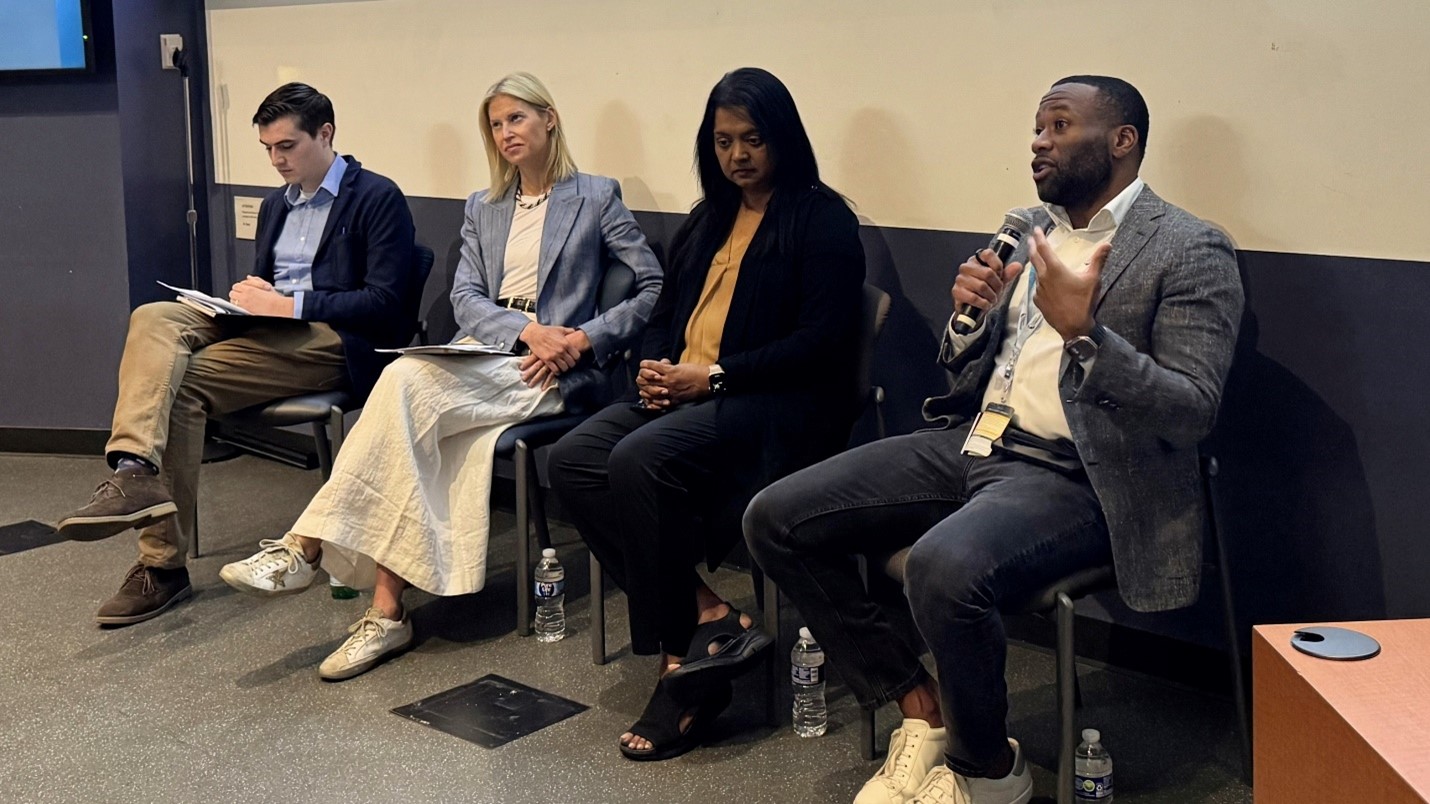
At Cincinnati Children’s, innovation is more than discovery, it’s about delivering solutions to patients. A recent panel hosted by Innovation Ventures brought together voices from across the region to share what it really takes to translate research into real-world impact.
Innovation Starts with Disclosure
According to Nick Archer, Vice President of Cincinnati Children’s Innovation Ventures (CCIV), every commercialization journey for Cincinnati Children’s employees begins with an invention disclosure. “Disclose your innovation through the Innovation Ventures CenterLink inventor portal early – well before publishing or presenting,” he emphasized. This enables CCIV to understand what Intellectual Property (IP) protections need to be in place, if any. Additionally, “even if you don’t move forward, it allows us to evaluate market potential and offer guidance that may shape the direction of each research or clinical project.”
Archer noted that there is no one-size-fits-all process for commercialization. Innovation typically begins with federally funded research, but It takes a blend of communication, project management and partnerships to advance technologies toward the bedside. He emphasized that CCIV is the organization’s expert resource for commercialization and can help advise innovators on the appropriate development pathway for each unique innovation.
Why Commercialize? Mission, Recognition, and Reach
For faculty and clinicians, commercialization offers significant benefits:
- Translates research into practice
- Positively impacts care and outcomes
- Increases professional visibility
- Attracts industry sponsors
- Supports regional and national economic development
- Enables shared revenue under Cincinnati Children’s updated Intellectual Property Policy
“Commercialization aligns with the mission of Cincinnati Children’s Research Foundation,” said Rashmi Hegde, PhD, Vice Chair of Basic & Data Sciences and Education and Co-Chief Scientific Officer for Innovation Ventures. “It’s the shortest path to getting innovations to patients and it opens the door to new research and funding opportunities.”
Building Collaboration through Office Hours
Emma Off, JD, CEO and President; Partner and Logan Hille, PhD, Life Sciences Analyst from CincyTech, a local venture capital firm, participated in the panel emphasizing the value of partnerships in turning ideas into investable ventures.
Innovation Ventures is offering office hours featuring CincyTech, designed to create a low-pressure space for clinicians and researchers to understand the technology transfer process, uncover early-stage ideas and receive personalized coaching on commercialization.
Each session will include Hille and a representative from Cincinnati Children’s Innovation Ventures. The two organizations have a confidentiality agreement in place, allowing for open discussions.
“You don’t need a business plan or pitch deck,” said Hille. “A five-minute chalk talk is enough to start.”
Off emphasized that while not every idea is suited for venture capital, all innovations deserve thoughtful consideration. “Some technologies are a better fit for licensing—but every idea is worth evaluating for venture creation.”
What You Need to Succeed
Panelists emphasized the importance of innovators collaborating with Innovation Ventures to prepare the following as they advance in the commercialization process.
- A clear, compelling value proposition – clearly differentiating your innovation from others whether emerging or on the market
- An intellectual property assessment
- A working prototype or minimum viable product
- A market analysis that shows how many people can benefit from the innovation, describes competitors, and estimates potential revenue opportunity
- A credible business plan and financial model
- A focused, persuasive pitch deck
Off offered practical advice for success, “To change behavior, your innovation must be first-in-class, best-in-class—or a very close second.” Otherwise, it may not be a great fit for commercialization.
Moving Forward Together
Cincinnati Children’s has a growing network of collaborators that can help advance promising technologies. However, not every idea will be pursued internally. Our updated IP policy offers alternative pathways to inventors if the organization is unable to commercialize the asset on their behalf.
“We want to provide excellent customer service,” Archer said, “but we also owe you clarity. Some ideas will move fast; others may not be a fit. Either way, early, frequent and transparent communication is key.”
Don’t Miss a Post:
- Subscribe to the Research Horizons Newsletter
- Follow Innovation Ventures on LinkedIn
- Follow Cincinnati Children’s Research Foundation on Bluesky, X and LinkedIn
Don’t Miss a Post:
- Subscribe to the Research Horizons Newsletter
- Follow Cincinnati Children’s Research Foundation on Bluesky, X and LinkedIn


Latest Posts

About this blog
The Research Horizons blog features news and insights about the latest discoveries and innovations developed by the scientists of Cincinnati Children's. This blog does not provide medical advice, diagnosis, or treatment. Email researchnews@cchmc.org with questions or ideas.
Subscribe to Our Newsletter