

New ‘Atlas’ of Rare Lung Disease LAM May Help Researchers Develop Improved Treatments
Research By: Yan Xu, PhD
Post Date: November 18, 2026 | Publish Date: Nov. 5, 2026

Cincinnati Children’s experts lead study shedding light on disease that primarily affects women during childbearing years
Key Takeaways
- Cincinnati Children’s researchers led creation of the first spatially resolved “atlas” of cells in lung lesions of women with lymphangioleiomyomatosis (LAM), a rare disease that mainly affects women during childbearing years.
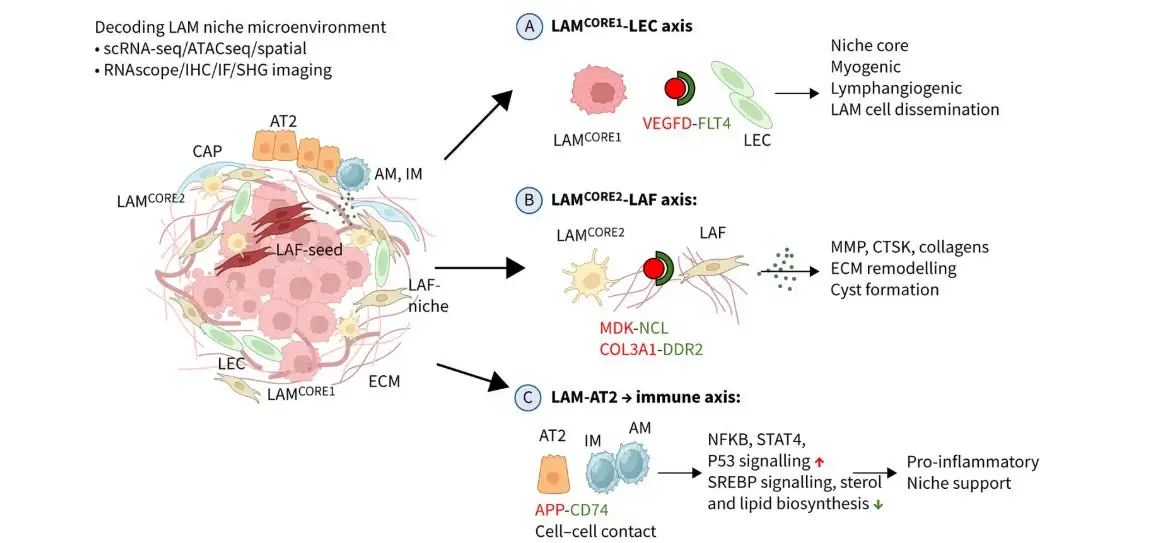
- The atlas reveals three distinct LAMCORE cell subtypes and shows that LAM is a community of communicating cells, not a single type of abnormal cell.
- The findings point to new drug targets that could be combined with sirolimus, which stabilizes lung function but is not a cure, to better control or even reverse the disease.
When women develop the hard-to-pronounce lung disease called lymphangioleiomyomatosis (LAM), a natural set of brakes on cell growth fails inside their lungs, causing affected cells to form cysts that can threaten their ability to breathe.
As many as 25% of those who develop LAM die within 10 years, not including those whose lives are extended via difficult-to-obtain lung transplants. In recent years, doctors have used a drug called sirolimus to stabilize lung function, but this treatment is not a cure and is not always well-tolerated.
Now a research team led by experts at Cincinnati Children’s have produced an extremely detailed ‘atlas’ that details how the various types of cells involved in LAM lose their normal functions and begin interacting in a cancer-like tumor formation process.
“This is the first spatially resolved map of the cells that make up LAM lesions in the lungs of women with this rare disease,” says corresponding author Yan Xu, PhD, a leading bioinformatics expert and professor in the Perinatal Institute at Cincinnati Children’s.
“This map reveals three distinct LAMCORE subtypes with unique signatures, spatial distributions, and functions. More importantly, LAM is not just one type of abnormal cell, but a community of cells that communicate with each other,” she adds. “By revealing how the community works, this map points to new targets that could one day be combined with current treatment to better control, or even reverse, the disease.”
Detailed findings were published online in November 2026 in the European Respiratory Journal. The study’s lead authors were Ken Chen, a former data analyst in Xu’s lab and now a PhD candidate at the University of California, Berkeley; and Shuyang Zhao, a senior biostatistical data analyst in Xu’s lab.
Cincinnati Children’s co-authors included Minzhe Guo, Hasan Reza, Andrew Wagner, Cheng Jiang, Jenna Green, Emily Martin, Grace Wikenheiser, Kathryn Wikenheiser-Brokamp, Anne Karina Perl, and Debora Sinner. Co-authors from Vanderbilt University and the University of Florida contributed.
Successful treatment requires more than mTOR inhibitors
Exactly how many people have LAM remains unclear. While certainly rare, estimates have ranged from 4 cases per million women to more than 20 cases per million.
Researchers revealed years ago that LAM is connected to mutations in the genes TSC1 and TSC2. In fact, LAM often develops after a person is diagnosed with tuberous sclerosis complex (TSC), which is also triggered by these abnormally functioning genes.
While the drug sirolimus has shown much success against TSC, it does not fully stop LAM. The new atlas gives scientists much more information about what other genes and cell types are involved.
For example, the research team found three subtypes of LAM cells with differing functions and spatial locations. They also found “helper” cells that act like a team, pushing LAM lesions to expand and spread.
Identifying these cells and their functions required a massive data mining effort using several advanced scientific techniques. These techniques included single-cell and single-nucleus RNA-sequencing, single-nucleus ATAC-sequencing, and spatial transcriptomics.
View an editorial commentary about this study
Eventually patients may benefit from new approaches
The study advances the understanding of how LAM develops and progresses by delineating the LAM cell origin, heterogeneity, and LAM cell interactions with the surrounding cells in the LAM niche. This detailed map of the LAM disease environment provides important clues for developing more effective, targeted treatments.
For example, drugs that block the HOX/PBX pathway may help stop the survival of uterine-like LAM cells, while treatments that block EMT or TGF-β signaling may help prevent another LAM cell subtype from promoting abnormal smooth muscle growth. Drugs that target EGR1 or the extracellular matrix – the structural network surrounding cells – may help break up the supportive environment that allows LAM cells to grow.
If new or existing drugs can successfully disrupt this disease-supporting environment, they could potentially be combined with sirolimus to not only slow disease progression but also help reverse some of the underlying disease processes.
While the new LAM atlas helps establish a foundation for such advancement, the co-authors caution that much more research will be needed to develop safe and effective therapies.
About the study
Funding sources for this research included the NHLBI (R01HL153045, R01 HL172914, U01 HL175383, and U01HL148856), multiple grants from the LAM Foundation, and the University of Florida Startup Fund.
Don’t Miss a Post:
- Subscribe to the Research Horizons Newsletter
- Follow Cincinnati Children’s Research Foundation on Bluesky, X and LinkedIn
| Original title: | Decoding the lymphangioleiomyomatosis niche microenvironment via integrative analysis of single cell multiomics and spatial transcriptomics |
| Published in: | European Respiratory Journal |
| Publish date: | Nov. 5, 2026 |
Research By

My research focuses on the identification of gene signatures, regulatory networks, and biological pathways controlling lung maturation and diseases.
Latest Posts

About this blog
The Research Horizons blog features news and insights about the latest discoveries and innovations developed by the scientists of Cincinnati Children's. This blog does not provide medical advice, diagnosis, or treatment. Email researchnews@cchmc.org with questions or ideas.
Subscribe to Our Newsletter